
Mercedes-Benz's Strategic Stake in Chongqing Qianli: A Blueprint for European Automakers in China's EV Supply Chain
Mercedes-Benz's recent acquisition of a 3% stake in Chongqing Qianli Technology—a Shanghai-listed autonomous-driving systems developer valued at $8.35 billion—marks a pivotal moment in the European automaker's strategy to navigate China's rapidly evolving electric vehicle (EV) landscape. This investment, valued at 1.34 billion yuan ($187.9 million), underscores a broader shift among European automakers to secure high-margin technologies and localize production in the world's largest automotive market. By aligning with Qianli, a Geely-backed innovator in AI-driven mobility solutions, Mercedes is not only addressing immediate competitive pressures from Chinese EV startups but also signaling a long-term commitment to China's supply chain ecosystem[1].
China's EV Dominance and the European Struggle
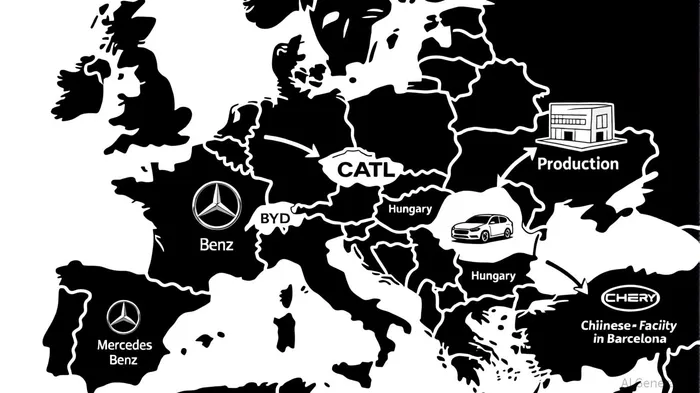
China's grip on the global EV market has tightened dramatically since 2023. According to the International Energy Agency, the country accounted for over 70% of global EV production in 2024, with domestic manufacturers like BYD and Xiaomi capturing 80% of China's output[2]. European automakers, meanwhile, have struggled to keep pace. Volkswagen's 30.6% profit decline in 2023, attributed to aggressive pricing and innovation from Chinese rivals, exemplifies the sector's challenges[3]. The EU's 45% tariffs on Chinese EVs, introduced in 2024, aim to shield local producers but have instead accelerated Chinese firms' shift to onshore manufacturing in Europe. BYD's Hungarian plant and Chery's Barcelona facility are emblematic of this trend, blending cost advantages with European regulatory compliance[4].
Mercedes' partnership with Qianli reflects a strategic recalibration. By leveraging Qianli's software expertise—particularly in autonomous driving and AI—Mercedes aims to integrate cutting-edge technologies into its China-tailored models, such as the long-wheelbase EQS and GLE SUV[5]. This move aligns with the company's $2 billion investment in China's EV supply chain, emphasizing localized production and consumer-centric features like rear-seat comfort and intelligent infotainment systems[6].
A New Era of Collaboration: European Automakers and Chinese Supply Chains
Mercedes is not alone in this approach. European automakers are increasingly embracing partnerships with Chinese firms to access high-margin technologies and scale production. Stellantis, for instance, has invested €1.4 billion in Leapmotor, a Chinese EV startup, to co-develop vehicles for the European market[7]. Similarly, CATL's €7.3 billion gigafactory in Hungary highlights the deepening integration of Chinese battery technology into European supply chains[8].
Experts argue that these collaborations are reshaping the industry's competitive dynamics. As noted in a 2025 Bruegel policy brief, Chinese automakers' dominance in EV materials (lithium, cobalt, graphite) and their ability to scale production rapidly create opportunities for European firms to remain competitive through strategic alliances[9]. However, this shift also raises concerns about market distortions and long-term dependency, particularly as Chinese EVs priced at an average of €32,000 capture one in four EU sales[10].
Investor Confidence and the Future of M&A
Mercedes' investment in Qianli—and similar moves by peers—signals growing investor confidence in localized, high-margin supply chain partnerships. According to a 2025 EY analysis, European automakers are projected to surpass internal combustion engine sales by 2028, a timeline accelerated by Chinese competition and regulatory pressures[11]. This transition is likely to spur further M&A activity, as European firms seek to acquire or partner with Chinese technology leaders to bridge gaps in software, battery innovation, and AI-driven mobility solutions[12].
The strategic value of such partnerships lies in their ability to mitigate risks while capitalizing on China's innovation ecosystem. For example, Mercedes' collaboration with Geely-backed Qianli not only enhances its autonomous driving capabilities but also aligns with Geely's broader ecosystem, which includes ownership of Polestar and Lotus[13]. This interconnectedness suggests that future M&A deals may prioritize cross-border synergies, blending European brand equity with Chinese technological agility.
Conclusion: A Strategic Imperative
Mercedes' stake in Chongqing Qianli is more than a financial transaction—it is a strategic acknowledgment of China's centrality to the future of mobility. As European automakers grapple with the dual challenges of decarbonization and market fragmentation, partnerships with Chinese firms offer a viable path to innovation and cost efficiency. However, success will depend on balancing collaboration with safeguards against over-reliance on Chinese supply chains. For investors, the key takeaway is clear: the next phase of the EV revolution will be defined by those who can navigate the complex interplay of competition, cooperation, and geopolitical risk in real time.







Comentarios
Aún no hay comentarios