
MemeCore's Structural Innovation in the Meme Coin Economy: Evaluating the Long-Term Investment Potential of a Protocol-Driven Meme Economy
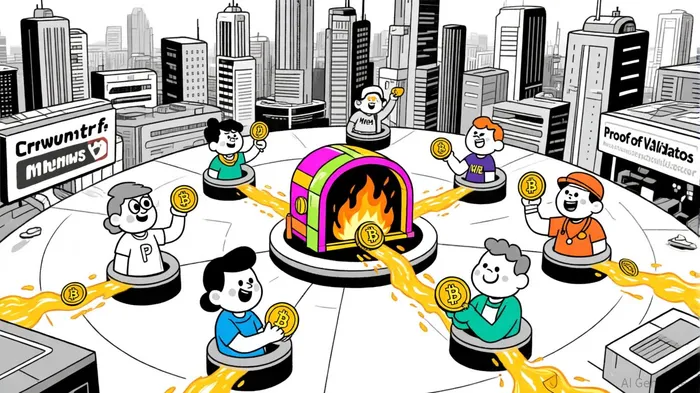
The meme coin economy has long been a paradox: a space defined by viral virality yet plagued by volatility and short-term speculation. Enter MemeCore, a Layer 1 blockchain project that aims to restructure this chaotic landscape through protocol-driven innovation. By introducing a Proof of Meme (PoM) consensus mechanism, deflationary tokenomics, and a structured economic framework, MemeCore seeks to transform meme coins from ephemeral jokes into sustainable, community-driven assets. This article evaluates whether MemeCore's structural innovations can deliver long-term value—or if it's just another speculative fad.
Structural Innovations: PoM and Tokenomics
MemeCore's core innovation lies in its Proof of Meme (PoM) consensus mechanism, which replaces traditional computational or staking incentives with cultural contributions. Validators and delegators earn rewards by creating, remixing, and amplifying memes, with on-chain activity directly tied to token distribution [1]. This model shifts the focus from “hodling” to participation, aligning network security with community engagement. For instance, the Meme Vault—a smart contract for each new meme coin—allocates 5% of its supply to a liquidity pool, distributed linearly over 1,000 days to sustain long-term activity [2].
Tokenomics further reinforce this structure. The native $M token has a capped supply of 10 billion, with 58% allocated to community incentives. Deflationary mechanisms, including permanent burns from transaction fees and staking locks, reduce circulating supply and incentivize long-term participation [3]. As of August 2025, $M had surged 2,400% since its July listing, hitting an all-time high of $1.15 [4]. This growth is underpinned by strategic partnerships with exchanges like Binance and institutional backing from Waterdrip Capital and AC Capital [5].
Ecosystem and Partnerships: Building a Meme 2.0 Infrastructure
MemeCore's ecosystem extends beyond its blockchain. Platforms like MemeX (a no-code token creation tool) and Everyswap (an AMM-based DEX) enable creators to tokenize memes and trade them seamlessly. The project also integrates gaming elements, such as Memes.War, to gamify participation [6]. These tools position MemeCore as a Meme 2.0 infrastructure, where attention is monetized through verifiable on-chain activity.
Strategic investments, including a $7 million stake in MemeX, signal confidence in the ecosystem's scalability [7]. Institutional adoption is further bolstered by regulatory progress in South Korea and a planned MemeX Liquidity Festival in Seoul [8]. Such moves aim to attract both retail and institutional capital, differentiating MemeCore from traditional meme coins like DogecoinDOGE-- and Shiba InuSHIB--, which lack structured governance or utility [9].
Comparative Analysis: MemeCore vs. Traditional Meme Coins
Traditional meme coins like Dogecoin and Shiba Inu rely on social virality and celebrity endorsements (e.g., Elon Musk) for value. Dogecoin, for instance, has no hard supply cap and depends on speculative demand, while Shiba Inu's Ethereum-based DeFi ambitions remain unproven [10]. In contrast, MemeCore's protocol-driven model introduces technical and economic frameworks to stabilize value.
Key differentiators include:
1. PoM Consensus: Rewards cultural contributions, reducing reliance on speculative trading.
2. Deflationary Tokenomics: Burns and locks supply to counteract inflation.
3. Ecosystem Utility: Tools like MemeX and Everyswap create real-world use cases for meme tokens.
While Dogecoin and Shiba Inu face bearish signals in late 2025 (e.g., derivatives data showing rising short bets), MemeCore's on-chain activity—over 1.27 million transactions since its TGE—suggests deeper engagement [11].
Risks and Challenges
Despite its innovations, MemeCore faces significant risks:
- Volatility: The token's 2,400% surge in 90 days is driven by hype, not fundamentals. Critics warn of a potential collapse if key support levels break [12].
- On-Chain Activity vs. Market Cap: While $M's market cap hit $1.93 billion in September 2025, on-chain activity remains low relative to its valuation [13].
- Regulatory Uncertainty: Meme-based blockchains may attract scrutiny from regulators, particularly in jurisdictions with strict crypto laws.
Investment Thesis: A Meme Economy with Legs?
MemeCore's long-term viability hinges on its ability to convert attention into value. By structuring meme creation and distribution through PoM and tokenomics, it addresses the core issue of meme coins: value extraction without compensation. The project's institutional backing, deflationary design, and ecosystem tools suggest a path toward sustainability.
However, investors must weigh the risks of volatility and speculative hype. For those comfortable with high-risk, high-reward assets, MemeCore represents a paradigm shift in the meme economy—a space where culture and code converge.







Comentarios
Aún no hay comentarios