
Meme Coins with Deflationary Utility: Is $NNZ the Next Big Thing?
The Case for Deflationary Meme Coins
Meme coins have long been criticized for their lack of utility and reliance on speculative fervor. However, the rise of deflationary mechanisms-such as token burns and fixed supply caps-has introduced a new dynamic. These models aim to counteract inflation by reducing circulating supply, thereby creating artificial scarcity. According to a report by , deflationary cryptocurrencies like BitcoinBTC-- and EthereumETH-- use token burns to decrease supply over time, fostering a "holding" culture among investors who anticipate long-term value appreciation.
In the meme coin space, projects like Shiba InuSHIB-- (SHIB) have experimented with deflationary strategies, such as burning tokens from NFT sales to reduce supply. Yet, many remain vulnerable to market volatility due to their speculative nature. $NNZ, however, claims to offer a more structured approach.
$NNZ's Deflationary Engine
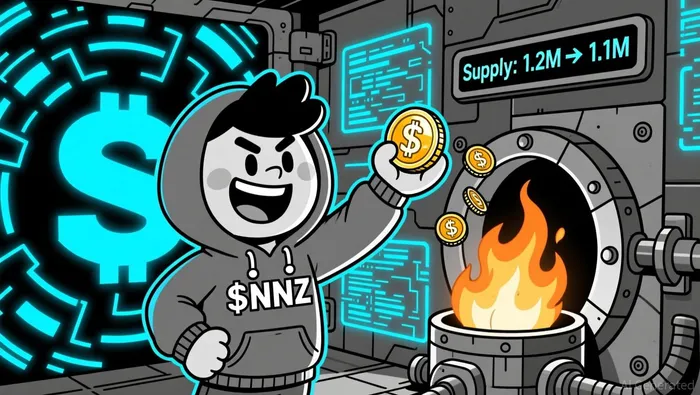
The Noomez project operates on a stage-based growth model with a focus on transparency and scarcity. Unlike traditional meme coins, $NNZ's supply is not fixed but evolves through a presale process that increases the token price incrementally. At each stage, unsold tokens are permanently burned, reducing the circulating supply and maintaining scarcity. This mechanism is enforced by the Noom Gauge and Burn Vault, tools that publicly track burn events and ensure accountability.
Additionally, $NNZ incorporates liquidity locks and staking rewards to incentivize long-term participation. These features differentiate it from projects like YZY, which rely heavily on social media hype without structured economic models. By aligning tokenomics with on-chain transparency, Noomez aims to build a sustainable ecosystem rather than a short-lived fad.
Solana's Inflationary Underpinnings
While $NNZ's deflationary model is compelling, it operates on the Solana blockchain, which has its own inflationary dynamics. Solana's economic model issues new SOL tokens annually to reward validators, with an initial inflation rate of 8% declining to 1.5% over time. However, the network also burns 50% of transaction fees, creating temporary deflationary effects during high-usage periods.
This duality-inflationary issuance offset by deflationary burns-makes Solana a unique environment for meme coins. For $NNZ, the challenge lies in ensuring that its token burns consistently outpace any inflationary pressures from the broader network. Analysts suggest that projects with robust deflationary mechanisms, like $NNZ, may thrive in such conditions by creating a counterbalance to Solana's inherent inflation.
Comparative Analysis: $NNZ vs. $BONK and $TRUMP
Solana's meme coin market is dominated by high-volume tokens like $BONK and $TRUMP, which rely on viral marketing and speculative trading. However, these projects lack the structural safeguards of $NNZ. For instance, $BONK's utility is tied to airdrops and social media engagement, while $TRUMP's value is driven by political sentiment rather than economic design. According to analysts, this creates a significant gap in long-term viability.
In contrast, $NNZ's structured presale and automated burns provide a framework for long-term value retention. By reducing supply through verifiable on-chain events, it addresses a key weakness of inflationary meme coins: the inability to maintain scarcity. This structural advantage could prove critical in 2025, as inflationary markets continue to test the resilience of speculative assets. According to market analysis, such projects are increasingly seen as more sustainable.
Market Implications and Investor Considerations
The broader cryptocurrency market in 2023–2025 has been shaped by a tug-of-war between inflationary and deflationary assets. While projects like DogecoinDOGE-- and Bitcoin CashBCH-- struggle with supply inflation, deflationary models like BNB's token burn program have shown promise in stabilizing value. According to industry reports, this suggests a growing preference for assets with structural deflationary mechanisms.
$NNZ's approach aligns with this trend. By combining meme coin appeal with deflationary mechanics, it targets a niche of investors seeking both cultural relevance and economic durability. However, risks remain. The token's success depends on sustained adoption of its presale model and the effectiveness of its burn events in offsetting Solana's inflationary tendencies.
Conclusion
Meme coins with deflationary utility represent a novel intersection of speculation and structural design. While many projects in this space remain vulnerable to market cycles, $NNZ's stage-based model and transparency tools offer a compelling alternative. By leveraging Solana's scalability while countering its inflationary tendencies, Noomez positions itself as a project with the potential to outperform traditional meme coins in 2025 and beyond. For investors seeking high-potential assets in inflationary markets, $NNZ's deflationary engine warrants closer scrutiny.






Comentarios
Aún no hay comentarios