
Meme Coins and DeFi Innovators: Assessing the Resilience and Future Potential of Dogecoin and Mutuum Finance in a Volatile Crypto Market
Dogecoin: Short-Term Resilience in a Sentiment-Driven Ecosystem
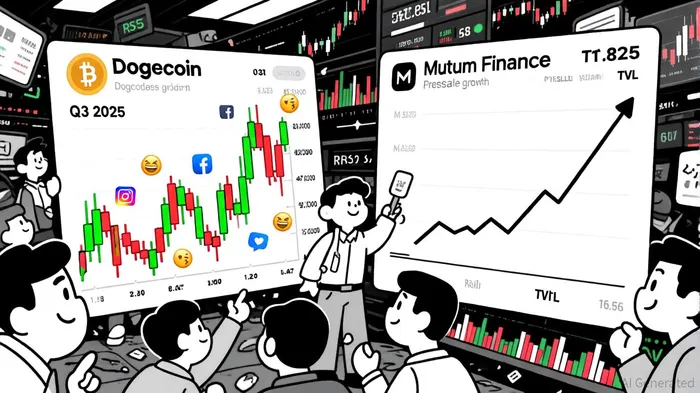
Dogecoin's Q3 2025 performance exemplifies the unpredictable nature of meme coins. Despite a 16.4% surge in total market capitalization, DOGE's price action has been a rollercoaster. As of October 24, 2025, DOGEDOGE-- trades at $0.1978, having gained 6.83% in the past week but declining 19% over 30 days, according to a FinanceFeeds analysis. Analysts remain cautiously optimistic, with bullish predictions targeting $0.27 by December 2025, the analysis added. This optimism is fueled by institutional inflows into the Rex-Osprey DOGE ETF, which has attracted $20 million in assets under management, and a dormant whale's $2.95 million withdrawal from Binance, signaling strategic liquidity shifts, according to a CoinCentral report.
Technical indicators paint a mixed picture. DOGE is consolidating near the $0.26 support level, with a potential breakout above $0.30 seen as a catalyst for a 50-100% rebound, analysts at CoinCentral noted. However, overbought conditions in oscillators like RSI and a "death cross" in moving averages hint at short-term exhaustion, as a Traders Union report warned. The coin's resilience is further tied to macro factors: a 68.5% surge in EthereumETH-- (ETH) and Bitcoin's seasonal trends have historically driven DOGE's performance, as noted in the CoinGecko Q3 report. Yet, as whales redirect capital into AI-driven projects like $LYNO, the long-term sustainability of DOGE's meme-driven narrative remains uncertain, according to a LiveBitcoinNews report.
Mutuum Finance: Long-Term Utility in a Structured DeFi Framework
In contrast to DOGE's volatility, Mutuum Finance (MUTM) embodies the DeFi sector's shift toward utility-driven innovation. As a decentralized lending and borrowing protocol on Ethereum, MUTM combines Peer-to-Contract (P2C) and Peer-to-Peer (P2P) models to serve both retail and institutional users, according to a TimesTabloid article. By Q3 2025, the project had raised $17.6 million in its presale, with token prices climbing from $0.01 in Phase 1 to $0.035 in Phase 6-a 250% increase for early buyers, the TimesTabloid piece reported. While specific Total Value Locked (TVL) figures for Q3 are not disclosed, the project's operational lending platform, CertiK audit (90/100 score), and $50,000 bug bounty program underscore its resilience during market turbulence, according to a GlobeNewswire release.
Mutuum's structured approach is further highlighted by its community-driven initiatives, including a $100,000 token giveaway and a 24-hour leaderboard rewarding top depositors, as the TimesTabloid article detailed. Analysts draw parallels between MUTM's presale trajectory and Solana's early stages, emphasizing its potential to redefine DeFi's lending landscape, the TimesTabloid piece added. With a planned Q4 2025 launch on the Sepolia testnet, MUTM's focus on security, compliance, and yield optimization positions it as a long-term contender in a market increasingly wary of speculative assets, according to a GlobeNewswire update.
Contrasting Dynamics: Sentiment vs. Structure
The juxtaposition of DOGE and MUTM reveals a fundamental divide in crypto investing. Dogecoin's short-term resilience hinges on sentiment, macroeconomic cues, and social media-driven demand. Its price is a barometer of retail confidence, with whale activity and ETF inflows acting as accelerants. However, this model is inherently fragile, as evidenced by the 1.3 million DOGE transfer to $LYNO-a shift reflecting investor appetite for projects with tangible utility, as reported by LiveBitcoinNews.
Mutuum Finance, by contrast, leverages DeFi's structural advantages. Its TVL growth (though not quantified in Q3) is underpinned by a diversified lending model, institutional-grade security, and a roadmap prioritizing compliance. While DeFi protocols often face TVL volatility during market downturns, MUTM's presale success and focus on Ethereum's ecosystem suggest a more stable trajectory. The project's 12% annual yield on USDT supplies and P2P customization options further differentiate it from meme coins, a CryptoDaily piece observed.
Navigating Volatility: A Dual-Strategy Outlook
For investors, the key lies in balancing short-term opportunities with long-term value. Dogecoin's potential for rapid, sentiment-driven gains-such as a Q4 breakout to $0.3173-appeals to risk-tolerant traders, particularly as Bitcoin's seasonal trends and ETF adoption create tailwinds, CoinCentral noted earlier. However, its reliance on macro factors and social media hype makes it a high-risk, high-reward proposition.
Mutuum Finance, meanwhile, offers a counterpoint. Its DeFi utility and structured growth model align with a broader industry shift toward regulated, yield-generating assets. While TVL metrics remain opaque, the project's $17.8 million presale and CertiK audit provide a foundation for long-term trust, the GlobeNewswire update reported. For investors prioritizing stability and innovation, MUTM represents a compelling alternative to speculative meme coins.
Conclusion
In a crypto market defined by volatility, the resilience of Dogecoin and the utility of Mutuum Finance highlight divergent paths. DOGE thrives on sentiment and liquidity, while MUTM builds on structure and compliance. As Q4 2025 unfolds, the former may offer explosive short-term gains, but the latter's DeFi-driven approach could redefine sustainable value in an increasingly mature ecosystem. For investors, the challenge lies in aligning their risk profiles with these contrasting paradigms.






Comentarios
Aún no hay comentarios