
Meme Coins in 2025: Assessing MoonBull, LOFI, and Pudgy Penguins as High-Volatility Growth Opportunities
The 2025 crypto market has become a theater for behavioral finance, where psychological biases and sentiment-driven dynamics amplify the volatility of memeMEME-- coins and NFT-linked tokens. MoonBull ($MOBU), LOFI, and Pudgy PenguinsPENGU-- ($PENGU) exemplify three distinct strategies within this high-stakes arena. This analysis unpacks their trajectories through the lens of behavioral finance, revealing how FOMO, loss aversion, and herd behavior shape their price action—and what this means for investors.
MoonBull ($MOBU): The FOMO-Driven Presale Play
MoonBull's explosive rise in 2025 is a masterclass in leveraging behavioral triggers. Its whitelist model—offering early access to presale tokens, bonus allocations, and private roadmap updates—has created a scarcity-driven frenzy. Over 50,000 whitelist applications were submitted in 24 hours, reflecting the power of herd mentality and urgency bias[3]. Investors, fearing missed opportunities, flock to secure spots despite limited project fundamentals, a classic case of FOMO (fear of missing out) amplifying speculative demand[1].
The token's deflationary mechanics—auto-liquidity, reflection rewards, and token burns—further align with prospect theory, where investors overweight potential gains (e.g., projected 24,540% ROI) while underestimating risks[4]. This creates a self-reinforcing cycle: early buyers, incentivized by staking rewards and token scarcity, become vocal advocates, fueling social media hype and attracting more FOMO-driven buyers[2].
However, MoonBull's success hinges on liquidity and regulatory stability. A sudden sell-off or SEC scrutiny could trigger a loss aversion response, where investors cling to tokens despite falling prices, hoping for a rebound[5].
Pudgy Penguins ($PENGU): Brand Loyalty and Long-Term Utility
Pudgy Penguins, once a niche NFT collection, has evolved into a multi-layered ecosystem with gaming, staking, and metaverse integrations. Its 2025 price trajectory—projected to reach $0.05 by 2026—reflects emotional alignment and confirmation bias. Investors are drawn to its brand storytelling and real-world utility (e.g., toy licensing, Walmart partnerships), reinforcing their belief in its long-term potential despite short-term volatility[2].
The project's recent 24% price surge following an Upbit listing and ETF filing speculation highlights recency bias, where recent news disproportionately influences sentiment[1]. Whale activity, such as a $320,000 purchase, further bolsters confidence, creating a narrative of institutional validation[1].
Yet, Pudgy Penguins faces headwinds. The SEC's delayed approval of a PENGU/NFT ETF has caused an 11% price drop, exposing the fragility of sentiment-driven valuations[4]. Here, loss aversion may keep investors holding onto tokens, hoping for a rebound rather than cutting losses.
LOFI: The Bearish Case and Behavioral Pitfalls
LOFI's 2025 performance tells a different story. With a Fear & Greed Index at 33 (Fear) and technical indicators pointing to a 25% price drop by October 2025, LOFI embodies the bearish sentiment dominating parts of the crypto market[1]. Its current price of $0.015741 trades below both 50-Day and 200-Day SMAs, signaling downward pressure[1].
The token's struggles are compounded by loss aversion and overconfidence bias. Despite a 23.8% price drop, LOFI retains a $1.85 million trading volume, suggesting investors cling to the asset, hoping for a rebound[3]. This behavior aligns with the disposition effect, where investors sell winners too early and hold onto losers[5].
LOFI's ecosystem developments—like the Mystic Yetis NFTs and gaming expansion—offer cautious optimism, but they're overshadowed by macro risks, including the SuiSUI-- DEX exploit in May 2025, which triggered a 23% drop[3]. Here, prospect theory explains the reluctance to exit: investors frame LOFI's price as a potential gain (if the ecosystem recovers) rather than a loss, skewing risk assessments[4].
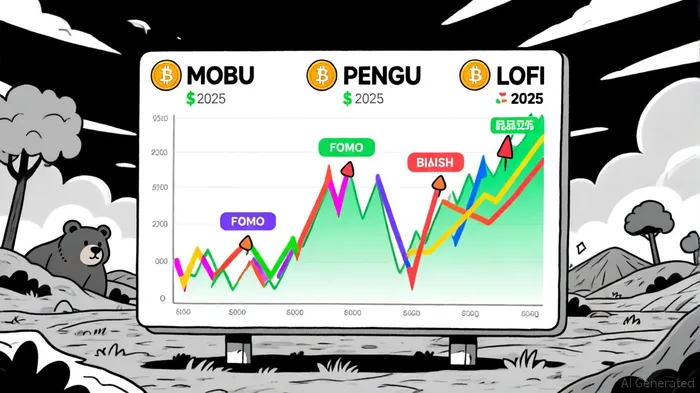
Visualizing the Behavioral Divide
Conclusion: Navigating the Behavioral Maze
Meme coins and NFT-linked tokens in 2025 are less about fundamentals and more about psychological warfare. MoonBull thrives on FOMO and urgency, Pudgy Penguins on brand loyalty and utility, and LOFI on the fragile hope of a rebound. For investors, the key is to recognize these behavioral triggers and avoid being swept up in the crowd.
As behavioral finance teaches, rationality is rare in speculative markets. MoonBull's presale frenzy, Pudgy Penguins' ecosystem bets, and LOFI's bearish grind all underscore the need for discipline. In a world where sentiment drives prices more than logic, the best strategy may be to invest with a plan and exit with a trigger—before the crowd's psychology turns against you.






Comentarios
Aún no hay comentarios