
Meme Coins 2.0: How Noomez ($NNZ) Is Redefining Utility and Scarcity in the Meme Space
The Problem with Legacy Meme Coins: Inflation, Speculation, and Uncertainty
Legacy meme coins like SHIBSHIB-- and DOGEDOGE-- have struggled to balance utility with long-term value. Shiba Inu, for instance, has seen a dramatic spike in its burn rate in late 2025, with over 26,492.5% daily burns reported in October, according to a Benzinga report. While this aggressive burn strategy aims to reduce supply, it lacks a structured roadmap, leaving investors to speculate on whether these burns will translate into meaningful price appreciation. Similarly, Dogecoin remains an inflationary asset with no hard supply cap, relying on Proof-of-Work mining to sustain its ecosystem, as noted in a Bitget article. While DOGE has made strides in real-world utility-such as enabling faster transactions and merchant integrations, according to a Bitcoinist analysis-its lack of a deflationary mechanism leaves it vulnerable to dilution over time.
These projects highlight a critical gap in the meme coin space: a lack of programmable scarcity and verifiable utility. This is where Noomez ($NNZ) steps in.
Noomez ($NNZ): A Tokenomics Revolution
Noomez's tokenomics model is engineered to create scarcity through a 28-stage presale and programmed burn events, ensuring that supply reduction is notNOT-- left to chance but embedded into the protocol. Here's how it works:
- Structured Deflation:
- $NNZ's total supply is fixed at 280 billion tokens, with 50% allocated to the presale. Each of the 28 stages lasts up to seven days, and any unsold tokens are permanently burned, reducing the circulating supply, as detailed in a Blockonomi breakdown.
This creates a 280× price curve, starting at $0.00001 and ending at $0.0028, incentivizing early participation while ensuring gradual price discovery, according to a FinanceFeeds article.
Transparency via the Noom Gauge:
The Noom Gauge, a live on-chain dashboard, tracks presale progress, burns, and vault activity in real time, as described in a FinanceFeeds analysis. This level of transparency is rare in the meme space, where projects often lack verifiable data.
Utility Beyond Hype:
$NNZ introduces community-driven airdrops (e.g., "Stage X Million" rewards) and staking incentives (up to 66% annual yields post-launch), according to a Blockonomi deep dive. These features create tangible value for holders, contrasting with SHIB and DOGE's reliance on passive speculation.
Strategic Allocation:
- 15% of tokens are locked in liquidity, 5% reserved for strategic burns, and 10% allocated to marketing and ecosystem growth. This balanced distribution ensures long-term sustainability rather than short-term volatility (Blockonomi's deep dive provides the full allocation breakdown).
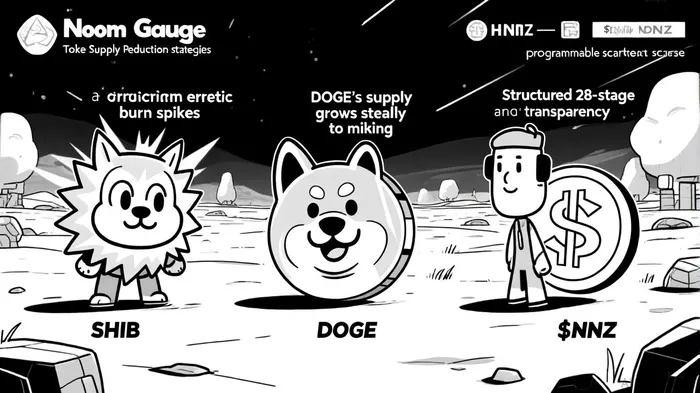
Contrasting Burn Mechanisms: SHIB's Volatility vs. $NNZ's Precision
While SHIB's recent burn rate has surged to unprecedented levels (see the Benzinga report mentioned above), its approach lacks the structured roadmap that $NNZ employs. For example:
- SHIB's Burns: Large-scale burns (e.g., 7.7 million tokens in a single transaction) are reactive rather than pre-programmed, leaving investors uncertain about their long-term impact (the Benzinga report documents these spikes).
- DOGE's Inflation: DOGE's supply continues to grow via mining, with no explicit burn mechanism to counterbalance this inflation (the Bitget article outlines DOGE's inflationary model).
- $NNZ's Burns: Every burn is automated and verifiable, with 50% of the presale tokens already scheduled for destruction (see the Blockonomi breakdown). This creates a predictable path to scarcity, aligning with modern crypto investors' demand for transparency.
Utility and Real-World Adoption: Where $NNZ Stands Out
While DOGE has made strides in real-world utility-such as enabling faster transactions and merchant integrations (as noted in the Bitcoinist analysis)-$NNZ's utility is more protocol-driven. Key features include:
- Staking Rewards: Post-launch, holders can earn up to 66% annual yields, creating a flywheel effect that rewards long-term participation (Blockonomi's deep dive outlines these yields).
- Community Governance: Airdrops and referral programs incentivize organic growth, ensuring the project's success is tied to its community's engagement (see the Blockonomi breakdown for governance details).
- BSC Ecosystem Integration: Built on Binance Smart Chain, $NNZ benefits from fast transactions and low fees, making it accessible to both retail and institutional investors, according to a FinanceFeeds report.
In contrast, SHIB and DOGE rely heavily on external factors like celebrity endorsements (e.g., Elon Musk for DOGE) and speculative trading volume (the Benzinga and Bitget reports discuss these dynamics).
The Road Ahead: Can $NNZ Sustain Its Momentum?
Analysts are closely watching key metrics such as stage completion speed, total burned tokens, and vault activity to gauge $NNZ's potential as a 2025 breakout project (the FinanceFeeds article cited earlier highlights these metrics). The project's emphasis on proof over speculation-backed by smart contract audits and KYC-verified team members-positions it as a serious contender in the meme space (Blockonomi's deep dive provides audit and team details).
However, challenges remain. The meme coin market is highly competitive, and $NNZ must continue to innovate in utility (e.g., expanding into DeFi or NFTs) to maintain its edge. That said, its structured tokenomics and community-driven approach offer a blueprint for sustainable growth in a sector often plagued by hype cycles.
Conclusion: Meme Coins 2.0 and the Future of Digital Assets
Noomez ($NNZ) represents a new era for meme coins: one where scarcity is programmable, utility is verifiable, and growth is sustainable. By addressing the shortcomings of legacy projects like SHIB and DOGE, $NNZ is not just redefining the meme coin space-it's setting a new standard for value creation in the crypto ecosystem. For investors seeking exposure to the next generation of digital assets, $NNZ's tokenomics model offers a compelling case for long-term participation.






Comentarios
Aún no hay comentarios