
The Meme Coin Mania: How Elon Musk and Social Media Sentiment Drive Dogecoin's Volatility
The Meme Coin Mania: How Elon Musk and Social Media Sentiment Drive Dogecoin's Volatility
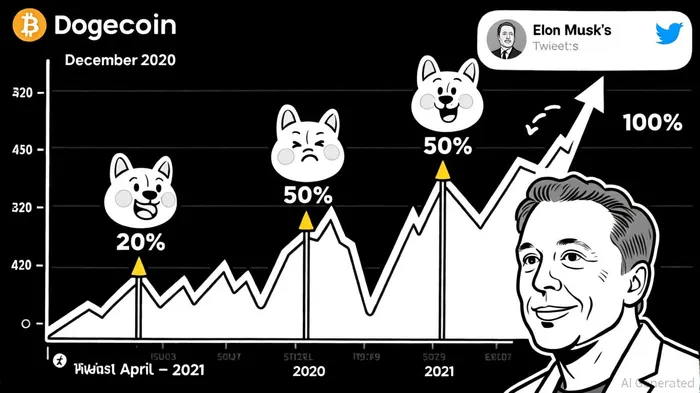
Meme coins like DogecoinDOGE-- (DOGE) have become a fascinating case study in modern finance, where social media sentiment and behavioral psychology often override traditional valuation metrics. Dogecoin, originally a joke cryptocurrency, has seen its price swing wildly in response to tweets from high-profile figures like Elon Musk. According to a report by Press Farm, Musk's social media activity between 2020 and 2021 directly triggered sharp price movements, with his December 2020 tweet—“One word: Doge”—sparking a 20% surge within hours [2]. By April 2021, his “Doge Barking at the Moon” tweet, paired with an image of a painting, caused the coin's price to nearly double [2]. These examples underscore how social media sentiment, amplified by influential voices, can override fundamentals in speculative markets.
Behavioral Finance and the Psychology of MemeMEME-- Coins
The volatility of meme coins is deeply rooted in behavioral finance principles. Fear of Missing Out (FOMO) and herd behavior dominate investor decisions, particularly in retail-driven markets. When Musk dubbed Dogecoin “the people's crypto” in February 2021, the coin surged by 70% as retail investors rushed to avoid being left behind [3]. This aligns with the concept of social proof, where individuals mimic the actions of perceived experts or large groups. A 2023 study published in ScienceDirect found that Musk's tweets notNOT-- only influenced Dogecoin's price but also altered its volatility patterns, with positive sentiment driving liquidity and negative remarks triggering panic selling [4].
The role of platforms like Reddit and Twitter cannot be overstated. A dataset from Kaggle reveals that Dogecoin's price spikes in 2021 correlated strongly with increased engagement on r/Dogecoin and similar subreddits [2]. Tools like the Meme Coin Trend Analyzer, which aggregates sentiment from multiple platforms, have shown that viral content and influencer endorsements create echo chambers, reinforcing emotional decision-making [5]. However, this dynamic is a double-edged sword. When Musk criticized Dogecoin as “a hustle” during a Saturday Night Live appearance in May 2021, the coin's value plummeted by 30% [4], illustrating how sentiment can flip overnight.
The Risks of Social Media-Driven Markets
While meme coins thrive on hype, their lack of intrinsic value makes them inherently unstable. A 2024 analysis in IEEE Explore demonstrated that Dogecoin's price movements are more closely tied to social media sentiment than macroeconomic indicators [1]. This creates a feedback loop: positive sentiment drives buying, which fuels further optimism, until a negative trigger—such as a celebrity disavowal—triggers a collapse. Behavioral finance models, including logistic regression and XGBoost algorithms, have shown that meme coin trends can be predicted with up to 74% accuracy using sentiment scores from unstructured text data [5]. Yet, these models struggle with unpredictable events, such as Musk's sudden shifts in tone or geopolitical shocks.
Implications for Investors
For investors, the meme coin market is a high-risk, high-reward environment. The absence of utility-driven value means that Dogecoin's price is entirely dependent on narrative and community engagement. As noted in a 2022 sector analysis, meme coins are “speculative assets with no intrinsic value,” making them prone to extreme volatility [1]. Retail investors must weigh the allure of FOMO against the risks of market manipulation and regulatory scrutiny.
Moreover, the broader cryptocurrency market is increasingly influenced by social media. A 2023 study found that Musk's remarks on BitcoinBTC-- and Dogecoin amplified hedging and leverage effects, particularly during periods of economic uncertainty [3]. This suggests that meme coins are not isolated phenomena but part of a larger trend where digital assets are shaped by public sentiment and influencer culture.
Conclusion
Dogecoin's journey from a meme to a multi-billion-dollar asset highlights the power of social media in modern finance. Elon Musk's tweets have repeatedly demonstrated their ability to move markets, but the underlying psychology—FOMO, herd behavior, and social proof—remains the true driver. As meme coins continue to evolve, investors must recognize that these assets are as much about sentiment as they are about code. In a world where a single tweet can send prices soaring or crashing, understanding behavioral finance is no longer optional—it's essential.






Comentarios
Aún no hay comentarios