
MegaETH's USDm Stablecoin: A Disruptive Play in Layer-2 Economics
The Scalability Bottleneck and Ethereum's Fee Model Dilemma
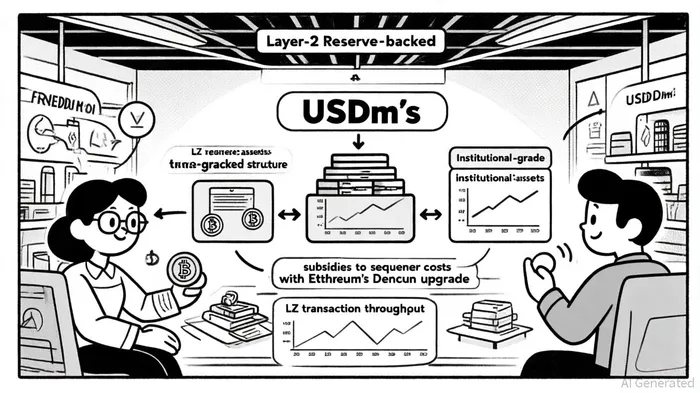
Ethereum's Layer-2 (L2) networks have long grappled with a paradox: scalability requires low fees, but low fees threaten economic sustainability. Traditional L2 solutions rely on volatile token models or centralized sequencer subsidies, creating instability in transaction costs and network security. Enter USDm, MegaETH's yield-backed stablecoin, which aims to decouple these constraints by leveraging institutional-grade reserves and yield-generating strategies. By subsidizing sequencer costs and stabilizing gas fees, USDmUSDC-- could redefine how L2 networks balance scalability with profitability[1].
USDm's Economic Architecture: Stability Meets Yield
USDm is not just another stablecoin—it's a self-sustaining economic engine. Built on Ethena's infrastructure, USDm's reserves include tokenized U.S. Treasuries (via BlackRock's BUIDL fund) and liquid stable assets, ensuring both transparency and resilience[2]. The stablecoin's yield mechanisms, such as delta-neutral trading and RWA-backed returns, generate consistent cash flows to cover sequencer operating expenses (OPEX). This model allows MegaETH to price gas at cost while maintaining long-term profitability—a critical innovation in an ecosystem where 56.8% of stablecoins now incorporate yield strategies[3].
The institutional-grade backing of USDm also addresses a key weakness in existing stablecoins: liquidity fragmentation. By coexisting with USDT and cUSD, USDm offers users flexibility without forcing a single asset's dominance. This hybrid approach mitigates risks from reserve concentration while fostering adoption across DeFi and traditional finance (TradFi) applications[4].
Layer-2 Synergy and the Dencun Upgrade
MegaETH's integration with Ethereum's Dencun upgrade (EIP-4844) amplifies USDm's disruptive potential. EIP-4844 reduced on-chain data costs by over 90%, but it also introduced unpredictability in fee margins[5]. USDm's yield mechanisms counteract this by providing a predictable revenue stream for sequencers, stabilizing fee predictability even as transaction volumes surge. This synergy is critical: post-Dencun, Ethereum's L2 networks are projected to handle 10x more daily transactions, with blob fees dropping to near-zero levels[6].
Moreover, USDm's modular design aligns with the broader modular blockchain thesis, enabling application-specific optimizations. For instance, high-frequency trading dApps can leverage USDm's low-latency finality (200 ms–2 seconds) without compromising decentralization[7]. This adaptability positions MegaETH to capture a significant share of the $11 billion yield-bearing stablecoin market[3].
Risks and the Dual Mandate Challenge
Despite its promise, USDm's dual mandate—maintaining peg stability while generating competitive yields—introduces systemic risks. Yield strategies like DeFi lending and RWA tokenization depend on market conditions and regulatory clarity. A sudden depeg or liquidity crunch could destabilize the entire model, as seen in past stablecoin collapses[8]. However, USDm's monthly third-party audits and 1:1 USD backing mitigate these risks compared to algorithmic counterparts[9].
Regulatory tailwinds, such as the GENIUS Act of 2025, further bolster USDm's viability by legitimizing yield-bearing stablecoins as a hybrid of TradFi and DeFi[3]. Yet, off-chain legal uncertainties—such as reserve seizure risks—remain unresolved challenges[10].
Conclusion: A New Paradigm for L2 Economics
USDm represents a paradigm shift in blockchain fee models. By replacing volatile token subsidies with yield-backed stability, MegaETH addresses Ethereum's scalability trilemma at its core. As L2 networks race to outperform centralized systems, USDm's institutional-grade infrastructure and Dencun compatibility position it as a cornerstone of the next-generation blockchain economy. For investors, the key question is not whether USDm will succeed, but how quickly it will displace legacy stablecoins in the L2 ecosystem.






Comentarios
Aún no hay comentarios