
Medline's IPO: A Value Investor's Look at Moats, Valuation, and the Private Equity Ceiling
Medline's journey to public markets was a significant event. The medical supplies giant raised $6.26 billion in its offering, making it the largest IPO of 2025 and the biggest in over four years. The stock made its debut earlier this month, with shares opening at $35, a 21% pop from the initial price of $29. Since then, the shares have traded near $41.25, representing a move of roughly 40% from the IPO price.
This strong debut has set up the central question for a value investor. The stock now trades at a trailing price-to-earnings ratio of 42 and a price-to-sales multiple of 1.94. As noted by Jim Cramer, the forward-looking multiple implied by current earnings estimates is around 45 times earnings. For a company with low double-digit revenue growth, that valuation leaves little room for error.
The setup introduces a specific risk that classic value analysis must weigh: the private equity ceiling. The IPO was backed by major firms like Blackstone and Carlyle, which bought the company in 2021. As Cramer pointed out, these entities will eventually seek to cash out, a process that could put downward pressure on the stock. While the selling likely won't be immediate, the long-term trajectory of the share price may be capped by the need for these large shareholders to fully liquidate their positions. The question for the patient investor is whether the current price adequately discounts this structural ceiling, or if it has already priced in a perfect, perpetually growing future.
The Durable Moat: Barriers to Entry and Financial Quality
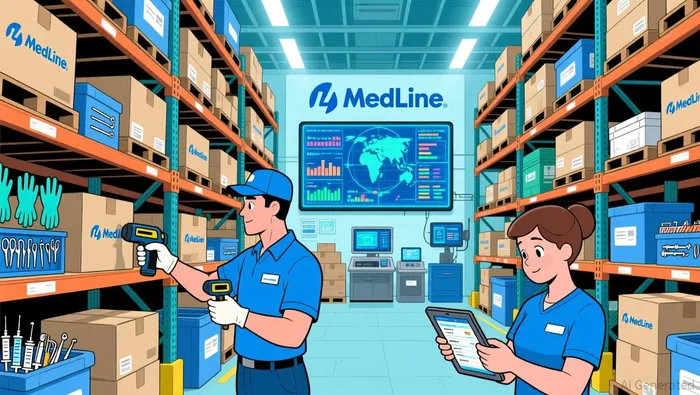
The foundation of any value investment is a durable competitive advantage, a "moat" that protects profits over the long term. Medline's model appears built on a classic, wide moat. As CNBC's Jim Cramer noted, CEO Jim Boyle describes the company as a sort of Costco for healthcare. This analogy captures the essence: a vast, one-stop-shop for medical facilities. The company's portfolio of over 335,000 items creates immense switching costs for customers. Hospitals and clinics simply cannot afford the operational chaos of sourcing from dozens of niche suppliers. This scale advantage is reinforced by a membership model and a significant portfolio of private brands, which further lock in buyers and improve margins.
The financial results show this moat is translating into powerful growth. Over recent years, MedlineMDLN-- has been compounding earnings at an average annual rate of 62.9%. That's a staggering pace, dwarfing the 11.1% annual earnings growth seen across the broader medical equipment industry. Even on a revenue basis, the company's 8.7% average annual growth outpaces its peers. This isn't just a story of size; it's a story of accelerating dominance.
Yet, the moat's width must be measured against the financial quality it generates. Here, the picture is more nuanced. Medline's net profit margin stands at a modest 4.6%. While this is an improvement from 3.8% a year ago, it reflects a business that operates on thin margins, typical for a high-volume distributor. The return on equity is similarly restrained at 7.5%. These figures suggest the company is a capital-intensive operator, where scale is critical to profitability but does not inherently generate high returns on equity.
The sheer size of the enterprise, however, is undeniable. With a market cap of $53.23 billion and an enterprise value of $68.86 billion, Medline is a colossus in its field. This scale is the ultimate barrier to entry for new competitors. Building a distribution network and product catalog of this magnitude would require decades and tens of billions in capital. For the patient investor, the moat is real and wide. The question is whether the current valuation, which prices in near-perfect execution, leaves any margin of safety for the inevitable cycles of cost pressures and competitive friction.
Valuation, Margin of Safety, and the Cramer Conundrum
The high valuation leaves no room for error. The stock trades at a trailing P/E of 42 and a price-to-sales multiple of 1.94. More critically, as Jim Cramer noted, the forward-looking multiple implied by current earnings estimates is around 45 times earnings. For a company with low double-digit revenue growth, that is a steep price. It demands near-perfect execution and sustained expansion of its already-thin margins.
The post-IPO momentum has been dramatic. Shares have rallied roughly 40% over the past 20 days and 120 days, a classic "pop" following a blockbuster offering. Yet, this surge masks underlying volatility. The stock's year-to-date return is actually down about 3.5%, showing that the initial euphoria has cooled and the shares are now trading in a wide range. This choppiness is a warning sign; it suggests the market is already pricing in the risks of a private equity exit and questioning whether the growth story justifies the premium.
The primary risk is valuation compression. If Medline's growth falters even slightly below the lofty expectations baked into the current price, the multiple could contract sharply. This risk is amplified by the private equity backing. As Cramer pointed out, these firms will want to "ring the register" eventually, and their need to fully liquidate their positions creates a long-term ceiling on the stock. The selling may not be immediate, but the knowledge that it is coming can cap upside.
Cramer's verdict is clear. Despite liking the company's durable moat, he finds the stock "a little too expensive" and says he'd wait for a pullback to buy. His suggested entry point of $29 or $30 is roughly where the IPO began, a level that would imply a much more reasonable valuation. For the value investor, the margin of safety is the gap between the current price and that level. With the stock trading near $41, that gap has narrowed to almost nothing. The setup now hinges entirely on the company delivering a flawless, accelerating growth trajectory for years to come-a bet that requires a significant leap of faith.
Catalysts, Risks, and What to Watch
For the value investor, the path forward is clear. The thesis hinges on Medline's ability to grow earnings fast enough to justify its premium valuation, all while navigating the structural ceiling created by its private equity backers. The key watchpoints are specific and measurable.
First, monitor the quarterly earnings reports for sustained growth above the company's own 8.7% average annual revenue CAGR. More critically, watch for margin expansion beyond the current 4.6% net profit margin. The business model suggests this is possible through scale and its AI-driven initiatives, but it must materialize. The company has already taken steps, as noted in a recent collaboration with Northwestern Medicine and Providence on a Microsoft-based, AI-powered supply chain solution. The execution and financial impact of these technology investments will be a major catalyst for improving returns on capital.
Second, track the progress on international expansion. The company operates in more than 100 countries and territories, but its stated mission is to make healthcare run better globally. Success in new markets like India and Africa could unlock significant new revenue streams and diversify its footprint, reducing reliance on any single economy. Any concrete milestones in these regions will be positive signals.
The overarching risk, however, remains the valuation and the private equity ceiling. The stock's forward multiple near 45 times earnings leaves no margin for error. If growth slows even slightly, or if the market begins to price in the eventual selling pressure from Blackstone, Carlyle, and Hellman, a sharp correction is possible. The recent volatility, with the shares trading in a wide range after their initial pop, is a warning that the market is already weighing these factors.
The bottom line for the patient investor is to wait for a clearer signal. The company has a wide moat and a solid growth trajectory. But until it demonstrates that it can compound earnings at a rate that justifies its current price, the prudent move is to watch from the sidelines. As Jim Cramer concluded, the stock looks a little too expensive for now.





Comentarios
Aún no hay comentarios