
Media Industry Consolidation in the Streaming Era: Strategic Valuation Shifts and Investment Implications
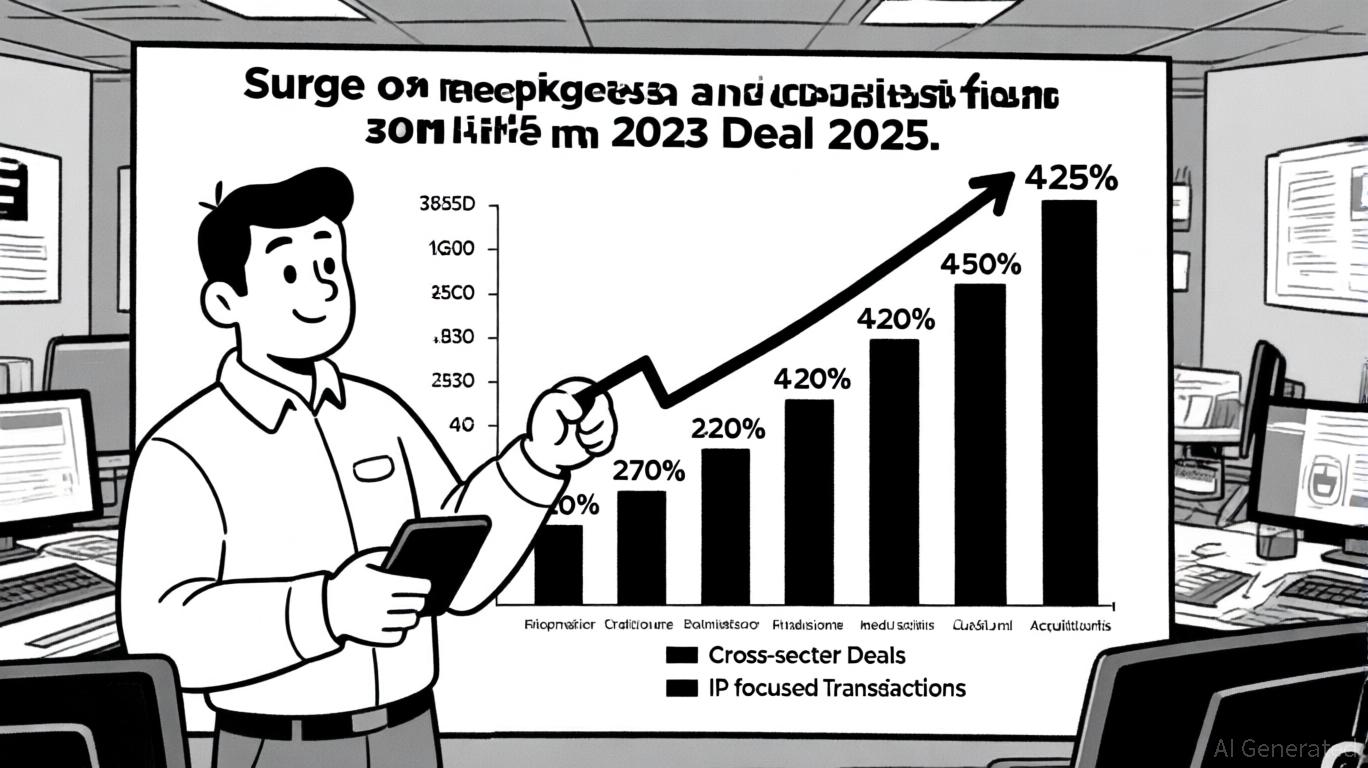
The media industry is undergoing a seismic shift as streaming reshapes how content is created, distributed, and valued. From 2024 to mid-2025, mergers and acquisitions (M&A) in the sector surged by 82% compared to the second half of 2024, driven by a confluence of technological innovation, regulatory pressures, and the relentless pursuit of scale in a fragmented market, according to a Bain report. At the heart of this consolidation lies a fundamental redefinition of valuation metrics: investors and acquirers are increasingly prioritizing intellectual property (IP) and cross-sector synergies over traditional revenue streams like advertising or subscription growth.
!image{style="max-width:100%;"}The Drivers of Consolidation
The streaming era has intensified competition for audience attention, forcing media companies to adapt to declining linear TV revenues and subscription fatigue. According to an FTI analysis, over half of media M&A in 2024 involved a target or acquirer outside the industry, reflecting a strategic pivot toward convergence with tech, gaming, and experiential sectors. For example, Disney's $1.5 billion investment in Epic Games, the creator of Fortnite, underscores the value of transmedia IP that can span gaming, virtual events, and streaming, according to Parrot Analytics. Similarly, Sony's acquisition of Alamo Drafthouse—a theater chain known for immersive experiences—highlights the sector's push into live events as a revenue diversifier, as described in a Wingding report.
Regulatory shifts and economic pressures have further accelerated consolidation. Falling interest rates in 2025 have made financing cheaper, while the need to build resilient business models in the face of cord-cutting has pushed legacy players to seek scale. Paramount Global's $8 billion sale to Skydance Media, for instance, injected $6 billion into Paramount's balance sheet to fund streaming growth and shareholder returns, as Deadline reports.
Valuation Metrics: From Revenue to IP and Synergy
Traditional valuation methods—such as discounted cash flow (DCF) analysis and revenue multiples—are being supplemented by metrics that quantify the long-term potential of IP and cross-modal scalability. A KPMG report notes that media companies now evaluate IP based on its ability to generate revenue across platforms, including merchandise, virtual events, and gaming. For example, SonySONY-- Music's $600 million acquisition of half of Michael Jackson's catalog was justified not just by existing royalties but by the catalog's adaptability for streaming, NFTs, and virtual concerts, according to Biquantumarc.
Data-driven frameworks are also reshaping valuations. Parrot Analytics' Streaming Economics model, which uses audience demand signals to predict subscriber growth and churn, has become a critical tool for investors. Netflix's ability to raise prices without significant subscriber attrition, for instance, is tied to its strong IP catalog, which maintains high demand elasticity (as shown in Parrot Analytics' framework).
Case Studies in Strategic Valuation
Paramount-Skydance Merger: This $8 billion deal exemplifies the shift toward IP-centric valuation. Skydance's focus on Paramount+'s legacy brands (e.g., Star Trek, Mission: Impossible) and its plan to leverage Paramount's film library for streaming and gaming illustrates how IP can drive cross-platform revenue. The transaction's structure—prioritizing balance sheet strength and shareholder returns—reflects a departure from pure revenue-focused deals (Deadline coverage).
Disney-Epic Games Investment: By acquiring a stake in Epic Games, Disney is betting on the future of gaming as a distribution channel for its IP. The $1.5 billion investment values not just Fortnite's user base but its potential to integrate Disney's characters into interactive, monetizable experiences (analysis from Parrot Analytics).
Sony's Michael Jackson Catalog Acquisition: Priced at $600 million, this deal highlights the premium placed on evergreen IP. The catalog's adaptability for streaming, live events, and digital collectibles (e.g., NFTs) ensures a steady revenue stream beyond traditional music royalties (Biquantumarc analysis).
The Role of AI and Automation
AI-driven content creation and audience analytics are further complicating valuation models. Media companies now acquire not just content libraries but data assets that enhance personalization and ad targeting. Walmart's acquisition of Vizio, for example, provides access to 10 million households' viewing data, enabling hyper-targeted advertising and e-commerce synergies, per Statista. Similarly, AI tools are being used to optimize content production costs and predict audience preferences, factors now embedded in due diligence processes (as detailed in a Ciesco report).
Future Outlook and Investment Implications
As the media landscape evolves, investors must focus on three key trends:
1. IP Monetization: Companies with diversified IP portfolios (e.g., Disney, Sony) will outperform those reliant on linear revenue.
2. Cross-Sector Synergies: Deals integrating media with gaming, retail, or tech (e.g., Paramount-Skydance, Walmart-Vizio) will dominate.
3. Ad-Supported Models: With consumers managing an average of 13 entertainment services, bundling and ad-supported tiers will become critical for retention, according to a NewscastStudio analysis.
For investors, the lesson is clear: traditional metrics like EBITDA multiples are insufficient. Success in the streaming era demands a nuanced understanding of IP's cross-modal potential, data assets, and the ability to adapt to fragmented consumer behaviors. As The Hollywood Reporter notes, "Owning the consumer, owning the IP, or owning nothing" has become the new mantra.







Comentarios
Aún no hay comentarios