
Media Brand Resilience and Stock Valuation: Navigating Political Controversies in 2025
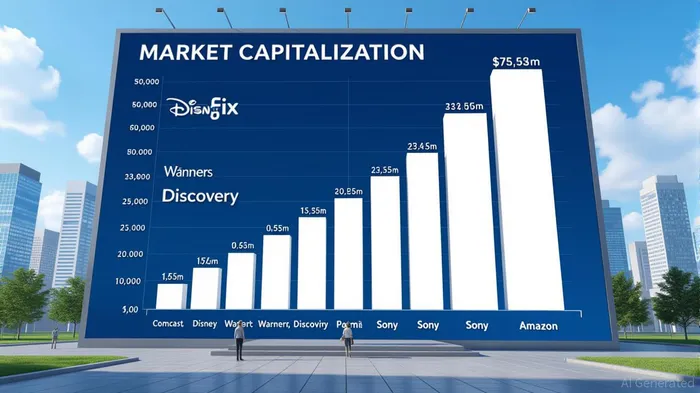
The media landscape in 2025 is defined by a paradox: unprecedented consolidation among major conglomerates and a simultaneous erosion of editorial independence due to political pressures. For investors, this duality raises critical questions about which media brands are truly resilient and which are vulnerable to reputational and financial risks. Drawing on recent data and industry analysis, this article examines the stock valuation dynamics of the "Big Six" media giants—Comcast, Walt DisneyDIS--, Warner BrosWBD--. Discovery, Paramount Global, SonySONY--, and Amazon—and evaluates their ability to withstand political controversies while delivering long-term returns.
The Political Resilience Divide
According to a report by Free Press, the Media Capitulation Index (MCI) has identified systemic failures among the 35 largest U.S. media companies in safeguarding democratic norms. Companies like DisneySCHL-- (ABC), Paramount (CBS), and Warner Bros. Discovery (CNN) have faced scrutiny for compromising editorial independence through legal settlements, rolling back diversity initiatives, or currying favor with the Trump administration [4]. For example, Paramount's $16 million settlement with President Trump over a 60 Minutes interview with Kamala Harris coincided with the abrupt cancellation of Stephen Colbert's Late Show, a move critics interpreted as capitulation to political pressure [2]. Similarly, Disney's ABC News paid $15 million to Trump after a report on his sexual abuse liability, raising concerns about self-censorship [4].
These incidents highlight a key risk for investors: media conglomerates with high political exposure may see their valuations punished if perceived as lacking independence. Yet, the MCI also reveals a counterintuitive trend: companies that align with dominant political narratives—such as NewsmaxNMAX-- and Trump MediaDJT-- & Technology Group—have seen speculative valuations soar despite poor financial performance. Newsmax, for instance, trades at a price-to-sales ratio of 9.01x, far above the industry average of 1.05x, despite losing $55 million in 2024 [3]. This suggests that political alignment can temporarily insulate media brands from traditional valuation metrics, but such models remain fragile without sustainable revenue streams.
Strategic Adaptation and Market Positioning
Among the Big Six, AmazonAMZN-- stands out as a rare example of a media giant leveraging political neutrality and technological innovation to bolster resilience. With a market cap of $2.5 trillion, Amazon's Prime Video and AI-driven content production have insulated it from the controversies plaguing traditional broadcasters [2]. Its acquisition of MGM Studios and investments in AI-generated content position it to dominate both entertainment and emerging tech-driven media ecosystems [5]. By contrast, legacy players like ComcastCMCSA-- and Warner Bros. Discovery are restructuring to mitigate risks. Comcast's planned spin-off of its cable networks into Versant by year-end 2025 aims to reduce regulatory scrutiny and focus on high-margin streaming and theme park operations [2]. Warner Bros. Discovery, meanwhile, faces challenges in balancing its CNN and HBO brands amid accusations of editorial bias, yet its diversified portfolio—including Discovery+ and gaming assets—provides a buffer against sector-specific shocks [2].
Disney's $207 billion market cap reflects its global brand strength and diversified revenue streams, but its recent controversies underscore vulnerabilities. The company's reliance on politically sensitive content (e.g., The Walt Disney Company's handling of diversity initiatives) could test its long-term resilience. However, its dominance in streaming (Disney+ and Hulu) and theme parks offers a counterweight to short-term reputational risks [2]. Sony, with its $173 billion valuation, has navigated political pressures more deftly by leveraging its music, film, and gaming divisions to maintain a neutral public profile while investing in AI-driven content creation [2].
Global Pressures and Regulatory Shifts
The U.S. press freedom crisis, as documented by the 2025 RSF World Press Freedom Index, adds another layer of complexity. The U.S. now ranks 57th globally, with economic fragility and political attacks undermining media viability [1]. This environment pressures media companies to either adapt to new regulatory frameworks or face declining ad revenue and public trust. For instance, antitrust actions against GoogleGOOGL-- and MetaMETA-- could reshape digital advertising revenue, while AI-related copyright lawsuits may redefine content monetization models [5]. Investors must weigh these risks against opportunities in companies that prioritize financial independence, such as public broadcasters like NPR and PBS, which maintain editorial autonomy despite government funding [5].
Valuation Opportunities and Risks
For investors, the key lies in identifying media companies that balance political resilience with strategic innovation. Amazon's scale and AI-driven edge make it a top pick, while Comcast's spin-off strategy and Disney's global brand offer long-term potential despite near-term controversies. Conversely, companies like Paramount and Warner Bros. Discovery face higher risks due to their entanglement in political disputes and reliance on legacy revenue models.
However, the speculative boom in politically aligned media (e.g., Newsmax and Trump Media) remains a double-edged sword. While these firms benefit from short-term hype, their lack of profitability and dependence on volatile political climates make them high-risk bets. As the Free Press report warns, systemic failures in media independence could erode public trust and regulatory support, ultimately harming valuations [4].
Conclusion
The 2025 media landscape is a battleground of political pressures, technological disruption, and regulatory uncertainty. For investors, resilience lies not in avoiding controversy but in strategic adaptability—whether through diversification (Amazon), restructuring (Comcast), or technological innovation (Sony). While no media brand is immune to political risks, those that prioritize editorial independence and financial flexibility are best positioned to thrive in an increasingly fragmented and polarized world.





Comentarios
Aún no hay comentarios