
The Measles Outbreaks and Their Impact on Public Health Infrastructure Investment Opportunities
The resurgence of measles in the United States, particularly in South Carolina, has exposed critical vulnerabilities in public health infrastructure and vaccine distribution systems. With 1,912 confirmed cases nationwide as of December 2025 and 129 cases in South Carolina alone, the crisis underscores a growing need for investment in healthcare preparedness and biopharma innovation. This analysis examines how declining vaccination rates, limited mobile health unit effectiveness, and federal policy shifts are reshaping opportunities in public health infrastructure and vaccine manufacturing.
Declining Vaccination Rates and Herd Immunity Gaps
South Carolina's measles vaccination rates have fallen from 96% in 2020 to 93.5% in 2025, leaving the state below the 95% threshold required for herd immunity according to reports. In Spartanburg County, the epicenter of the 2025 outbreak, K-12 vaccination coverage dropped to 90% for the 2024–2025 school year, directly correlating with the surge in cases. Nationally, U.S. kindergarten vaccination rates have declined from 95.2% in 2019–2020 to 92.7% in 2023–2024, leaving 280,000 children at risk. These trends highlight a systemic erosion of vaccine confidence, driven by misinformation, expanded philosophical exemptions, and political rhetoric. For investors, this signals a long-term demand for solutions to rebuild trust and improve vaccination access.
Mobile Health Units: Limited Reach, High Potential
In response to the South Carolina outbreak, the state deployed mobile health units (MHUs) to administer free MMR vaccines. However, uptake has been minimal. Between October and mid-November 2025, MHUs administered only 44 doses, with one clinic in Boiling Springs seeing just one attendee according to analysis. Historical data from the 2021–2022 period, however, shows MHUs can be effective: Prisma Health's mobile clinics delivered 12,102 vaccines across 149 locations, disproportionately benefiting Black, Hispanic, and uninsured populations. This duality-limited current effectiveness but proven past success-suggests untapped potential for scaling mobile vaccination programs with better community engagement and funding.
Federal Policy Shifts and State-Level Gaps
The Trump administration's policies have exacerbated challenges in public health infrastructure. The cancellation of $500 million in mRNA vaccine contracts and the withdrawal of $11 billion in pandemic-era grants to state health departments have crippled federal support for outbreak response. South Carolina's DPH, for instance, now bears the burden of managing the measles crisis with reduced resources. While states are stepping in-such as through expanded school vaccination requirements-the lack of centralized coordination creates a fragmented landscape. This fragmentation presents opportunities for private-sector investment in state-level public health systems, including digital tracking tools and community-based outreach platforms.
Market Growth and Investment Opportunities 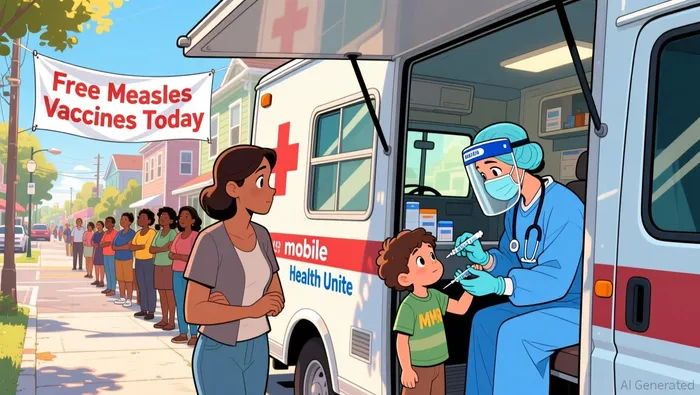 The global vaccines market is projected to grow from $50.46 billion in 2025 to $63.66 billion by 2030, with the U.S. market expected to reach $83.47 billion by 2033 at a 8.4% CAGR according to market research. The MMR vaccine segment, in particular, is gaining traction due to its role in combating outbreaks. Recent government contracts, such as the $56 million extension to EmergentEBS-- BioSolutions for smallpox/mpox vaccines, indicate sustained demand for stockpiled immunizations. Additionally, the economic cost of measles outbreaks-$90 million for 1,500 cases-underscores the financial imperative for preventive investments.
Strategic Sectors for Investors
- Vaccine Manufacturing: Companies specializing in MMR vaccines or advanced production technologies (e.g., AI-driven quality control) are well-positioned to benefit from rising demand.
- Mobile Health Infrastructure: Innovations in mobile clinics, including AI-powered logistics and telehealth integration, could enhance vaccine delivery efficiency.
- Public Health Software: Platforms for real-time disease tracking, exemption management, and community engagement are critical for states like South Carolina.
- Cold Chain Logistics: As global vaccination campaigns expand, investments in temperature-controlled storage and distribution networks will grow in importance.
Conclusion
The 2025 measles outbreaks have laid bare the fragility of U.S. public health systems and the urgent need for modernization. While federal policy shifts have created uncertainty, they have also opened avenues for private-sector leadership in vaccine manufacturing, mobile health solutions, and data-driven infrastructure. For investors, the crisis is not merely a public health issue but a catalyst for transformative opportunities in a sector poised for sustained growth.





Comentarios
Aún no hay comentarios