
McEwen Agrees to Acquire Canadian Gold in All-Stock Deal: Strategic Consolidation and Shareholder Value Creation in the Gold Sector
The gold mining industry is undergoing a transformative phase of consolidation, driven by the need to scale operations, diversify assets, and capitalize on favorable gold prices. McEwenMUX-- Inc.'s recent all-stock acquisition of Canadian Gold Corp. exemplifies this trend, offering a compelling case study of strategic consolidation and its potential to create shareholder value. By acquiring Canadian Gold's high-grade Tartan Lake Gold Mine in Manitoba, McEwen aims to strengthen its production pipeline, reduce operational volatility, and position itself as a mid-tier producer with a diversified asset base.
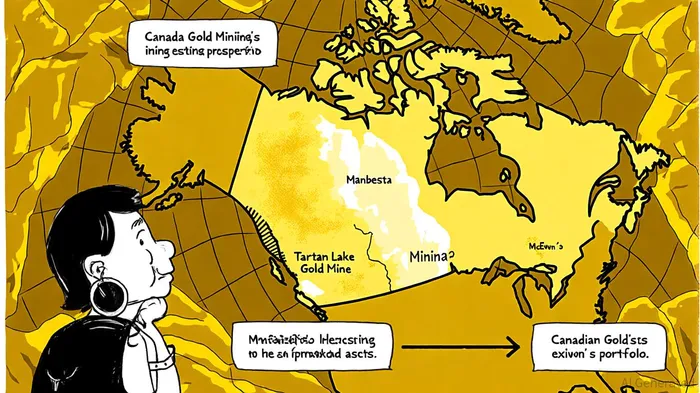
Strategic Rationale: Consolidation in a High-Value Sector
The gold sector has seen a surge in mergers and acquisitions (M&A) since 2023, fueled by a combination of rising gold prices, declining exploration success rates, and the financial strength of mid-tier producers. According to a Discovery Alert report, companies with annual production exceeding 200,000 ounces trade at higher valuation multiples than smaller peers, incentivizing consolidation to achieve scale. McEwen's acquisition of Canadian Gold aligns with this dynamic. Seasia Consulting notes that the Tartan Lake project, a former producing mine with existing infrastructure, offers a low-cost path to restart production within 24–36 months. This aligns with McEwen's goal to double its gold and silver output to 250,000–300,000 gold equivalent ounces (GEOs) by 2030, according to a GlobeNewswire release.
Geographical diversification is another key driver. Seasia Consulting highlights that Canada's stable regulatory environment and established mining infrastructure make it an attractive jurisdiction for consolidation. By integrating Tartan Lake into its portfolio, McEwen reduces jurisdictional risk while leveraging its technical expertise-particularly in high-grade gold deposits, which are similar to its Fox Complex in Nevada, a synergy that is critical in an industry where operational predictability and ESG compliance are increasingly valued by investors, according to a Mordor Intelligence report.
Shareholder Value Creation: Premiums, Synergies, and Financial Metrics
The all-stock structure of the deal reflects confidence in McEwen's ability to deliver long-term value. The GlobeNewswire release states that Canadian Gold shareholders will receive 0.0225 McEwen shares per Canadian Gold share, representing a 96.7% premium over the pre-announcement price. This premium underscores the perceived upside of the combined entity, which is expected to trade under the ticker MUX on both the NYSE and TSX. Post-transaction, Canadian Gold shareholders will own 8% of McEwen, while existing shareholders retain 92% ownership.
Financially, the acquisition is poised to enhance McEwen's balance sheet. For Q2 2025, the GlobeNewswire release reports the company recorded a net income of $3.0 million ($0.06 per share), a stark improvement from a $13.0 million loss in Q2 2024. This turnaround was driven by higher gold prices and improved cash flow, which will further strengthen as Tartan Lake's production ramps up. The release also notes the company's adjusted EBITDA rose to $17.3 million in Q2 2025, up from $7.2 million a year earlier. These metrics suggest that the acquisition is not just a strategic play but a financially viable one, with the potential to reduce all-in sustaining costs (AISC) through operational synergies, as highlighted in the Mordor Intelligence report.
Risks and Regulatory Hurdles
While the deal is structured to close in early 2026, it remains subject to regulatory and shareholder approvals. The GlobeNewswire release indicates Canadian Gold shareholders must approve the arrangement at a December 5, 2025, meeting, requiring 66⅔% support. The inclusion of a $2.195 million break fee also signals the seriousness of both parties' commitments. However, the gold sector's cyclical nature and macroeconomic headwinds-such as inflation or interest rate volatility-could impact the deal's long-term success.
Conclusion: A Model for Future Consolidation
McEwen's acquisition of Canadian Gold highlights the strategic and financial logic underpinning the gold sector's consolidation wave. By combining proven assets, reducing operational costs, and leveraging scale, the deal positions McEwen to capitalize on sustained gold price momentum. For investors, the transaction offers a blueprint of how mid-tier producers can navigate a challenging exploration landscape through disciplined M&A. As the industry shifts toward larger, more diversified entities, transactions like this will likely become the norm rather than the exception.





Comentarios
Aún no hay comentarios