
McDonald's: Is Value Still in the Menu?
In the fast-food industry, where convenience and brand loyalty have long driven profitability, McDonald'sMCD-- has stood as a titan. Yet, as markets mature and global dynamics shift, investors are increasingly asking: Is the value still in the menu? This article examines the sustainability of McDonald's profit growth through the lens of emerging risks, including market saturation, geopolitical turbulence, and the accelerating green transition.
Market Saturation and Competitive Pressures
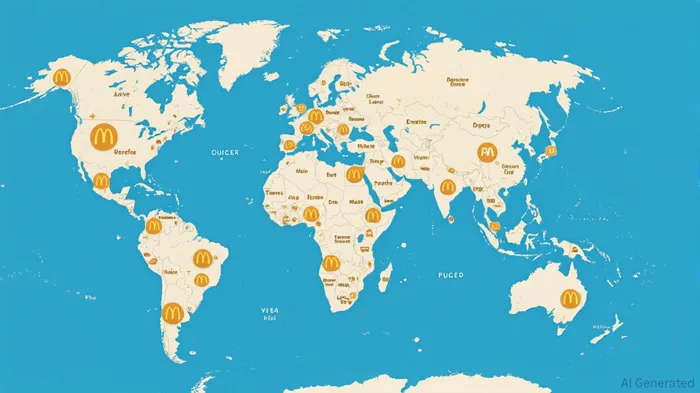
McDonald's dominance in the quick-service sector has been built on decades of expansion, but the company now faces a paradox: a maturing market with diminishing growth opportunities. While the brand remains a global household name, its ability to scale revenue is constrained by market saturation in key regions. For instance, North America—a core market—accounts for over 30% of its revenue but has seen slowing same-store sales growth in recent years[1].
Competitive pressures are intensifying as regional players and health-conscious alternatives gain traction. Chains like ChipotleCMG-- and Panera Bread are capitalizing on shifting consumer preferences toward fresh, organic ingredients, while delivery platforms like DoorDashDASH-- and UberUBER-- Eats are reshaping distribution models[2]. These trends highlight a broader challenge: McDonald's must innovate beyond its core menu to retain relevance.
ESG Challenges: The Green Transition's Double-Edged Sword
Environmental, social, and governance (ESG) factors are no longer peripheral concerns for corporations—they are existential. The green transition, a top transformative trend in 2025[2], demands that companies align with decarbonization goals, renewable energy adoption, and sustainable supply chains. For McDonald's, this means navigating a complex web of challenges:
- Supply Chain Decarbonization: The company's reliance on beef and dairy—sectors with high carbon footprints—poses a significant risk. While McDonald's has pledged to source 100% of its coffee, palm oil, and fish sustainably by 2025, scaling similar commitments across its entire supply chain will require substantial investment.
- Labor and Social Equity: The fast-food industry faces scrutiny over labor practices, including minimum wage disputes and employee turnover. As global employers prioritize roles in renewable energy and electric vehicle technologies[2], McDonald's must balance cost efficiency with workforce retention strategies.
- Consumer Sentiment: A 2025 survey by the World Economic Forum found that 68% of consumers prefer brands with transparent ESG practices. Failure to meet these expectations could erode brand loyalty, particularly among younger demographics.
Geopolitical and Trade Policy Risks
The global landscape in 2025 is marked by trade fragmentation and economic nationalism, particularly under policies that prioritize domestic industries[1]. For a multinational brand like McDonald's, this means navigating a patchwork of tariffs, regulatory hurdles, and supply chain disruptions. For example, the U.S.-China trade tensions have forced the company to rethink its sourcing strategies, while the European Union's stringent carbon border tax has increased operational costs in key markets.
Strategic Adjustments: Can McDonald's Adapt?
To sustain profit growth, McDonald's must pivot from a model of geographic expansion to one of operational and strategic innovation. Key opportunities include:
- Technology Integration: Leveraging AI for personalized marketing and optimizing supply chains.
- Menu Diversification: Expanding plant-based options and health-conscious offerings to align with consumer trends.
- ESG Leadership: Positioning itself as a sustainability pioneer by investing in renewable energy for its restaurants and advocating for industry-wide standards.
However, these initiatives require significant capital and carry risks. For instance, over-investment in ESG programs could strain short-term profitability, while underinvestment could alienate stakeholders. The balance between growth and sustainability will define McDonald's trajectory in the coming years.
Conclusion: A Ticking Clock for Value
McDonald's remains a formidable player, but its ability to maintain value hinges on addressing three critical questions:
1. Can it innovate in a saturated market without diluting its brand?
2. Will its ESG commitments keep pace with global expectations?
3. How will it navigate geopolitical risks in an era of trade fragmentation?
For investors, the answer lies in the company's agility. If McDonald's can transform its operational model to embrace sustainability and technological disruption, it may yet retain its place at the top of the fast-food hierarchy. But in a maturing market, complacency is no longer an option.





Comentarios
Aún no hay comentarios