
Mccormick's Dividend Delicacy: Sustaining Returns in a Volatile Kitchen
As McCormick & CompanyMKC-- declared its 101st consecutive quarterly dividend on June 24, 2025, investors are left to ponder a critical question: Can the spice giant continue its storied dividend tradition amid simmering financial pressures? With a payout ratio now above industry norms and earnings growth under strain, the answer hinges on balancing shareholder returns with operational resilience.
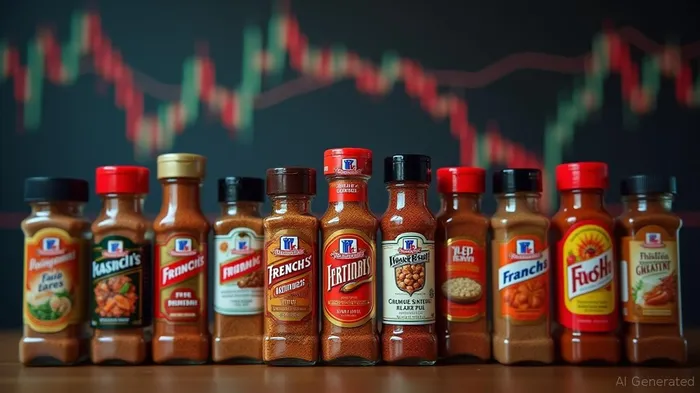
The Dividend's Flavor Profile: A 7% Raise Amid Rising Costs
McCormick's latest dividend increase—$0.45 per share, a 7% hike from 2024—marks its 39th consecutive annual boost, underscoring its reputation as a dividend stalwart. The annualized yield of 2.33% may not set records, but it offers steady income in a volatile market. However, the sustainability of this payout is now under scrutiny.
The key metric is the dividend payout ratio, which surged to 75% in Q2 2025 (calculated using EPS of $0.60). While this reflects McCormick's commitment to shareholders, it's a stark contrast to its historical median of 46% and the industry median of 42%. A payout ratio above 70% leaves little room for reinvestment or earnings shocks.
The Bitter Aftertaste: Earnings Volatility and Margin Pressures
McCormick's Q2 2025 results highlight the challenges. Analysts project EPS of $0.65—a 5.8% decline from 2024—as cost inflation, rising SG&A expenses, and weaker foodservice demand bite. Revenue is expected to grow just 1.2% to $1.7 billion, with margin compression squeezing profitability.
The company's trailing twelve-month net income of $785 million masks a concerning trend: Q1 2025 EPS of $0.60 missed estimates by 6.25%, and the Zacks Rank #4 (Sell) signals skepticism. Even as McCormickMKC.V-- invests in innovation and operational efficiency—like its Comprehensive Continuous Improvement (CCI) program—the math is clear: lower margins = less room to sustain dividends.
Total Return Potential: Dividends vs. Stock Performance
Investors seeking total returns must weigh McCormick's dividend yield against its stock's volatility. While the 2.33% yield is attractive for income seekers, the stock has underperformed the S&P 500 in recent quarters, reflecting broader concerns about consumer goods valuations.
Comparisons to peers like Clorox (CLX) and Kimberly-Clark (KMB)—which boast similar dividend yields but stronger earnings momentum—suggest McCormick's stock may lag unless it resolves cost issues. The payout ratio's rise also raises a red flag: a dividend Aristocrat's reputation is only as strong as its ability to grow earnings.
The Recipe for Sustainability: Ingredients and Risks
Strengths:
- Brand Power: McCormick's iconic brands dominate global spice and seasoning markets, offering pricing power.
- Dividend Track Record: 101 years of consistent payouts signal disciplined capital allocation.
- Strategic Initiatives: The pending Sauer acquisition and ESG commitments aim to drive long-term growth.
Risks:
- Input Costs: Soaring agricultural commodity prices and currency headwinds (notably the strong U.S. dollar) squeeze margins.
- Volume Declines: Weak North American consumer demand, particularly in retail, contrasts with modest growth in Asia.
- Payout Ratio: A 75% ratio leaves little margin for error if earnings stall further.
The Bottom Line: A Cautionary Hold
McCormick remains a compelling income play for conservative investors, but its dividend sustainability now depends on execution. The stock is a hold for those seeking stability, but buyers should proceed with caution.
Investment Advice:
- Hold: For income investors who prioritize consistency over growth. Monitor the Q2 2025 earnings report for signs of margin recovery.
- Avoid: If you seek aggressive growth; McCormick's valuation (20.5x P/E vs. 19.3x five-year average) may not justify the risk of stagnant earnings.
The kitchen metaphor holds: McCormick's dividend is a well-seasoned dish, but the recipe must adapt to avoid burning. Investors should keep an eye on cost controls, volume trends, and the payout ratio's trajectory. In a volatile market, patience—and a pinch of skepticism—may be the best spices to apply.







Comentarios
Aún no hay comentarios