
Mazda's Strategic Shift and Market Challenges: Navigating Supply Chains and Electrification in a Post-USMCA Era
The automotive industry is undergoing a seismic transformation, driven by trade policy shifts, electrification mandates, and evolving consumer preferences. For Mazda, a mid-sized automaker historically reliant on imported vehicles, the post-USMCA (United States-Mexico-Canada Agreement) landscape has forced a strategic recalibration. As U.S. tariffs on non-compliant imports and global electrification pressures converge, Mazda's pivot to localized production, crossovers, and a multi-solution electrification strategy offers both promise and peril for investors.
Supply Chain Adaptation: Localizing Production to Mitigate Tariff Risks
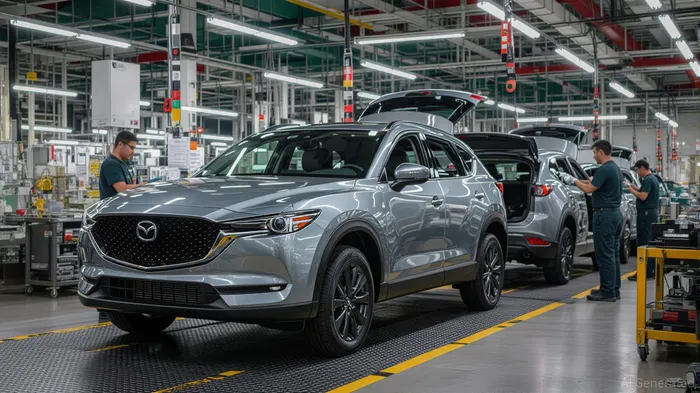
Mazda's U.S. operations have long been vulnerable to trade policy shocks. With 81% of its U.S. sales previously sourced from Japan and Mexico, the 25% tariffs on non-USMCA-compliant imports in 2025 posed an existential threat. The company's response? A bold shift to localized production. By 2025, Mazda had partnered with ToyotaTM-- in a joint venture to produce the CX-50 crossover at a plant in Alabama. This move not only reduces exposure to tariffs but also aligns with the global trend toward crossovers and SUVs, which now account for over 50% of global sales.
The Alabama plant exemplifies Mazda's “Lean Asset Strategy,” which prioritizes cost efficiency through shared production lines and cross-product flexibility. By co-producing with Toyota, Mazda avoids the capital-intensive burden of standalone EV or ICE facilities. This approach cuts initial capital investment by 85% and preparation time by 80% compared to building new plants. However, the transition is not without risks. Mazda's Salamanca, Mexico, plant has seen a 28.5% decline in exports during 1H25 due to tariff pressures, forcing the company to explore slower-growth markets like Argentina and Brazil. These markets, while less immediately profitable, could diversify revenue streams but require careful financial planning.
Electrification Strategy: A Multi-Solution Approach in a Polarized Market
Mazda's electrification strategy diverges from the all-in EV bets of competitors like Hyundai and HondaHMC--. Instead, it embraces a “multi-solution” model, balancing internal combustion engines (ICEs), hybrids, plug-in hybrids (PHEVs), and battery electric vehicles (BEVs). This approach allows Mazda to adapt to regional demand and regulatory environments without overcommitting to a single technology.
The SKYACTIV-Z engine, set to debut in the 2027 CX-5, epitomizes this strategy. Combining high fuel efficiency with driving dynamics, it meets stringent emissions standards like Euro 7 and LEV4 while preserving Mazda's signature “Jinba Ittai” (horse and rider as one) driving experience. Meanwhile, the company's first in-house BEV, built on a flexible platform developed with Panasonic Energy, is slated for 2027. This platform supports future battery innovations and extended range, addressing consumer concerns about EV range and performance.
Mazda's cost-sharing partnerships with Toyota and DENSO have been critical. These collaborations reduced battery costs by 85% through shared production lines and enabled the “Lean Asset Strategy.” By leveraging existing manufacturing assets, Mazda can produce ICE and EV models on the same lines, a flexibility that rivals like Toyota and Hyundai lack. However, this cautious approach risks falling behind in the EV race. While Toyota and Hyundai aim for 50% EV sales by 2030, Mazda's 2030 target includes only five hybrid models and 13 electrified models—a slower trajectory that may struggle to meet U.S. and European emissions mandates.
Financial Resilience and Long-Term Investment Potential
Despite these challenges, Mazda's financials remain robust. As of fiscal 2025, the company reported a positive operating profit of ¥186.1 billion (€1.1 billion) and net income of ¥114.1 billion (€697 million), with strong cash reserves of ¥400.3 billion (€2.4 billion). These figures suggest resilience in the face of trade policy uncertainty and electrification costs. However, the U.S. market remains a wildcard. Mazda revised its U.S. operating profit forecast for fiscal 2026 to ¥50 billion—a sharp decline from prior projections—due to tariffs and competitive pressures from TeslaTSLA-- and Chinese EV startups.
For investors, Mazda's long-term potential hinges on its ability to balance innovation with fiscal prudence. The company's “Mazda Monozukuri Innovation 2.0” initiative, which triples development productivity and reduces investment by 40%, positions it to compete in a cost-conscious market. Additionally, its partnerships with Toyota and Panasonic Energy mitigate supply chain risks and accelerate R&D. Yet, the U.S. market's volatility and the global shift toward EVs pose significant challenges.
Conclusion: A Calculated Gambit in a Shifting Landscape
Mazda's strategic shift reflects a nuanced response to industry pressures. By localizing production, embracing a multi-solution electrification approach, and leveraging partnerships, the company is navigating the post-USMCA era with agility. However, its slower EV adoption and U.S. market exposure could hinder growth in the long term. For investors, Mazda represents a high-conviction opportunity: a company that prioritizes brand identity and cost efficiency while adapting to a rapidly evolving industry.
The key question is whether Mazda's balanced strategy can outperform the aggressive EV bets of its rivals. If the company can maintain its driving experience while scaling electrification, it may carve out a unique niche. But in a market increasingly dominated by pure EV players, the margin for error is slim. For now, Mazda's resilience and innovation suggest a compelling, albeit cautious, investment case.





Comentarios
Aún no hay comentarios