
Maximizing Yield in 2026: A Deep Dive into High-Yield Savings Accounts
In 2026, the financial landscape remains shaped by the Federal Reserve's gradual rate-cutting cycle, which began in late 2025. For savers prioritizing liquidity and wealth preservation, high-yield savings accounts (HYSAs) continue to offer compelling returns, even as rates trend downward. With top-tier HYSAs yielding up to 5.00% APY as of January 2026-far exceeding the national average of 0.39%-these accounts remain a cornerstone of short-term financial strategies. However, as experts anticipate a decline in savings yields to around 3.8% APY by year-end, strategic allocation across complementary instruments like certificates of deposit (CDs) and money market funds becomes critical to optimize returns while maintaining flexibility.
Rate Trends and Projections: A Window of Opportunity
The Federal Reserve's three consecutive quarter-point rate cuts in late 2025 have set the stage for a softening of savings yields in 2026. Despite this, HYSAs are expected to retain a significant edge over traditional savings accounts, which average 0.46% APY. For instance, daily compounding-a feature offered by many top HYSAs-can boost annual returns by 0.13 percentage points compared to annual compounding, amplifying the value of these accounts. 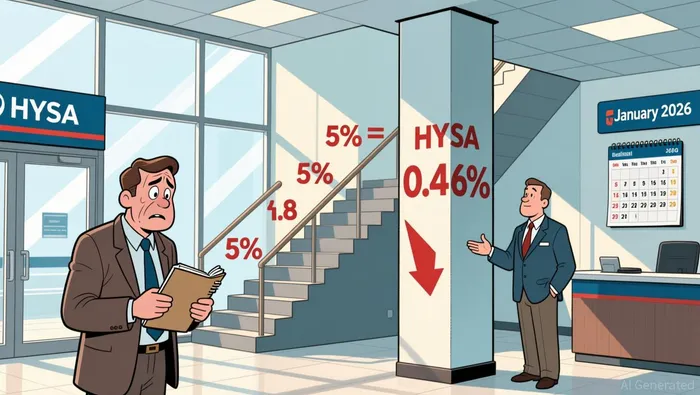 . By year-end 2026, while HYSA rates may dip to 3.8% APY, they are projected to still outpace inflation, making them a robust tool for preserving purchasing power.
Strategic Allocation: Balancing Liquidity and Yield
To maximize returns in a shifting rate environment, savers must diversify across instruments that align with their liquidity needs and risk tolerance. A hybrid approach combining HYSAs, CDs, and money market funds offers a balanced solution:
- High-Yield Savings Accounts: These remain ideal for emergency funds and short-term goals requiring immediate access. Experts recommend automating transfers to HYSAs to maintain a reserve covering six months of expenses.
- Certificates of Deposit (CDs): For disciplined savers, CDs provide a way to lock in favorable rates for specific terms. A CD ladder strategy-spreading funds across CDs with staggered maturity dates-mitigates reinvestment risk and ensures a steady stream of liquidity. For example, a saver might allocate 30% of their cash to a 12-month CD, 30% to an 18-month CD, and 40% to a 24-month CD, allowing for periodic access to funds without sacrificing yield.
- Money Market Funds: These instruments offer flexibility and competitive yields, with many providing check-writing capabilities and daily liquidity. As interest rates decline, money market funds adjust quickly to reflect new conditions, making them a dynamic option for preserving capital while earning modest returns.
Expert Strategies and : A Blueprint for Success
High-income individuals, in particular, can benefit from aggressive allocation strategies. A recommended framework suggests allocating 40% of income to needs, 25% to wants, and 35% to savings and investments, with a focus on maximizing HYSA contributions. For instance, a saver with $100,000 in annual income might allocate $35,000 to a diversified portfolio of HYSAs, CDs, and money market funds. By splitting this amount into 40% HYSAs, 30% CDs, and 30% money market funds, they balance immediate liquidity with the potential for higher returns.
Case studies further illustrate the efficacy of this approach. One example involves a family using a CD ladder to fund a child's wedding in 2027. By locking in current rates across CDs with staggered maturities, they secure predictable returns while avoiding the risk of rate declines. Meanwhile, another investor combines HYSAs with short-term bond ETFs like the Vanguard 0-3 Month Treasury Bill ETF (VBIL) to meet liquidity needs while earning indexed returns.
Conclusion: Navigating 2026 with Confidence
As 2026 unfolds, the key to maximizing yield lies in proactive diversification and adaptability. While HYSAs remain a pillar of short-term financial planning, integrating them with CDs and money market funds creates a resilient portfolio capable of weathering rate fluctuations. Savers should prioritize compounding frequency, automate contributions, and explore tools like CD ladders to optimize returns. By staying informed and agile, investors can harness the current rate environment to build a foundation of liquidity and wealth preservation that endures beyond 2026.







Comentarios
Aún no hay comentarios