
The Maturing Crypto Ecosystem: Why VCs Are Prioritizing Predictable Revenue Models Over Speculation
The crypto ecosystem is undergoing a profound transformation. Venture capital firms, once drawn to speculative tokens and unproven protocols, are now channeling capital into projects with clear revenue streams, institutional-grade infrastructure, and regulatory compliance. This shift reflects a broader maturation of the market, where institutional adoption and yield-driven infrastructure—particularly in stablecoins, tokenized real-world assets (RWA), and Ethereum-based DeFi platforms—are reshaping investment priorities [1].
Stablecoins: The Bedrock of Institutional Adoption
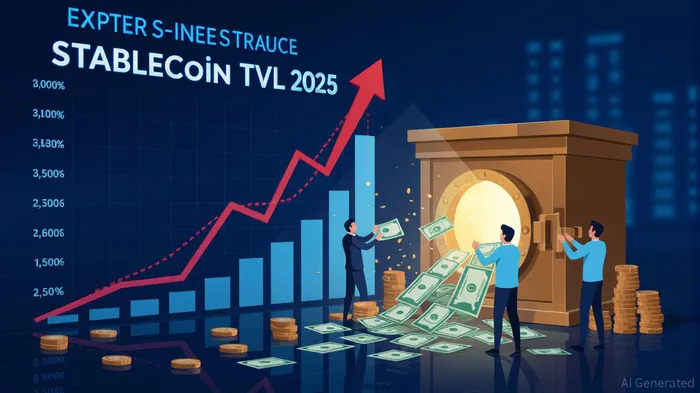
Stablecoins like USDCUSDC-- and USDTUSDC-- have emerged as linchpins of institutional adoption, offering predictable yields and liquidity in a volatile market. With combined total value locked (TVL) exceeding $150 billion in Q2 2025, these assets are critical for cross-border payments, treasury management, and DeFi yield strategies [3]. Their appeal lies in their ability to bridge traditional finance and crypto, enabling institutions to hedge risk while accessing blockchain-based returns.
Regulatory clarity has further accelerated this trend. The U.S. CLARITY Act’s reclassification of EthereumETH-- as a utility token and the EU’s MiCA framework have provided a legal foundation for stablecoin platforms to scale [3]. This has spurred public market interest, with companies like Circle leveraging stablecoin revenue to secure IPOs and expand operations [5].
Tokenized Real-World Assets: Scaling Revenue Through Fee-Driven Models
Tokenized RWA platforms are another focal point for venture capital. By digitizing real estate, commodities, and corporate debt, these platforms generate recurring fees through asset management and fractional ownership. Securitize, for instance, raised $400 million in Q2 2025 to expand its RWA infrastructure, underscoring investor confidence in scalable, revenue-driven models [5].
The institutional appeal of RWA lies in its ability to diversify portfolios while complying with existing financial regulations. Unlike speculative tokens, tokenized assets offer tangible collateral and audit trails, aligning with the risk-averse preferences of pension funds and sovereign wealth funds.
Ethereum-Based DeFi: Utility Tokens and Staking Yields
Ethereum remains the backbone of institutional-grade DeFi, with protocols offering staking yields, lending markets, and governance mechanisms that generate consistent returns. The reclassification of Ethereum as a utility token under the CLARITY Act has reduced regulatory ambiguity, enabling institutional investors to allocate capital without fear of securities law violations [2].
In Q2 2025, Ethereum-based DeFi platforms accounted for 30% of institutional crypto allocations, driven by their ability to deliver annualized yields of 4-8% through staking and liquidity provision [3]. This shift is further supported by the rise of institutional custodians like BitGo, which now offer Ethereum staking services with insurance and compliance frameworks [5].
The Road Ahead: Regulatory Clarity and Public Market Access
The maturing crypto ecosystem is not without challenges. Regulatory frameworks must continue evolving to accommodate innovation while protecting investors. However, the current trajectory—toward stable, yield-driven infrastructure—suggests that crypto is becoming a legitimate asset class for institutional capital.
As venture capital firms double down on projects with proven revenue models, the focus will remain on scalability, compliance, and long-term value creation. For investors, this means prioritizing platforms that align with institutional needs: stablecoins for liquidity, RWA for diversification, and Ethereum-based DeFi for yield.
Source:
[1]
Venture capital game has changed due to market maturation
[2]
The Shift in Venture Capital Priorities in Crypto
[3]
Crypto and Blockchain Venture Capital – Q2 2025
[4]
State of Venture Capital in Crypto, Q2 2025







Comentarios
Aún no hay comentarios