
The Maturing Bitcoin Market: Chop as Catalyst for Long-Term Value
The BitcoinBTC-- market of 2025 is no longer a nascent experiment but a maturing asset class shaped by institutional forces and evolving structural dynamics. While recent volatility and liquidity shifts have introduced short-term turbulence, these developments are not signs of fragility but rather a recalibration toward long-term equilibrium. Institutional liquidity participation, structural distribution patterns, and the interplay between ETF-driven demand and on-chain behavior are now central to understanding Bitcoin's trajectory.
Institutional Liquidity: From Surge to Stabilization
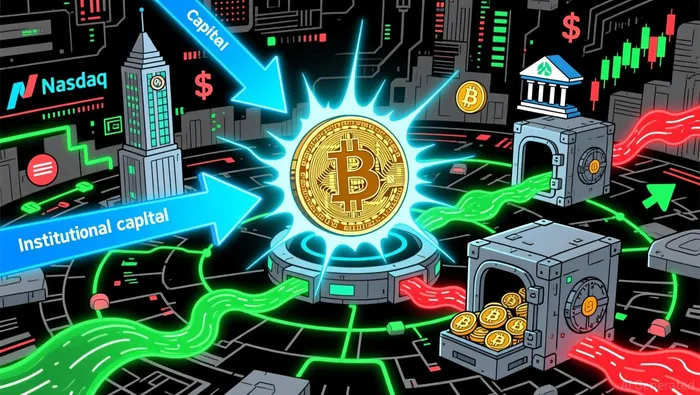
The launch of Bitcoin ETFs in early 2024 catalyzed a historic influx of institutional capital, with net inflows exceeding $54.75 billion into spot ETFs by mid-2025. However, 2025 has seen a moderation in these flows, marked by $3.5 billion in redemptions from Bitcoin ETFs in November alone. This pause in institutional accumulation reflects a broader liquidity reset, as stablecoin market capitalization contracted by $4.6 billion since November 1, 2025, and centralized exchange spot volume averaged less than $25 billion daily-a 40% decline from early October.
Despite these outflows, institutional adoption remains robust. Institutions now hold 31% of known Bitcoin, with ETFs serving as a critical on-ramp for retail investors, who account for 80% of the ETF investor base. The moderation in liquidity is not a retreat but a maturation: institutions are increasingly treating Bitcoin as a core asset class, prioritizing long-term allocation over speculative trading.
Structural Distribution: A Redistribution of Power
On-chain activity reveals a striking bifurcation in Bitcoin's distribution. Mid-tier "whales" holding at least 100 BTC have been accumulating during the drawdown, while large holders with over 1,000 BTC have reduced exposure. This redistribution mirrors historical patterns preceding prolonged base formations, where control shifts from short-term speculators to long-term custodians.
The ETF-driven increase in institutional liquidity has also altered Bitcoin's correlation with traditional assets. Its correlation with the Nasdaq has risen above 0.72, signaling deeper integration into global financial markets. This shift underscores Bitcoin's evolving role as a hedge and diversifier, rather than a standalone speculative vehicle.
Market Mechanics: Volatility, Arbitrage, and Efficiency
Bitcoin's volatility has dropped significantly post-ETF era, averaging 1.8% daily compared to pre-ETF levels of 4.2%. This stability has reduced arbitrage opportunities in low-volatility environments, though spreads can widen to 0.25–0.50% during periods of high volatility, offering opportunities for sophisticated traders. The reduced volatility also reflects improved market efficiency, as institutions and market makers adapt their strategies to a more mature ecosystem.
Outlook: Chop as a Catalyst
The current liquidity reset and structural redistribution are not obstacles but prerequisites for long-term value creation. Market participants are now watching for two key signals: stabilization in ETF flows and sustained spot demand above $84,000, which could indicate a recovery phase. The maturing Bitcoin market is learning to navigate institutional pressures and structural shifts, with chop serving as a catalyst for deeper institutional integration and more resilient price discovery.
As Bitcoin's correlation with traditional assets strengthens and on-chain dynamics align with historical base formations, the stage is set for a new phase of growth. The challenges of 2025 are not endpoints but milestones in the journey toward a fully realized digital asset class.






Comentarios
Aún no hay comentarios