
Matson (MATX): A Defensive Play in a Volatile Shipping Market
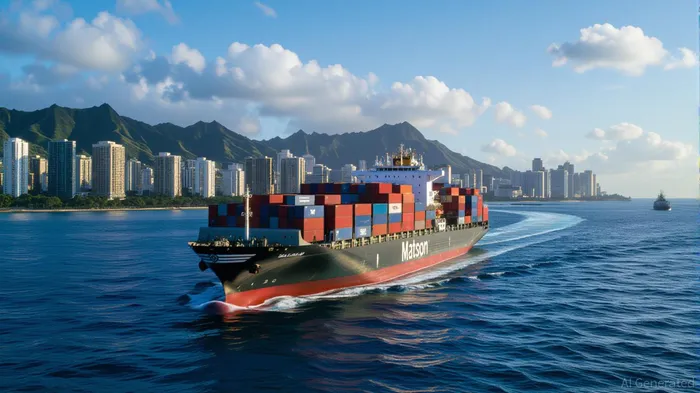
The shipping industry in 2025 remains a stormy sea, battered by geopolitical tensions, supply chain disruptions, and unpredictable trade policies. Yet, MatsonMATX-- Inc. (MATX) has emerged not just as a survivor but as a standout performer, leveraging its strategic positioning and operational discipline to outshine speculative peers. For investors seeking stability in a high-volatility sector, Matson offers a compelling case as a defensive growth opportunity.
Financial Resilience: A Fortress Balance Sheet
Matson's Q2 2025 earnings report was nothing short of remarkable. The company delivered $2.92 in earnings per share (EPS), a 47% beat over estimates, and $830.5 million in revenue, surpassing forecasts by 10.4%. This outperformance came despite a 14.6% year-over-year decline in China container volume, a critical trade lane for the company.
The secret to Matson's resilience lies in its disciplined capital structure. As of Q2 2025, the company's debt-to-EBITDA ratio stands at 1.2x, one of the lowest in the industry. Total debt has fallen to $381 million, while cash reserves and cash flow from operations have remained robust. Matson's P/E ratio of 6.94 (as of August 1, 2025) reflects a valuation that is both attractive and conservative, especially compared to speculative peers like DHT HoldingsDHT-- (DHT) at 10.35x earnings or Ardmore ShippingASC-- (ASC) at 4.17x earnings.
Operational Strengths: Speed, Reliability, and Strategic Adaptability
Matson's core advantage lies in its differentiated service model. While global carriers grapple with delays and tariff uncertainties, Matson has built a reputation for fast, reliable Transpacific services, particularly in the Hawaii-Alaska-Guam corridor. The company controls 80% of the Hawaii container market and 70% in Guam, creating a near-monopoly in these high-traffic domestic routes.
In Q2 2025, Matson capitalized on the temporary U.S.-China tariff reduction in May 2025, which spurred a rebound in demand. The company also expanded its transshipment capabilities in Vietnam, redirecting 21% of China service volume through Ho Chi Minh City. This “catchment basin” strategy not only mitigates exposure to U.S.-China trade tensions but also taps into Southeast Asia's booming manufacturing and e-commerce sectors.
Meanwhile, the SSAT joint venture (a 35% stake in San Pedro Stack Terminal) contributed $7.3 million in Q2 2025, a $6.1 million year-over-year increase. This asset, coupled with the company's $305 million investment in new vessel construction in 2025, underscores Matson's commitment to long-term infrastructure.
Defensive Positioning: Outperforming Speculative Peers
In a sector where leverage and volatility are the norm, Matson's low-risk profile sets it apart. Competitors like Horizon Lines and Pasha Hawaii lack the scale and liquidity to compete in Hawaii's premium lanes. Meanwhile, global giants such as COSCO and Maersk face geopolitical headwinds and fragmented pricing power.
Speculative peers like StealthGas (GASS) and Ardmore Shipping (ASC) trade at lower P/E multiples but carry higher leverage and geographic concentration risks. Matson's $685.4 million in fixed-rate U.S. Treasuries (held in its Capital Construction Fund) acts as a self-funded rainy-day reserve, reducing reliance on volatile credit markets.
Investment Thesis: A Safer Bet in a Turbulent Sector
Matson's defensive characteristics—a fortress balance sheet, recurring cash flows from stable trade lanes, and strategic adaptability—make it an attractive long-term play. The company has returned $284.4 million to shareholders through dividends and buybacks in the first half of 2025 alone, maintaining its 53-year streak of dividend payments.
While the company anticipates a muted peak season in Q3 2025, it has raised its full-year 2025 outlook, reflecting confidence in its transshipment strategy and domestic momentum. For investors wary of the sector's cyclicality, Matson's P/B ratio of 1.40 suggests the market is undervaluing its premium fleet and route dominance.
Conclusion
In a shipping market defined by uncertainty, Matson has proven its ability to thrive. Its focus on speed, reliability, and shareholder returns, combined with a disciplined capital structure, positions it as a rare defensive asset in an otherwise speculative sector. For those seeking stability without sacrificing growth potential, Matson's current valuation and strategic momentum make it a compelling addition to a diversified portfolio.





Comentarios
Aún no hay comentarios