
Mastering Market Timing in 2026: Navigating Volatility, Liquidity, and Geopolitical Risk
As 2026 unfolds, investors face a complex interplay of central bank policy shifts, liquidity dynamics, and geopolitical tensions. The year promises both opportunities and pitfalls for those who can align their portfolio strategies with the rhythms of global markets. Drawing on insights from Russell Investments, Citi, and JPMorgan, this analysis explores how calendar-based execution-anchored to central bank events, liquidity dips, and geopolitical developments-can reduce implementation costs and enhance risk-adjusted returns.
Central Bank Events: Timing the Policy Cycle
Central banks will remain pivotal in shaping 2026's market environment. J.P. Morgan Global Research forecasts a 35% probability of a U.S. and global recession, with sticky inflation persisting as a key theme. Most developed market central banks are expected to either stay on hold or conclude their easing cycles by mid-2026 according to JPMorgan analysis. This creates a critical window for investors to position portfolios ahead of policy shifts.
Russell Investments has developed an institutional trading calendar to identify days with elevated risk or reduced liquidity, such as those surrounding central bank meetings and monthly inflation data releases according to Russell Investments.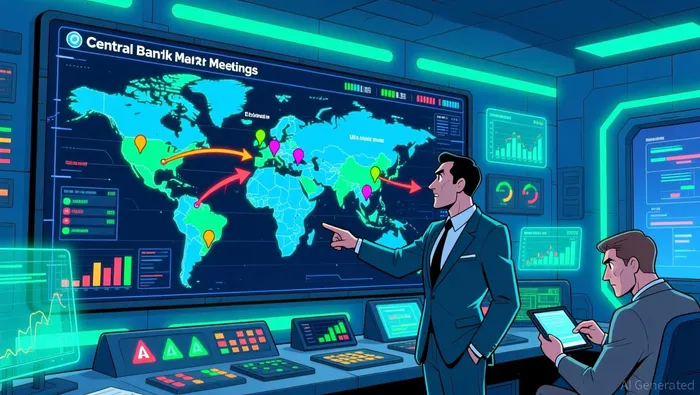 For example, the European Central Bank's March and June 2026 policy decisions, paired with the U.S. Federal Reserve's June and September meetings, could trigger sharp volatility. By avoiding large trades during these periods or using derivatives to hedge exposure, investors can mitigate slippage and execution costs.
Liquidity Dips: Avoiding the "Calendar Traps"
Liquidity dips-often tied to global holidays and quarter-end flows-will amplify market volatility in 2026. Russell Investments highlights periods like the Lunar New Year, Ramadan, and Japan's Golden Week as times when liquidity thins, increasing transaction costs for large institutional trades. For instance, the Lunar New Year in late January/early February 2026 could see reduced trading activity in Asian markets, while Ramadan (March–April) may dampen Middle Eastern liquidity.
JPMorgan's analysis of U.S.-China trade policy further underscores the need for liquidity-aware strategies. The temporary tariff truce between the two nations-reducing U.S. tariffs on Chinese goods from 42% to 32%-has eased short-term risks but left midsize businesses exposed to $82.3 billion in direct costs according to JPMorgan. These costs are concentrated in trade hubs like Southern California and Texas, where liquidity dips during global holidays could exacerbate execution challenges. Investors should consider pre-funding positions or using limit orders during these periods to avoid slippage.
Geopolitical Risks: Navigating U.S.-China Trade Dynamics
Geopolitical tensions, particularly U.S.-China trade policy, will remain a wildcard in 2026. JPMorgan notes that while a "hard decoupling" remains unlikely, strategic competition could lead to tit-for-tat tariff escalations. The resilience of China's export sector-bolstered by a depreciated yuan and transshipment through third-party countries-suggests that trade disruptions may be less severe than feared according to JPMorgan analysis. However, investors must remain vigilant.
Citi's "Goldilocks" outlook-a mix of robust global growth and stable inflation-highlights the importance of diversification according to Citi. The firm recommends overweighting China's AI value chain, financials, and base metals to capitalize on structural trends while hedging with gilts and credit underweights according to Citi. This approach balances exposure to high-growth sectors with defensive positions to cushion against geopolitical shocks.
Strategic Portfolio Execution: A Synthesis
To master market timing in 2026, investors must synthesize these insights into a cohesive strategy:
1. Calendar-Based Positioning: Align large trades with Russell Investments' liquidity calendar, avoiding high-volatility periods around central bank meetings and global holidays.
2. Geopolitical Hedging: Diversify into sectors like China's AI value chain (Citi) and quality bonds (JPMorgan) to balance growth and risk according to Citi.
3. Tariff-Resilient Supply Chains: For firms exposed to U.S.-China trade costs, JPMorgan advises evaluating supply chain diversification and pre-funding inventory to mitigate tariff-driven price shocks.
Conclusion
2026 will test investors' ability to navigate a fragmented global landscape. By leveraging calendar-based strategies-rooted in central bank timelines, liquidity patterns, and geopolitical foresight-portfolios can reduce costs, avoid volatility, and capitalize on dislocations. As Russell Investments, Citi, and JPMorgan collectively emphasize, success lies not in predicting the future but in preparing for its rhythms.





Comentarios
Aún no hay comentarios