
Mastering Crypto Volatility: Strategic Rebalancing and Hedging in a Post-Crash Era
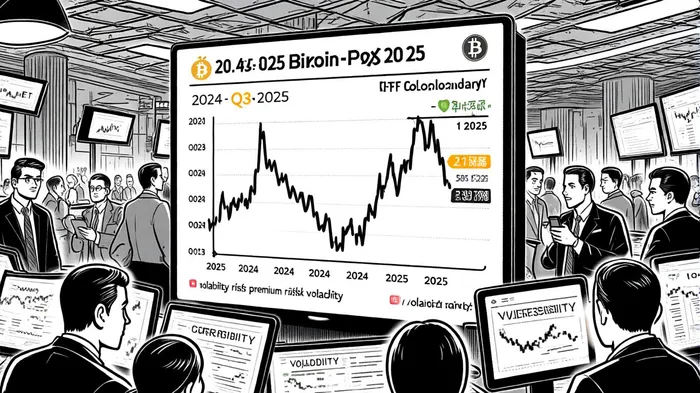
The cryptocurrency market in 2025 remains a high-stakes arena, where volatility is both a threat and an opportunity. After the 2024 crash and subsequent institutional-driven rebound, investors must adopt disciplined strategies to navigate the post-crash landscape. This article dissects the evolving volatility dynamics and outlines actionable approaches for rebalancing and hedging in a market shaped by macroeconomic uncertainty, regulatory shifts, and institutional innovation.
Market Context: A Tale of Two Volatilities
The 2024 crypto market was defined by a paradox: low volatility in early 2024 due to lingering FTX trauma, followed by a sharp rebound as BitcoinBTC-- spot ETFs ignited a $3.8 trillion market cap by year-end [2]. However, Q3 2025 brought a 17% contraction in total market capitalization, with altcoins bearing the brunt of the correction [3]. Bitcoin stabilized near $108,000, while EthereumETH-- retreated to $2,100–$2,200, reflecting institutional risk-off behavior amid macroeconomic headwinds [4].
Key drivers of this volatility include the U.S. Federal Reserve's soft-landing uncertainty, geopolitical tensions (e.g., Trump-era tariffs), and the maturation of institutional infrastructure. The Strategic Bitcoin Reserve, established with $23 billion in seized assets, has acted as a stabilizing force, but liquidity remains fragile in altcoin markets [4]. Meanwhile, the correlation between Bitcoin and traditional assets like the S&P 500 has diverged, turning negative in 2025 as crypto's unique risk profile emerged [1].
Strategic Rebalancing: Beyond Dollar-Cost Averaging
In a post-crash environment, rigid dollar-cost averaging (DCA) strategies are insufficient. Instead, investors must adopt dynamic rebalancing to align with shifting risk profiles. For example, long-term holders of Bitcoin and Ethereum should consider:
1. Portfolio Weight Adjustments: Reduce exposure to overleveraged altcoins and increase allocations to blue-chip assets with stronger fundamentals.
2. Time-Weighted Rebalancing: Use volatility metrics like the DVOL Index to trigger rebalances when implied volatility exceeds historical thresholds [2].
3. Tokenized Asset Diversification: Allocate to tokenized real-world assets (RWAs) and blockchain-based real estate to mitigate crypto-specific risks [5].
Institutional players have pioneered delta-neutral strategies, balancing long spot positions with short perpetual futures to hedge directional risk while capturing funding rate arbitrage [1]. For instance, a $10 million Bitcoin spot holding paired with short futures can neutralize price exposure while generating yield from perpetual funding rates.
Hedging Techniques: From Options to AI-Driven Models
Hedging in 2025 requires a multi-layered approach. Options and futures remain foundational tools:
- Strategic Options Use: Buying out-of-the-money (OTM) puts during high implied volatility periods (e.g., pre-Election Day) can cap downside risk without sacrificing upside potential [3].
- Futures Basis Trading: Exploit the basis trade between ETFs and CME futures to lock in risk-free returns, as seen in early 2024 [2].
However, the rise of AI-driven hedging is reshaping the landscape. Over 50% of crypto hedge funds now employ machine learning to optimize volatility surfaces and predict liquidity crunches [4]. For example, AI models analyzing on-chain data (e.g., exchange inflows, wallet activity) can detect early signs of volatility spikes, enabling proactive hedging [6].
Risk Management: The Volatility Premium and On-Chain Signals
Understanding the volatility risk premium (VRP) is critical. A positive VRP (implied > realized volatility) signals a risk-averse market, while a negative VRP suggests panic is already priced in [2]. In Q3 2025, Bitcoin's VRP turned negative in March as the market digested Trump-era tariffs, offering a warning of impending corrections [3].
On-chain analytics further enhance risk management. Platforms like OREOME track metrics such as exchange inflows and wallet concentration to predict volatility clusters [6]. For instance, a surge in stablecoin inflows to centralized exchanges often precedes liquidity-driven sell-offs, as observed in July 2025 [4].
Conclusion: Navigating the New Normal
The 2025 crypto market is a hybrid of traditional and novel risks. While volatility remains a defining feature, strategic rebalancing and advanced hedging tools offer pathways to stability. Investors must embrace a multi-asset, multi-strategy approach, leveraging both derivatives and AI-driven analytics to thrive in this environment.
As the market evolves, the key takeaway is clear: volatility is not the enemy—it is the terrain. Those who master it will outperform.







Comentarios
Aún no hay comentarios