
Mastercard's Strategic Shift: Aligning Sustainability and Financial Inclusion with Ethical Finance Demand
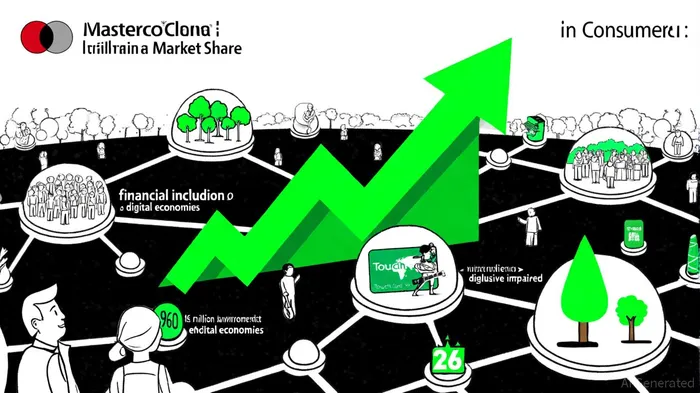
The rise of ethical finance has reshaped consumer expectations, compelling corporations to align their strategies with sustainability and inclusion. MastercardMA--, a global payments leader, has emerged as a pivotal player in this transformation. By embedding environmental, social, and governance (ESG) principles into its core operations, Mastercard is not only responding to shifting consumer demand but actively driving it. This analysis explores how Mastercard's strategic initiatives in sustainability and financial inclusion reflect and amplify the growing appetite for ethical finance, positioning the company as a forward-thinking investment opportunity.
Financial Inclusion: Bridging the Digital Divide
Mastercard's financial inclusion efforts directly address the demand for equitable access to economic tools. By 2024, the company had connected 960 million people and 65 million micro, small, and medium enterprises (MSMEs) to the digital economy since 2015, surpassing its 2025 target of 1 billion individuals and 50 million businesses [3]. Platforms like Community Pass have enrolled over 7 million users in underserved regions, enabling access to essential services such as agricultural markets and digital identification [3]. For instance, smallholder farmers in Kenya and Uganda now use the platform to track transactions, build credit histories, and secure fair compensation for their crops.
This aligns with consumer trends: 89% of global consumers have altered shopping habits to prioritize eco-friendly and ethical brands, with 80% willing to pay a premium for sustainable products [4]. By democratizing access to digital finance, Mastercard is fostering trust among consumers who value inclusivity and economic empowerment.
Environmental Sustainability: Decoupling Growth from Emissions
Mastercard's environmental initiatives demonstrate its ability to reconcile profitability with planetary responsibility. The company reduced combined Scope 1, 2, and 3 emissions by 46% since 2016 while achieving a 13% revenue growth in 2023 [3]. It is on track to achieve net-zero emissions by 2040 and has already transitioned 100% of its operations to renewable energy [3]. The Priceless Planet Coalition, which has planted 26 million trees in reforestation projects across Kenya, Brazil, and Vietnam, further underscores its commitment to ecological restoration [3].
These efforts resonate with a consumer base increasingly prioritizing sustainability. For example, 79% of Gen Z consumers consider sustainability when choosing brands [4], and 78% seek businesses that align with their green values [4]. Mastercard's emission reductions and reforestation programs not only mitigate climate risks but also enhance brand loyalty among eco-conscious consumers.
Inclusive Design: Meeting Diverse Consumer Needs
Mastercard's innovation in inclusive design reflects its understanding of evolving consumer demographics. Products like the Touch Card (for the visually impaired) and the True Name card (for transgender and non-binary individuals) ensure that digital financial tools are accessible and respectful to all users [3]. These initiatives align with the 61% of small businesses supported by Mastercard that are women-owned [3], highlighting the company's focus on marginalized groups.
Such efforts are critical in a market where 78% of consumers globally prioritize businesses that reflect their values [4]. By addressing underrepresented communities, Mastercard is not only expanding its customer base but also fostering long-term loyalty in a competitive payments landscape.
Market Impact and Investment Implications
Mastercard's strategic alignment with ethical finance trends is translating into tangible market advantages. Its $10.6 billion investment in cybersecurity over five years has prevented $47.9 billion in fraud, reinforcing trust in its digital ecosystem [3]. Meanwhile, its ESG performance has attracted investors prioritizing sustainable portfolios. For example, Mastercard's inclusion in ESG-focused indices like the MSCI ESG Leaders Index has driven inflows from impact-driven capital.
From an investment perspective, Mastercard's ability to decouple emissions from revenue growth (1% reduction in emissions with 13% revenue growth in 2023 [3]) signals operational resilience. As regulatory pressures for ESG compliance intensify, companies like Mastercard that proactively integrate sustainability into their models are likely to outperform peers.
Conclusion
Mastercard's strategic shift toward sustainability and financial inclusion is a masterclass in aligning corporate goals with consumer demand. By connecting underserved populations to digital economies, reducing its environmental footprint, and innovating for inclusivity, Mastercard is not only meeting the expectations of ethical consumers but also setting industry benchmarks. For investors, this positions Mastercard as a resilient, forward-looking asset in an era where ESG criteria are no longer optional but essential.





Comentarios
Aún no hay comentarios