
Mastercard's Agentic Commerce Revolution: Redefining Fintech Innovation and Security in 2025
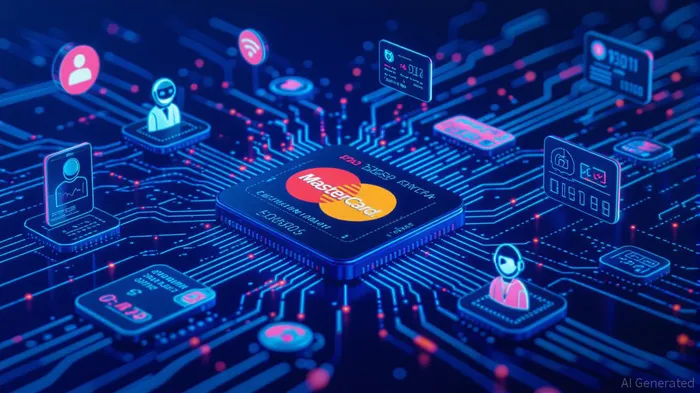
Mastercard's strategic pivot toward agentic commerce in 2025 marks a pivotal moment in the evolution of fintech innovation and digital security. By integrating conversational AI, tokenization, and AI governance frameworks, the company is not only redefining how transactions occur but also addressing the inherent risks of an increasingly autonomous digital economy. For investors, this transformation presents a compelling case for long-term value creation, underpinned by Mastercard's ability to balance technological disruption with robust security measures.
Agent Pay: The Dawn of Conversational Commerce
At the heart of Mastercard's agentic commerce strategy is Agent Pay, a groundbreaking technology that leverages conversational AI to enable autonomous payments via messaging platforms and contact centers[4]. This innovation allows consumers to delegate transactional tasks to AI agents, streamlining processes such as bill payments, subscription management, and even real-time price negotiations. According to a report by PYMNTS, Agent Pay's deployment aligns with Mastercard's broader vision to act as an “interoperability layer” across diverse payment rails, accommodating any currency, identity, or transaction type[4]. For fintechs and retailers, this means reduced friction in customer interactions and expanded access to underbanked markets.
However, the rise of autonomous agents introduces new security challenges. To mitigate risks, MastercardMA-- has introduced Agentic Tokens, an extension of its existing tokenization infrastructure. These tokens authenticate AI agents during transactions, ensuring they are flagged as legitimate extensions of consumer intent[3]. This innovation addresses a critical vulnerability in agentic commerce: the potential for malicious actors to impersonate users or exploit AI-driven workflows. By embedding authentication at the transaction layer, Mastercard is setting a precedent for secure AI-mediated commerce.
Strengthening the Ecosystem: Start Path and Cybersecurity Investments
Mastercard's commitment to security extends beyond its own platforms. The company recently launched the Start Path Security Solutions program, a $10.7 billion initiative since 2018 aimed at accelerating cybersecurity innovation[1]. This program supports startups like OneID (digital identity verification) and Scamnetic (AI-powered scam detection), which are critical to fortifying the agentic commerce ecosystem. Data from Mastercard's 2025 press releases highlights that these partnerships are not merely defensive but strategic, enabling the company to integrate cutting-edge solutions into its global network[1].
The urgency of such investments cannot be overstated. As AI agents handle more transactions, the attack surface for fraudsters expands exponentially. Mastercard's focus on tokenization, biometric authentication, and AI-driven fraud detection—detailed in a 2025 analysis by Klover.ai—positions it as a leader in securing the next-generation payments landscape[2].
AI Governance: Ethical Leadership in a Digital Age
Mastercard's strategic foresight is further evidenced by its establishment of an AI Governance Council and the appointment of Janet George as Executive Vice President of Artificial Intelligence[2]. This council ensures that AI development adheres to ethical standards, regulatory compliance, and transparency—a critical factor for investors wary of reputational risks in AI adoption. Internal AI training programs for employees also underscore Mastercard's commitment to fostering a culture of innovation and responsibility[2].
Investment Implications: A Catalyst for Growth
For investors, Mastercard's agentic commerce strategy represents a dual opportunity: capturing market share in a $2.5 trillion digital payments sector while addressing the security gaps that could stifle AI adoption. The company's partnerships with MicrosoftMSFT-- and other AI platforms[3] suggest a scalable infrastructure capable of supporting autonomous transactions across industries, from e-commerce to healthcare. Moreover, its Start Path program ensures a pipeline of cybersecurity innovations, reducing long-term operational risks.
Critics may argue that reliance on AI agents could alienate traditional banking clients or face regulatory pushback. However, Mastercard's proactive governance frameworks and emphasis on interoperability—allowing seamless integration with legacy systems—mitigate these concerns. As stated by a 2025 Fintech Strategy report, Mastercard's shift from a payments network to a data-driven technology platform is already driving revenue diversification[4].
Conclusion
Mastercard's foray into agentic commerce is not merely a technological leap but a calculated repositioning in the fintech landscape. By harmonizing innovation with security, the company is addressing the core challenges of digital transformation. For investors, the combination of strategic AI integration, robust cybersecurity measures, and ethical governance makes Mastercard a compelling bet in 2025 and beyond.







Comentarios
Aún no hay comentarios