
Marvell: Undervalued With Revenue Growth That Outpaces Peers
The semiconductor industry in 2025 is a tale of two extremes: AI-driven giants like NVIDIANVDA-- soaring on explosive growth, while traditional stalwarts like Intel flounder. Amid this divergence, Marvell TechnologyMRVL-- (MRVL) emerges as a compelling asymmetric value play. With revenue growth outpacing peers, a forward P/E ratio in line with industry averages, and a strategic pivot toward AI and data center infrastructure, MarvellMRVL-- is undervalued relative to its growth trajectory and operational resilience.
Marvell's Revenue Growth: A Quiet Powerhouse
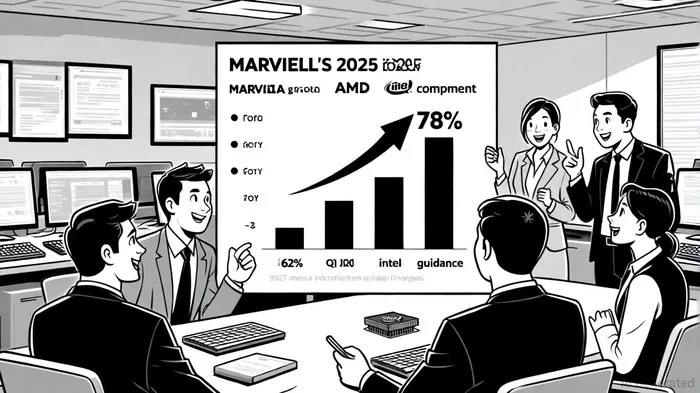
Marvell's 2025 annual revenue reached $5.767 billion, a 4.71% increase from 2024[4]. While this may pale against NVIDIA's 71.6% last 12 months (LTM) revenue growth[5], Marvell's Q4 2025 performance tells a different story. The quarter delivered $1.817 billion in net revenue, a 27% year-over-year surge, driven by a 78% YoY increase in data center revenue—accounting for 75% of total sales[6]. This segment strength, fueled by custom AI silicon programs entering high-volume production, positions Marvell as a critical supplier to the AI infrastructure boom[6].
Looking ahead, Marvell's guidance for Q1 2026 is even more aggressive: $1.875 billion in revenue, a 62% year-over-year increase at the midpoint[6]. This outpaces AMD's Q2 2025 32% YoY growth[7] and Intel's flat Q2 2025 results[8]. The company's strategic divestiture of its automotive Ethernet business to Infineon for $2.5 billion[6] further underscores its focus on high-growth AI and data center initiatives, while providing liquidity to manage $1.3 billion in current liabilities[6].
Valuation Metrics: Undervalued Relative to Peers
Marvell's valuation metrics suggest a disconnect between its fundamentals and market price. Its forward P/E ratio of 27.15 aligns with the semiconductor industry average[9], but its P/S ratio of 9.94[9] is significantly lower than NVIDIA's 26.52[1] and AMD's 8.89[1]. This implies investors are paying less for each dollar of Marvell's revenue compared to its AI-focused peers, despite its robust data center growth.
In contrast, NVIDIA's P/E ratio of 50.62[1] and AMD's 96.57[1] reflect market expectations of continued dominance in AI and high-performance computing. Intel, meanwhile, trades at a P/E of -5.10[2], highlighting its unprofitability. Marvell's non-GAAP net income of $1.377 billion in fiscal 2025[4] and $1.68 billion in operating cash flow[4] further justify its valuation, as it generates consistent profitability while peers like Intel struggle[8].
Asymmetric Value: Growth vs. Risk
The asymmetric case for Marvell hinges on its ability to capitalize on AI and data center tailwinds while trading at a discount to peers. Its custom AI silicon programs and partnerships with cloud providers position it to benefit from the $697 billion global semiconductor market in 2025[10], which is expanding at 11% YoY[10]. Additionally, Marvell's low leverage ratio (0.67)[11] and strong interest coverage (355.79)[11] ensure financial flexibility to invest in R&D or acquisitions, unlike overleveraged peers.
The risks, however, are clear: NVIDIA's 92.0% three-year average revenue growth[5] and AMD's $30 billion 2025 revenue target[7] suggest the AI race is intensifying. Yet, Marvell's niche in high-volume, specialized silicon for data centers—rather than competing directly in general-purpose GPUs—reduces exposure to commoditization. Its recent Infineon deal also eliminates underperforming assets, sharpening focus on growth areas[6].
Conclusion: A Contrarian Play in a High-Growth Sector
Marvell is not the most glamorous name in semiconductors, but its revenue growth, disciplined capital allocation, and strategic alignment with AI infrastructure make it a compelling asymmetric value investment. While the market underappreciates its data center momentum and financial strength, the company's forward-looking guidance and industry-leading margins suggest a re-rating is imminent. For investors seeking exposure to the AI boom without paying the premium demanded by NVIDIA or AMD, Marvell offers a lower-risk, higher-conviction alternative.





Comentarios
Aún no hay comentarios