
Marsh & McLennan's Dividend Stability: A Case Study in Financial Resilience and Shareholder Value
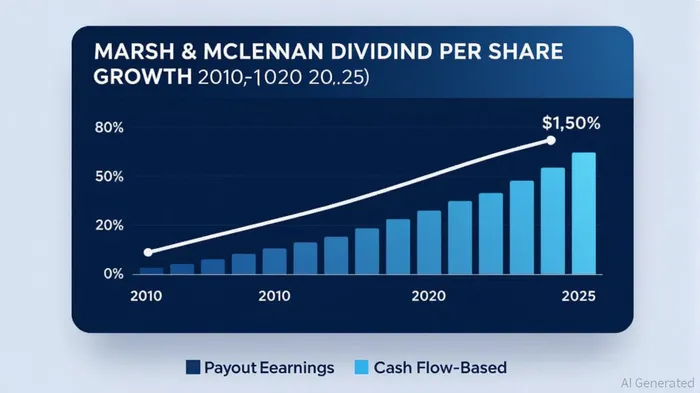
For income-focused investors, few metrics are as critical as dividend stability. Marsh & McLennanMMC-- Companies (MMC), a global leader in risk management and insurance brokerage, has long been a fixture on the list of “dividend aristocrats” for its 15-year streak of consecutive increases. But as markets grapple with macroeconomic uncertainty, the question remains: Can MMC's dividend strategy withstand long-term headwinds?
A Track Record of Discipline
MMC's dividend history is a testament to its operational discipline. As of August 2025, the company has raised its quarterly payout to $0.90 per share, representing a 10% increase from the prior year[1]. This brings the annualized dividend to $3.60, translating to a yield of approximately 1.83% based on recent share prices[4]. Crucially, this growth has been sustained for 15 years, a feat that underscores management's commitment to balancing reinvestment with shareholder returns[5].
The payout ratio—a key indicator of dividend sustainability—further reinforces this narrative. MMC's ratio currently ranges between 34.86% (earnings-based) and 43.17% (cash flow-based)[6]. These figures suggest ample room for flexibility, as a payout ratio below 50% is generally considered safe for long-term sustainability. By contrast, many high-yield stocks operate with ratios exceeding 70%, leaving them vulnerable to earnings shocks.
Revenue and Profitability: The Engine Behind the Payout
MMC's ability to sustain its dividend is underpinned by robust financial performance. In Q2 2025, the company reported a 12% year-over-year revenue increase to $7 billion, with underlying revenue growth of 4%[1]. Adjusted operating income rose 14%, and adjusted EPS hit $2.72, a 11% improvement[1]. These results highlight the company's resilience in a challenging macroeconomic environment, driven by strong demand for risk management services and disciplined cost controls.
Such performance is not accidental. MMC's business model—anchored in recurring fees from risk advisory and insurance brokerage—provides a stable cash flow foundation. This stability is further amplified by its global footprint, which diversifies exposure to regional economic cycles.
Balance Sheet Strength: A Shield Against Volatility
A company's balance sheet is the ultimate arbiter of long-term dividend safety. MMC's debt-to-equity ratio, while not negligible, remains within prudent bounds. As of June 30, 2025, the ratio was reported at 1.19 (long-term debt to equity)[1], 1.23[2], and 1.25 (total debt to equity)[4], depending on the methodology. While these figures suggest leverage, they are well below the thresholds that would trigger credit rating downgrades or liquidity constraints.
Moreover, MMC's $300 million in share repurchases during Q2 2025[1] demonstrates a dual focus on capital efficiency and shareholder value. Buybacks, when executed at a discount to intrinsic value, can enhance returns as effectively as dividend increases.
The Shareholder Value Equation
MMC's strategy is not merely about paying dividends—it's about optimizing total shareholder returns. The recent 10% dividend hike, coupled with buybacks, reflects a balanced approach. For context, companies that prioritize dividends alone often neglect buybacks, which can be more tax-efficient for investors. MMC's dual-pronged strategy ensures it appeals to a broad range of income and growth-oriented investors.
However, risks persist. Rising interest rates could pressure MMC's debt servicing costs, and a slowdown in global risk advisory demand could dampen revenue growth. Yet, given its low payout ratio and strong cash flow, the company appears well-positioned to navigate these challenges.
Conclusion: A Dividend Stock for the Long Haul
Marsh & McLennan's dividend stability is not a product of luck but a result of strategic rigor. Its disciplined payout ratio, consistent revenue growth, and prudent balance sheet management create a compelling case for long-term investors. While no company is immune to macroeconomic shifts, MMC's track record and current financial metrics suggest its dividend is as secure as it is generous. For those seeking a blend of income and resilience, MMCMMC-- remains a standout in the insurance sector.





Comentarios
Aún no hay comentarios