
Mars' $36 Billion Snack Ambition: Can Regulatory Risks Be a Tasty Opportunity?
The European Union's antitrust probe into Mars' proposed $36 billion acquisition of KellanovaK-- has become a critical test of whether the confectionery giant can cement its dominance in global snacking markets—or face a costly setback. With the EU's Phase 1 decision deadline looming on June 25, investors are weighing the implications of potential remedies, delays, or a full-scale Phase 2 investigation. For those watching Mars and Kellanova's stocks, the outcome could redefine the snacking landscape and present a compelling entry point for long-term gains.
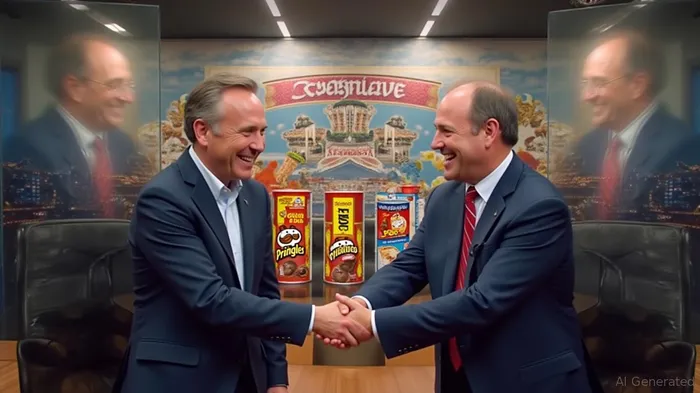
The Regulatory Crossroads
The EU's concerns center on Mars' already substantial market share in categories like confectionery, breakfast cereals, and frozen desserts in key member states. While Mars and Kellanova's product portfolios overlap minimally—Mars dominates chocolate and gum, while Kellanova's strengths lie in savory snacks and baked goods—regulators fear the combined entity could exploit its size to impose unfair terms on retailers. Retailers have already raised alarms, arguing that the merger could lead to higher prices or restrictive distribution practices.
However, legal experts note that the lack of direct product competition might limit the EU's appetite for a Phase 2 investigation. A conditional approval, requiring divestitures of certain Kellanova assets, appears more likely. The deal's "Burdensome Condition" clause adds nuance: if remedies exceed $750 million in annual revenue—potentially forcing the sale of up to four of Kellanova's five top brands—Mars could walk away and pay a $1.25 billion reverse termination fee. This creates a high-stakes gamble for shareholders.
Kellanova's stock has already faced volatility, dipping nearly 12% in April on fears of regulatory hurdles, though it rebounded slightly in May as investors priced in a mid-June decision. Mars, a private company, lacks public equity data, but its publicly traded peers like Mondelez International (MDLZ) offer context.
The Strategic Payoff of Snacking Dominance
Beneath the regulatory noise lies a compelling strategic rationale. Mars seeks to diversify beyond its chocolate-centric revenue, which accounts for 60% of its sales, while Kellanova's brands—Pringles, Pop-Tarts, and others—offer entry into high-growth categories like plant-based snacks and on-the-go convenience foods. The combined entity would control over 20% of the EU's snacking market, a scale that could outpace rivals like Unilever (UL) or Ferrero.
Investors should also note the U.S. Federal Trade Commission's muted stance: limited product overlaps there reduce the likelihood of a major challenge. This contrasts sharply with the EU's focus on regional market power, where Mars' dominance in countries like France and Germany could tip the scales against approval.
Navigating the Investment Timeline
For those considering Mars' or Kellanova's stocks:
1. Short-Term Volatility: If the EU demands a Phase 2 investigation (post-June 25), Kellanova's stock could dip further, creating a buying opportunity. A delayed deal might also pressure Mars to accelerate divestiture negotiations, reducing uncertainty.
2. Remediation Outcomes: A conditional approval with manageable asset sales (e.g., non-core Kellanova brands like its international beverage division) would likely boost both stocks, as synergies and growth prospects crystallize.
3. Long-Term Dominance: If the deal clears, Mars gains a stronger foothold in snacking innovation, from healthier snacks to e-commerce-driven distribution—a market expected to grow at 5% annually through 2030.
Final Call: A Strategic Buy Below the Radar
The EU's decision will likely hinge on whether divestitures can carve out enough competition to satisfy regulators. While a worst-case scenario (a blocked deal) would inflict a $1.25 billion hit on Mars, the likelihood of such an outcome remains low given the minimal product overlap. For investors, the current uncertainty may mask a golden entry point:
- Kellanova shareholders stand to gain from a deal's eventual approval, especially if divestitures are confined to non-core assets.
- Mars stakeholders (indirectly via partnerships or future IPO rumors) could benefit from a stronger, diversified portfolio.
The snacking market's structural growth, coupled with Mars' operational excellence, suggests that regulatory hurdles are a temporary speed bump rather than a roadblock. Investors who bet on the merger's success—post-remediation—may find themselves at the table of a newly consolidated snacking titan.
Final Verdict: Hold Kellanova's stock ahead of the June 25 decision; consider a gradual buy if a Phase 2 investigation is announced, targeting a 5-7% dip from current prices. If cleared, both companies could see a multi-year tailwind in a sector ripe for consolidation.
This analysis balances regulatory risks with strategic upside, urging investors to see near-term turbulence as a setup for long-term gains in a high-margin, growth-oriented industry.





Comentarios
Aún no hay comentarios