
U.S. Markit Services PMI Falls Below Forecast, Highlighting Sector Divergence
The U.S. Markit Services PMI for December 2025 dropped to 52.9, missing the forecast of 54 and marking the slowest expansion since June 2025. This moderation in the services sector—driven by weaker demand, stalled hiring, and surging costs—has created a stark divergence between struggling and resilient sub-sectors. For investors, this divergence presents a critical opportunity to recalibrate portfolios through strategic sector rotation, capitalizing on macroeconomic signals while mitigating downside risks.
Weakening Sectors: Tariffs, Labor Costs, and Holiday-Season Headwinds
The PMI decline was fueled by a 20-month low in new business growth, with sectors like retail, hospitality, and logistics bearing the brunt. These industries face a perfect storm: tariffs are inflating input costs, labor shortages are constraining capacity, and consumer spending is softening as inflation erodes disposable income. For example, logistics firms are grappling with higher fuel and labor expenses, while retailers are battling inventory overhangs and reduced foot traffic.
Employment in these sectors has nearly stalled, with payroll growth hitting a 20-month low. This signals a reluctance to invest in labor amid uncertain demand, a trend that could persist as businesses prioritize cost control. Investors should consider reducing exposure to these vulnerable areas, particularly as the PMI projects further moderation in early 2026.
Resilient Sectors: Healthcare, Professional Services, and Inflation-Linked Opportunities
While the broader services sector slows, healthcare, professional services, and utilities are bucking the trend. Healthcare, for instance, is benefiting from demographic tailwinds and the adoption of telehealth, which insulates it from cyclical downturns. Professional services—ranging from legal to consulting—are seeing sustained demand as businesses seek efficiency amid rising costs.
Utilities and real estate also stand out as inflation-linked plays. With input prices rising at a three-year high, these sectors offer stability through regulated pricing models and long-term contracts. For example, utility companies are passing on energy cost increases to consumers, maintaining profit margins even as broader inflation pressures ease.
Strategic Rotation: Balancing Growth and Stability
The key to navigating this divergence lies in overweighting resilient sectors while underweighting vulnerable ones. Here's how investors can act:
- Shift to Healthcare and Professional Services: These sectors are less sensitive to economic volatility and offer defensive characteristics. ETFs like the XLVXLV-- (healthcare) and XHBXHB-- (consumer staples) provide diversified access to these areas.
- Capitalize on Inflation-Linked Sectors: Utilities and real estate, though not glamorous, offer predictable cash flows. The XLEXLE-- (energy) and IYR (real estate) ETFs can anchor a portfolio during periods of macroeconomic uncertainty.
- Avoid Overexposure to Retail and Logistics: As these sectors face margin compression and demand softness, investors should trim holdings in companies reliant on discretionary spending.
Long-Term Outlook: A Gradual Normalization
While the PMI is expected to dip to 53.0 in Q1 2026, long-term projections suggest a return to equilibrium by 2027, with the index stabilizing around 52.0. This implies that while near-term challenges persist, the services sector's structural resilience—driven by innovation and demographic trends—will eventually offset cyclical headwinds.
For now, the divergence in sector performance underscores the importance of agility. By aligning portfolios with macroeconomic signals, investors can position themselves to weather near-term volatility while capturing growth in the most adaptive industries. The U.S. services sector may be slowing, but within its cracks lie opportunities for those who know where to look.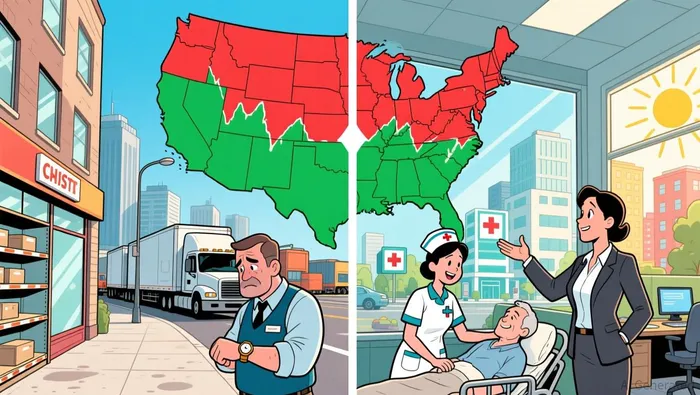





Comentarios
Aún no hay comentarios