
Market Volatility and Key Resistance Levels in December 2025: A Technical and Risk Management Perspective
As December 2025 approaches, the S&P 500 and Nasdaq 100 face a critical juncture defined by converging technical resistance levels, macroeconomic uncertainty, and shifting volatility dynamics. For investors, the interplay between these factors demands a strategic approach to risk management and positioning. This analysis synthesizes technical indicators, recent CPI trends, and implied volatility behavior to argue that a market correction is increasingly probable, urging immediate defensive measures and volatility-driven opportunities.
Technical Resistance and Bearish Momentum
The S&P 500 is currently testing a pivotal resistance zone near the 78.6% Fibonacci retracement level of its decline from all-time highs, compounded by a gap fill just above this level. This confluence represents a high-probability hurdle for bulls. A failure to break through would validate a bearish structure, potentially triggering a pullback into the 5,400–5,000 range. On the 4-hour chart, a defined trendline outlines bearish momentum, with a retest of this trendline likely to intensify selling pressure.
For the Nasdaq 100 (QQQ), resistance is concentrated around $637–$640, with the 50-day EMA at $625 acting as a critical support-turned-resistance level. A breakdown below $625 would invalidate the bullish trend, aligning with broader market weakness. These technical levels, combined with overbought conditions (RSI at 72.726 for the S&P 500), suggest that the indices are primed for a correction if macroeconomic catalysts exacerbate existing vulnerabilities.
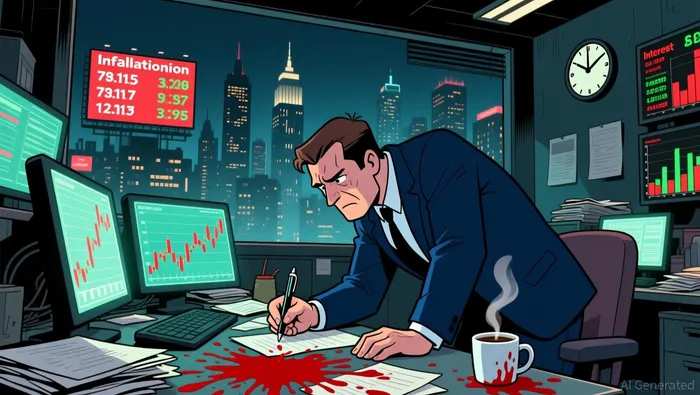
Macroeconomic Catalysts: CPI and Fed Policy
Recent CPI data underscores persistent inflationary pressures, with the U.S. annual inflation rate at 2.9% in December 2025-matching forecasts but remaining above the Federal Reserve's 2% target. Core inflation, at 3.2%, reflects stubborn price momentum, particularly in energy and durable goods. These trends complicate the Fed's policy calculus. While the central bank has cut rates from a peak of 5.5% in late 2024 to 4.5% by mid-2025, further reductions in 2026 are contingent on inflation easing to 2.1% by 2027.
The December 10, 2025 CPI release and concurrent Fed decision create a high-impact event window. Options traders are pricing in a 1.3% implied volatility move for the S&P 500 on this date-the largest expected for the remainder of 2025. This volatility premium reflects uncertainty around whether the Fed will deliver a rate cut, as Chair Jerome Powell has emphasized that a cut "wasn't in the bag". A deviation from market expectations-whether a delayed rate cut or a hawkish pivot-could amplify market swings.
VIX Dynamics and Market Sentiment
The VIX, or "fear gauge," has dropped 40% over five days, reaching a critical rising trendline support at 16.60. While this decline suggests short-term complacency, historical patterns indicate that a rebound off this level could coincide with a rejection of the S&P 500 at its resistance zone, triggering a pullback. The disconnect between declining VIX levels and overbought technical conditions highlights a fragile market psychology.
Moreover, the VIX's behavior following major CPI announcements from 2023–2025 reveals a mixed pattern. While the VIX typically declines by -3.5% in the week after CPI releases, short-term volatility spikes-such as those seen in April 2025 during trade war fears-underscore the risks of policy-driven shocks. This duality reinforces the need for hedging strategies as the market navigates the December 10 event risk.
Strategic Positioning: Downside Protection and Volatility Opportunities
Given the confluence of technical resistance, macroeconomic uncertainty, and elevated implied volatility, investors should prioritize defensive positioning. Key strategies include:
1. Hedging with Options: Buying put options on the S&P 500 and Nasdaq 100 to protect against a breakdown below critical support levels. The high implied volatility in options (e.g., 1.3% expected move on December 10) offers attractive risk-adjusted premiums for volatility-driven trades.
2. Defensive Sector Rotations: Shifting into sectors like Consumer Defensive and Healthcare, which have shown resilience amid volatility resets.
3. Position Sizing and Stop-Loss Orders: Reducing exposure to high-beta assets and implementing tight stop-loss levels near key technical thresholds (e.g., S&P 500 below 6,159 or QQQQQQ-- below $625).
Conclusion
The December 2025 market environment is defined by a fragile balance between technical resistance, macroeconomic headwinds, and policy uncertainty. While the S&P 500 and Nasdaq 100 have shown resilience, the alignment of overbought conditions, critical resistance levels, and a declining VIX suggests a high probability of a correction. Investors must act decisively to mitigate downside risks and capitalize on volatility-driven opportunities, particularly as the December 10 CPI-Fed decision convergence looms. Strategic positioning now is essential to navigate the impending volatility and preserve capital in a potentially turbulent year ahead.







Comentarios
Aún no hay comentarios