
Market Volatility and Investor Preparedness During Major U.S. Holidays
Holiday Schedules and Market Mechanics
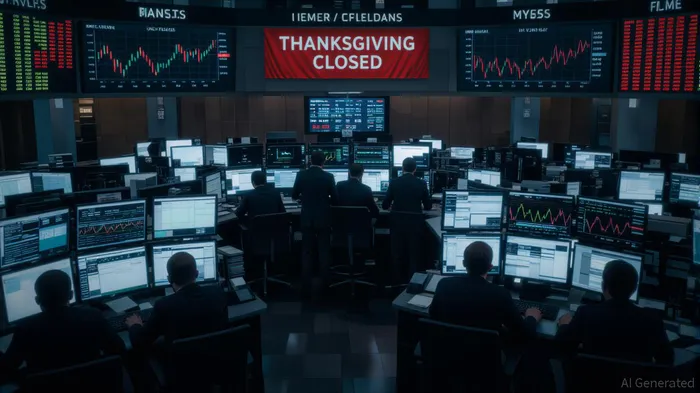
The U.S. stock market's holiday schedule is a double-edged sword. For instance, Thanksgiving Day on November 27, 2025, will see the NYSE and Nasdaq closed entirely, while Black Friday (November 28) will feature early closures at 1:00 p.m. ET for equities and 2:00 p.m. ET for bonds. These adjustments reduce trading volumes, which, in turn, amplifies price swings due to lower liquidity. The same pattern repeats during other major holidays, such as Christmas and New Year's, where trading halts or shortened sessions create similar conditions.
Academic research underscores this phenomenon. A study on the "holiday effect" reveals that major U.S. holidays like Christmas are associated with abnormal returns. This is often attributed to investor optimism and reduced liquidity, as traders close positions or take time off according to research. Additionally, investor sentiment exhibits a 5 + 2 cycle, with heightened optimism during weekends and holidays, further complicating market behavior.
Portfolio Strategies for Holiday Volatility
To mitigate risks during these periods, investors must adapt their strategies. One approach is adjusting position sizes to account for amplified volatility. For example, reducing exposure to high-beta stocks or widening stop-loss orders can help manage downside risk in low-liquidity environments. Similarly, avoiding complex strategies that rely on normal market conditions is prudent.
Options traders face unique challenges during the holiday season. Shortened trading hours and reduced liquidity lead to wider bid-ask spreads and increased volatility, particularly in less-liquid contracts. Strategies like covered calls or credit spreads may benefit from lower implied volatility, as options premiums decline during this period according to analysis. However, investors must plan trades well in advance of closures to avoid execution risks, as global equity and fixed-income volumes drop significantly from December 23.
Case Studies and Industry-Specific Impacts
Historical data provides actionable insights. For example, Amazon (AMZN) has historically outperformed during the Thanksgiving period due to its exposure to holiday shopping. A strategy of buying AMZN five days before Thanksgiving . Similarly, gold (GLD) has shown a consistent upward trend when purchased on December 23 and held until the first trading day of January, . These examples highlight the importance of sector-specific adjustments during holiday windows.
The "Santa Claus Rally," a well-documented phenomenon, further illustrates seasonal opportunities. The S&P 500 often rises in the final days of December and early January, driven by festive optimism and year-end tax considerations. However, this rally is not guaranteed, and investors must balance optimism with caution, especially as retail trader activity increases and institutional participation wanes.
Risk Management and Long-Term Discipline
Effective risk management during holidays requires a blend of tactical adjustments and long-term discipline. Defensive assets, such as Treasury bonds or dividend-paying equities, can provide stability in volatile periods. Additionally, can help rebalance portfolios to optimize risk-return profiles. Limit orders and dollar-cost averaging also play a role, allowing investors to capitalize on price swings without overexposure according to analysis.
Emotional discipline remains paramount. As noted by Kiplinger, equities have historically outpaced inflation and contributed to wealth-building through compounding growth and dividend reinvestment. Avoiding reactionary decisions during downturns-whether pre- or post-holiday-is critical for maintaining a stable portfolio. Time in the market, rather than timing the market, reinforces this principle.
Conclusion
Major U.S. holidays present both challenges and opportunities for investors. By understanding the mechanics of holiday schedules, leveraging historical patterns, and employing tailored risk management techniques, investors can navigate these periods with confidence. The key lies in balancing tactical flexibility with long-term discipline, ensuring that holiday-related volatility becomes a catalyst for strategic growth rather than a source of instability.







Comentarios
Aún no hay comentarios