
The Market's Thanksgiving Rally: Can It Signal a Broader Rebound?
Historical Context and Seasonal Biases
The Thanksgiving week has long been a focal point for market psychology. Data from 1945 to 2025 shows the S&P 500 averaging +0.60% during the holiday-shortened week, with a "super seasonal pattern" from late November to early January delivering an average gain of +2.58% since 1950. This pattern is often attributed to improved consumer optimism, retail-driven optimism, and institutional portfolio rebalancing ahead of year-end. For instance, the index has closed higher on 64.5% of the days before Thanksgiving and 65.2% of the days after since 1957.
Yet, recent years have seen a moderation in these gains. While the historical average remains positive, the magnitude of rebounds has diminished compared to earlier decades, such as the 22 consecutive positive returns from 1965–1992. This suggests that while the seasonal bias persists, external factors like macroeconomic uncertainty or sector-specific headwinds may temper its strength.
Technical Indicators and Mixed Signals
The 2025 Thanksgiving rally, though sharp, appears to lack the conviction seen in stronger seasonal cycles. As of November 18, 2025, the S&P 500 closed below its 50-day moving average of 6,708.39 at 6,672.41, a bearish signal that contrasts with the index's 0.92% average gain during Thanksgiving weeks over the past 15 years. Meanwhile, the 14-day RSI for the index stood at 34.88, indicating moderate strength but falling short of the overbought threshold of 70. The Directional Index (ADX) of 17.65 further suggests a weaker trend, with no clear directional momentum.
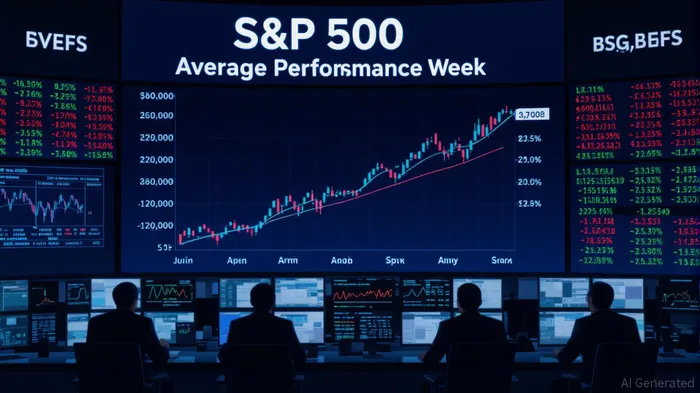
Volume data, a critical component of momentum analysis, remains elusive for the 2025 Thanksgiving week. However, the 5-day moving average decline of -2.95% highlights short-term volatility, while the 100-day moving average's 5.50% increase hints at a longer-term positive bias. This divergence between short- and long-term indicators underscores the market's indecision.
Investor Sentiment and Sector Dynamics
Investor sentiment, while historically bullish during Thanksgiving, appears cautiously optimistic in 2025. The AAII survey notes that bullish sentiment has consistently exceeded its historical average of 37.5% during this period, but recent economic data-such as mixed Q2 earnings and inflation concerns-may have tempered enthusiasm. Sector performance also diverges: energy and technology, typically strong performers during the holiday season, have shown uneven momentum, with energy stocks benefiting from seasonal demand and tech stocks grappling with valuation pressures.
Is This a Setup for a Larger Trend?
The Thanksgiving rally's ability to evolve into a broader trend hinges on two factors: volume confirmation and moving average crossovers. Historically, strong volume during the holiday week has been a precursor to sustained gains, but the absence of robust volume data in 2025 leaves this question unanswered. Additionally, the S&P 500's failure to close above its 50-day moving average-a key technical hurdle-suggests that bears still hold influence.
If the index can reclaim its 50-day moving average and sustain gains above it, the seasonal bias could gain traction, particularly if December's "window dressing" effect amplifies buying activity. However, without a clear breakout in RSI or ADX, the rally risks being viewed as a temporary relief trade rather than a trend reversal.
Conclusion
The Thanksgiving week rally of 2025 aligns with historical patterns but lacks the technical conviction to signal a definitive turning point. While the seasonal bias remains intact, investors should remain cautious, monitoring volume trends and moving average dynamics for confirmation. For now, the market appears caught between the optimism of tradition and the skepticism of current fundamentals-a tug-of-war that may define the remainder of the year-end season.







Comentarios
Aún no hay comentarios