
Market Resilience Amid Political Uncertainty: Navigating the Shutdown Risk in 2025
In 2025, political and economic uncertainty has become a defining feature of global markets. From aggressive tariff policies to geopolitical tensions and fiscal policy volatility, investors face a landscape where traditional growth strategies are increasingly exposed to risk. Amid this turbulence, defensive sector positioning has emerged as a critical tool for preserving capital and ensuring portfolio resilience. This article examines how defensive sectors have performed during periods of political instability in 2025 and outlines actionable strategies for combining defensive allocations with risk-mitigated growth opportunities.
Defensive Sectors: The Bedrock of Stability
Defensive sectors-utilities, healthcare, consumer staples, and defense contracting-have consistently outperformed during 2025's heightened uncertainty. For instance, defense contractors like General DynamicsGD-- and Lockheed MartinLMT-- have thrived due to their reliance on multi-year government contracts, which insulate them from short-term policy disruptions, according to an SSGA sector note. Similarly, utilities such as Xcel EnergyXEL-- have demonstrated resilience, as demand for electricity and water remains inelastic regardless of macroeconomic conditions (that SSGA sector note also highlights utilities' strengths).
Healthcare and consumer staples have also shown robustness. Companies like JohnsonJNJ-- & Johnson and Procter & Gamble provide essential goods and services, ensuring steady revenue streams even during economic downturns, as discussed in Crisis-Proof Your Portfolio. Notably, the GS US Defensives Index rose 5.2% year-to-date in 2025, while cyclical sectors declined by 7.9% (per the SSGA sector note). This divergence underscores the value of defensive allocations in volatile environments.
Strategic Sector Allocations in Q3 2025
Recent data highlights sector-specific trends. The insurance sector, for example, has gained traction as a defensive play due to its ability to pass on cost pressures from tariffs to customers, maintaining stable earnings (as outlined in the SSGA sector note). Utilities have further benefited from long-term power purchase agreements with AI-driven tech firms and policy support for nuclear energy under the Trump administration, another observation from the same SSGA analysis. Meanwhile, aerospace and defense remain strong growth areas, fueled by rising global defense budgets (SSGA's sector note covers these trends).
However, not all defensive sectors have performed equally. Healthcare, while still a defensive category, has lagged behind utilities in 2025, reflecting sector-specific challenges such as regulatory headwinds and margin pressures, as noted in a LibertyThroughWealth analysis. This variation emphasizes the need for granular sector analysis when constructing a defensive portfolio.
Risk-Mitigated Growth Strategies
Balancing defensive allocations with growth opportunities requires a multi-layered approach. Key strategies include:
Fixed Income and Alternative Assets: High-quality bonds, including U.S. Treasuries and Treasury Inflation-Protected Securities (TIPS), act as buffers against equity volatility while providing income, as explained in Portfolio Resilience. Additionally, alternative assets like private equity and real estate offer diversification and inflation protection (the SSGA sector note also highlights alternatives).
Factor Diversification in Equities: Moving beyond market-cap-weighted indices, investors are advised to emphasize value, quality, and momentum factors in U.S. equities to reduce concentration risk (see the Portfolio Resilience piece for context). For example, companies like ASML Holdings and Carlisle Companies, with strong competitive moats, have shown resilience despite cyclical headwinds (as discussed in that same analysis).
International Diversification: Shifting capital to international markets, particularly Europe and Asia, can access better valuations and reduce overexposure to U.S.-centric equities, according to a 2025 Defensive Portfolio piece. This approach also mitigates risks tied to domestic policy shifts.
Structured Notes and Hedging Tools: Instruments like structured notes provide downside protection while allowing participation in market gains, making them ideal for uncertain environments (the 2025 Defensive Portfolio write-up covers structured solutions). Tax-efficient strategies, such as municipal bonds, further enhance risk-adjusted returns (as outlined in Crisis-Proof Your Portfolio).
Navigating the Path Forward
As political uncertainty persists, investors must remain agile. Periodic rebalancing and real-time monitoring of macroeconomic indicators-such as debt-to-GDP ratios and inflation trends-are essential (the 2025 Defensive Portfolio piece emphasizes monitoring). For instance, the U.S. debt-to-GDP ratio, projected to reach 130% by 2030, strengthens the case for inflation-protected assets like gold and TIPS (the Portfolio Resilience analysis discusses rising debt pressures).
A hybrid approach, combining defensive equities with "growth-defensive" sectors like healthcare technology, allows investors to capture upside potential without full exposure to cyclical risks (the SSGA sector note highlights such hybrid opportunities). Tools like Alpha Picks by Seeking Alpha can help identify undervalued defensive stocks with strong fundamentals and reliable dividend histories.
Conclusion
In 2025, defensive sector positioning is not merely a reactive measure but a proactive strategy for navigating political and economic uncertainty. By prioritizing sectors with stable cash flows, diversifying into fixed income and alternatives, and leveraging structured hedging tools, investors can build portfolios that balance resilience with growth. As the market landscape continues to evolve, a disciplined, data-driven approach will remain critical to long-term success.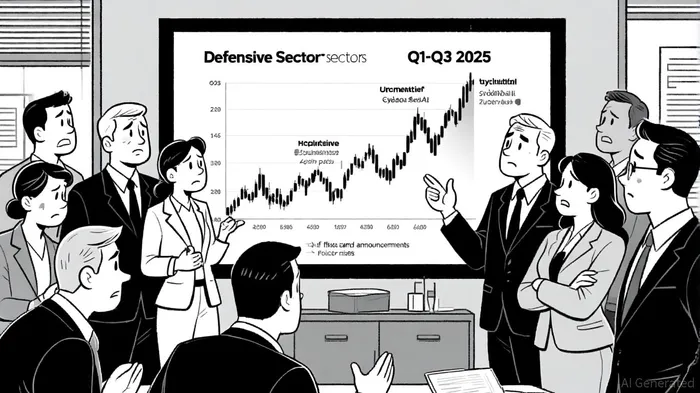





Comentarios
Aún no hay comentarios