
Market Resilience in the Face of Government Shutdown Uncertainty: Strategic Asset Allocation in a Policy Vacuum
The U.S. government shutdown that began on October 1, 2025, has thrust markets into a policy vacuum, leaving investors grappling with uncertainty. Yet history offers a blueprint for resilience. Over the past three decades, shutdowns have consistently shown that equities, bonds, and defensive sectors can weather political storms-if investors remain disciplined and strategic.
Historical Lessons: Markets Tend to Outperform
According to a Business Insider analysis, the S&P 500 has averaged near-flat returns during government shutdowns but with a slight upward bias. For instance, during the 16-day 2013 shutdown, the index rose 2.4%, while the 35-day 2018-2019 shutdown coincided with a 10.3% gain, driven by broader market trends rather than direct shutdown effects. Similarly, the 1995-96 shutdowns saw the S&P 500 gain 0.1% and 3.3%, respectively. These patterns suggest that while shutdowns create noise, they rarely derail long-term market trajectories.
Bond markets, meanwhile, have historically responded with a flight to safety. According to YCharts data, the 10-Year Treasury yield typically drops by 5 basis points during shutdowns, as investors seek refuge in U.S. Treasuries. The 2025 shutdown has already seen yields fall 3 basis points to 4.12%, reinforcing this dynamic.
Sector performance tells a nuanced story. Defensive plays like healthcare and utilities have historically outperformed, while small-cap stocks lag. During the 2025 shutdown, healthcare and government services firms have surged, while defense manufacturers remain stable. This aligns with historical trends, where financials underperform due to heightened economic uncertainty, as noted in the Business Insider analysis.
Current Fundamentals: A Resilient Economy Amid Fiscal Headwinds
The U.S. economy enters this shutdown with a robust foundation. The Philadelphia Fed SPF projects Q3 2025 GDP growth at 1.3%, while the Atlanta Fed's GDPNow model estimates a more optimistic 3.9%. Goldman Sachs has raised its forecast to 2.8%, citing strong consumer spending and business investment. These divergent estimates reflect optimism about the economy's ability to absorb fiscal shocks, particularly as the One Big Beautiful Bill Act (OBBBA) aims to offset tariff-driven fiscal tightening through tax incentives for capital expenditures and R&D, a point highlighted in the Glenmede Quarterly Letter.
Inflation, though still above the Fed's 2% target, is moderating. The Philadelphia Fed forecasts headline CPI at 3.0% for Q3 2025, down from 3.5% previously. Core PCE is expected to follow a similar trajectory, easing to 2.9%. However, tariffs and supply chain adjustments could reintroduce upward pressure, complicating the Fed's path to normalization.
The labor market remains a pillar of strength, with unemployment projected at 4.2% for 2025. Despite slower hiring, job gains of 132,800 per month are expected, supported by a more balanced labor market amid immigration policy adjustments. This stability provides a buffer against shutdown-related disruptions.
Strategic Allocation: Navigating the Policy Vacuum
The shutdown's most immediate risk lies in its impact on data transparency. As highlighted by Financial Content, the Bureau of Labor Statistics and Census Bureau have suspended operations, delaying critical reports like the September jobs data and CPI. This "data blackout" forces the Fed to rely on imperfect proxies like ADP payrolls, complicating its rate decision calculus. With the Fed already contemplating a September rate cut, prolonged uncertainty could delay further easing.
Investors should prioritize resilience over speculation. Here's how:
Overweight Defensive Sectors: Healthcare and utilities have historically outperformed during shutdowns. For example, the Business Insider analysis found healthcare firms gained 5.2% during the 2013 shutdown. With the 2025 shutdown prolonging policy uncertainty, these sectors offer downside protection.
Underweight Small-Cap Exposure: Small-cap stocks, as tracked by the Russell 2000, have historically lagged during shutdowns due to their sensitivity to economic disruptions. Investors should reduce exposure to IWM and similar ETFs until clarity emerges.
Extend Duration in Bonds: The 10-Year Treasury's 3-basis-point drop underscores demand for safe havens. Extending bond duration could capitalize on this trend, particularly as yields remain anchored near 4.12%.
Position for Fed Easing: While the Fed's September cut is priced in, further reductions depend on inflation and labor data. Investors should consider rate-sensitive sectors like financials and consumer discretionary, which could benefit from a dovish pivot.
Conclusion: Stay the Course, But Stay Alert
Government shutdowns are inherently disruptive, but history shows markets have a remarkable ability to adapt. The 2025 shutdown, while prolonged, occurs against a backdrop of strong GDP growth, moderating inflation, and a resilient labor market. By focusing on defensive sectors, extending bond duration, and avoiding overexposure to small-cap volatility, investors can navigate the policy vacuum with confidence. As always, patience and discipline will be the cornerstones of success in these uncertain times.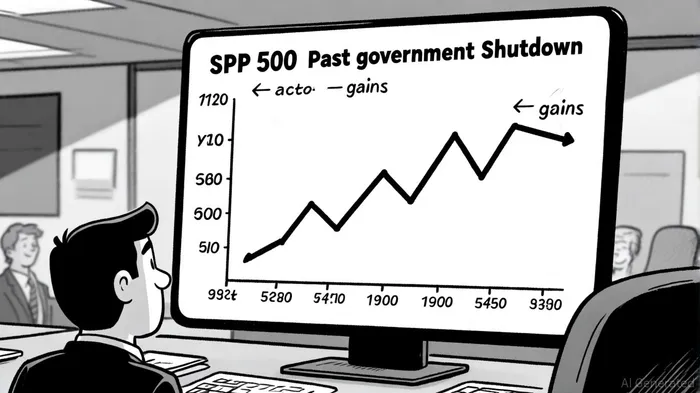







Comentarios
Aún no hay comentarios