
M&A Market Recovery and Risk Sentiment in 2025: Strategic Positioning in a Post-Pandemic Corporate Finance Landscape
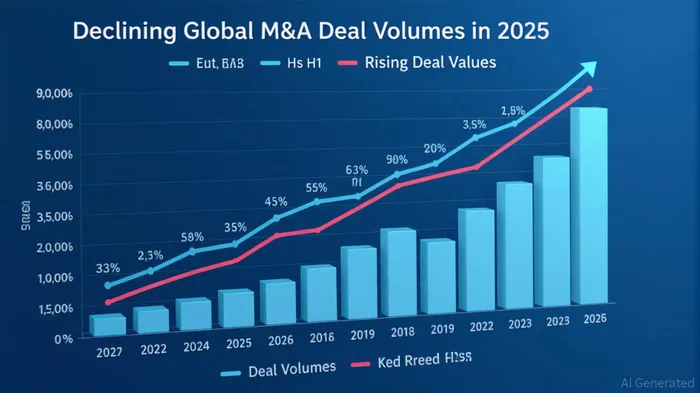
The M&A market in 2025 is navigating a complex interplay of macroeconomic headwinds and strategic reinvention. While global deal volumes dipped by 9% in the first half of 2025 compared to the same period in 2024, deal values surged by 15%, signaling a shift toward larger, more strategic transactions [1]. This duality reflects corporate caution amid uncertainty, as companies balance the pursuit of growth with the need to mitigate risks stemming from inflation, trade policy volatility, and supply chain fragility.
Macroeconomic Tailwinds and Headwinds
The U.S. market, a bellwether for global M&A trends, has seen corporate deal volumes remain flat in 2025, while private equity activity is projected to grow modestly by 1% [1]. However, 30% of U.S. firms have paused or revised deals due to tariff uncertainties, per a PwC Pulse Survey [1]. This hesitancy contrasts with the 51% of companies that continue prioritizing M&A for transformation, underscoring a strategic pivot toward long-term resilience over short-term gains.
Globally, regions like India and the Middle East have outperformed, with deal volumes rising by 18% and 13%, respectively [1]. These markets are capitalizing on more favorable regulatory environments and capital market liquidity, which analysts at Morgan StanleyMS-- argue could catalyze a broader M&A rebound in the second half of 2025 [4]. Yet, the specter of prolonged U.S. inflation (forecasted at 3.4% in 2025) and potential stagflation remains a critical constraint, forcing firms to weigh M&A against AI investments as capital allocation strategies [1].
Strategic Positioning: Balancing Risk and Opportunity
Companies are adopting nuanced strategies to navigate this landscape. For instance, the financial services sector has seen a 15% increase in deal values despite a 1% decline in volumes, reflecting a focus on consolidating market share and enhancing operational efficiency [5]. Similarly, firms in capital-intensive industries are leveraging real-time risk intelligence platforms to diversify suppliers and buffer against disruptions, such as the $250–275 billion in damages caused by the 2025 Los Angeles wildfires [2].
Climate risk, another persistent concern, has prompted firms to integrate advanced decision-making tools into their M&A frameworks. Aon's 2025 risk capital trends report highlights how organizations are now factoring in $368 billion in global economic losses from 2024's natural disasters, embedding climate resilience into due diligence processes [1]. This shift is particularly evident in sectors like energy and logistics, where systemic risks are most acute.
Geopolitical and Policy Dynamics
The re-election of Donald Trump as U.S. president has introduced further uncertainty, with trade policy shifts likely to ripple across global supply chains and capital flows [2]. While some firms are recalibrating cross-border strategies to account for protectionist pressures, others are accelerating digital transformation initiatives to offset geopolitical risks. Deloitte's global economic outlook emphasizes the need for “deliberate fiscal and monetary policy decisions” to balance inflation suppression with growth [3], a challenge that will shape M&A valuations and execution timelines.
Conclusion: Cautious Optimism and Adaptive Strategies
The M&A market in 2025 is defined by duality: a cautious approach to deal-making amid pockets of optimism in high-growth regions and sectors. Companies that succeed will be those that align their strategies with macroeconomic realities while leveraging technology and regulatory agility to mitigate risks. As the year progresses, the interplay between policy clarity, inflationary pressures, and corporate digitalization will determine whether the anticipated rebound materializes—or remains deferred.
For investors, the key takeaway is clear: strategic positioning in M&A requires not just financial acumen but a granular understanding of systemic risks and the agility to pivot as conditions evolve.





Comentarios
Aún no hay comentarios