
The Market's Pre-Holiday Rally: A Strategic Buying Opportunity or a Fleeting Bounce?
Technical Indicators: A Tale of Divergence
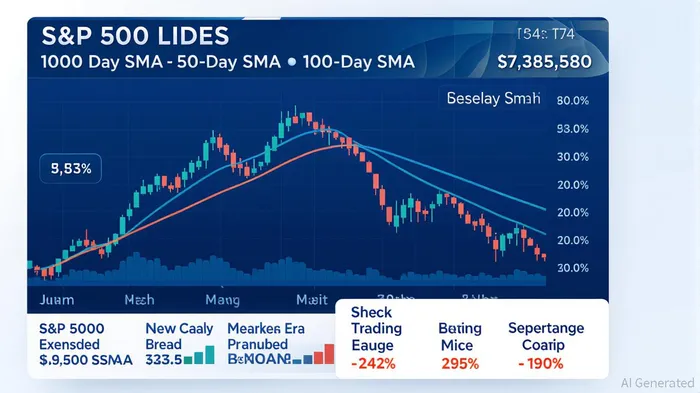
The S&P 500 and Nasdaq Composite have exhibited mixed signals in the week preceding Thanksgiving. The S&P 500 broke below its 50-day SMA for the first time since April 2025 but found support at its 100-day SMA, suggesting a potential near-term rebound. Similarly, the Nasdaq Composite, pressured by concerns over AI overinvestment and stretched valuations, also clung to its 100-day SMA. However, market breadth remains weak: the percentage of stocks in the S&P 500, Nasdaq Composite, and Russell 2000 trading above their 200-day SMAs has hit multi-month lows. This divergence-between index-level support and deteriorating breadth-hints at a fragile recovery.
For individual stocks, the (RSI) offers further insight. Stonex Group Inc (SNEX), for instance, trades with an RSI(14) , signaling an oversold condition, , reflecting a more neutral stance according to data. These micro-level indicators suggest pockets of undervaluation but lack broad-based confirmation.
Sentiment Data: Fear and Resilience in Equal Measure
Market sentiment, as measured by the , reveals a stark divide, . This bearish bias aligns with Citadel Securities' observation of a sharp decline in institutional positioning ahead of the holiday, contrasting with resilient retail flows. Retail investors, in particular, have sustained 29 consecutive weeks of net call buying, a testament to their optimism-or overconfidence.
Meanwhile, the put/call ratio has surged, reflecting heightened demand for downside protection. The VIX, , remains elevated, underscoring persistent volatility. An inverted VIX curve, as noted by Citadel Securities, suggests extreme risk aversion-a condition often preceding sharp market corrections according to analysis.
Seasonal Optimism vs. Structural Weakness
The pre-holiday rally coincides with the start of the holiday shopping season, traditionally a period of strong retail sales and market performance. Yet this year's backdrop is complicated by broader macroeconomic uncertainties-rising interest rates, inflationary pressures, and sector-specific overvaluations (particularly in AI-driven tech stocks). The technical support levels for the S&P 500 and Nasdaq may provide a temporary floor, but without a meaningful improvement in market breadth or a shift in sentiment toward bullishness, the rally risks being short-lived.
Strategic Implications
For investors, the current environment demands caution. While the technical indicators suggest a potential bounce, the lack of broad participation and the persistent bearish sentiment among both institutional and retail investors temper optimism. A strategic approach might involve hedging long positions with downside protection (e.g., put options) or selectively targeting oversold stocks like SNEX, provided they align with a broader fundamental thesis. However, a full-scale reversal seems unlikely without a catalyst-such as a policy shift or a meaningful easing of inflationary pressures-that addresses the structural headwinds.
In conclusion, the pre-holiday rally appears to be a blend of seasonal buying and tentative optimism, rather than a definitive reversal. Investors would be wise to treat it as a tactical opportunity rather than a signal of sustained bullish momentum.







Comentarios
Aún no hay comentarios