
Market Outlook: Navigating the Fed's Independence Test and Inflation's Next Chapter
The Federal Reserve's independence is facing its most direct legal assault in history. Last week, the Justice Department served the Fed with grand jury subpoenas, threatening a criminal indictment over Chair Jerome Powell's June testimony about a building renovation. This unprecedented move is not about construction costs. As Powell stated, it is a pretext in a broader campaign to seize control of interest rate policy from the Fed's technocrats. The dispute is a stark political maneuver, with the administration targeting the central bank's autonomy.
Yet the global financial community has drawn a firm line. In a powerful show of unity, eleven central bankers from around the world-including ECB President Christine Lagarde and Bank of England Governor Andrew Bailey-issued a statement standing in full solidarity with Powell. They affirmed that central bank independence is a cornerstone of price, financial and economic stability. This international consensus is a critical buffer, signaling that the Fed's actions are viewed through a global lens of institutional norms.
Powell's own mandate provides a clear defense. He has consistently stated his focus is on price stability and maximum employment, a duty he has carried out without political fear or favor across four administrations. The legal threat, therefore, is not an attack on a specific policy but on the very principle that monetary policy must be set by evidence, not intimidation. While the assault is unprecedented, the global backing and the clarity of the Fed's official mandate suggest that immediate policy impact will be contained. The battle now is for the institution's soul.
Inflation's Unwinding and the Policy Pause
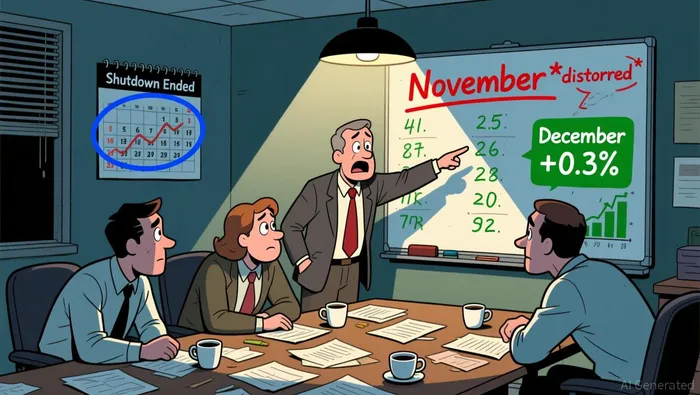
The immediate policy path is being set by a complex mix of data, with inflation's recent distortion now coming into focus. The December Consumer Price Index is forecast to accelerate by 0.3% month-over-month, a clear sign of the distortions from the 43-day government shutdown finally unwinding. That shutdown had artificially suppressed November's inflation by preventing price collection for October, forcing the Bureau of Labor Statistics to use a carry-forward method. As economists note, the anticipated pick-up in consumer prices is a meaningful payback after collection issues, particularly for goods and services that saw holiday discounting in November.
This inflation rebound, however, is not the full story. It is being cemented by a labor market that shows tentative signs of stabilizing. The December jobs report revealed a dip in the unemployment rate, a development that, combined with weak job growth, has convinced investors that the Fed's dual mandate is finding a fragile balance. As a result, the market has priced in a months-long pause. Futures now indicate no rate cut until June, a shift from earlier expectations of cuts in January and April.
The bottom line is a high degree of confidence in the current policy stance. The Fed's benchmark overnight interest rate remains in the 3.50%-3.75% range, and the central bank is expected to hold it there at its January meeting. Officials will likely remain on hold until they see clearer evidence that inflation is decelerating toward the 2% target, a process that may be influenced by the full pass-through of tariffs and the resolution of housing data distortions. For now, the pause is the policy.
Financial Market Implications and Forward Scenarios
The confluence of political risk and economic data is setting the stage for a volatile market environment. The primary threat to the prevailing narrative is a potential escalation of political pressure on the Fed. While the central bank's independence has strong international backing, any further legal or political overreach could undermine confidence in its credibility. This would be a direct challenge to the market's core assumption that monetary policy is insulated from political interference, likely triggering significant volatility across all asset classes.
The key near-term catalyst is the release of the December Consumer Price Index data on Tuesday. This report will confirm or challenge the inflation trajectory that is cementing the Fed's pause. Economists forecast a 0.3% month-over-month increase, a meaningful payback after distortions from the government shutdown. A stronger-than-expected print would reinforce the case for holding rates steady, while a softer result could reignite speculation about an earlier policy pivot.
A secondary watchpoint is the Fed's own communications. Regional bank presidents, including Raphael Bostic and Tom Barkin, are scheduled to speak this week. Their remarks will be scrutinized for any subtle shifts in tone that might signal a change in the 'higher for longer' stance. Given the market is pricing in a pause until June, these speeches are a critical channel for the Fed to manage expectations and prevent a narrative shift.
The bottom line is that the market is currently in a holding pattern, awaiting these catalysts to test the stability of the 'no rate cut until June' setup. The political backdrop adds a layer of uncertainty that could amplify the market's reaction to any data or commentary that deviates from the expected script.







Comentarios
Aún no hay comentarios