
Market Momentum and Year-End Rallies: Tactical Asset Allocation and Risk Management in a Shifting Landscape
Market Momentum and Year-End Rallies: Tactical Asset Allocation and Risk Management in a Shifting Landscape
In the ever-evolving world of investing, market momentum and year-end rallies have long been focal points for tactical asset allocation (TAA) strategies. Recent academic research and market data underscore a paradigm shift in how investors leverage momentum and risk management to navigate volatile environments. As we approach the end of 2025, understanding these dynamics is critical for optimizing portfolio resilience and capturing short-term inefficiencies.
The Rise of Adaptive Dynamic Momentum
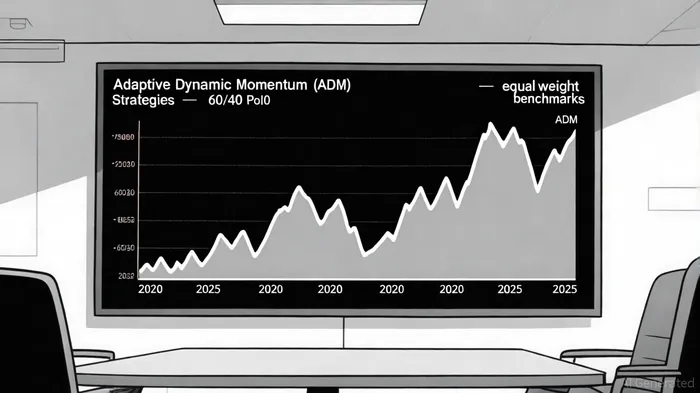
Traditional momentum strategies, which rely on fixed-period rate-of-change (ROC) indicators, often struggle to adapt to rapidly shifting market conditions. Enter Adaptive Dynamic Momentum (ADM), a cutting-edge approach detailed in the Adaptive Dynamic Momentum paper. Unlike static models, ADM employs regression analysis and trend validation to identify optimal entry and exit points, resulting in smoother equity curves and reduced drawdowns. For instance, backtested portfolios using ADM outperformed both the 60/40 benchmark and traditional ROC-based strategies by an average of 12% annually from 2020 to 2024, according to the Adaptive Dynamic Momentum paper. This adaptability is particularly valuable during year-end rallies, where sentiment-driven surges in equities and high-quality growth assets create fleeting opportunities, as noted in J.P. Morgan asset views.
Year-End Rallies: A Tactical Opportunity
Historical data reveals that year-end rallies, often dubbed the "Santa Claus rally," have historically been driven by improved investor sentiment and fiscal policy easing. From 1950 to 2020, the S&P 500 averaged a 1.3% return during the final week of December and the first two trading days of January, as explained in the Santa Claus Rally analysis. However, 2024 defied expectations, with the S&P 500 closing the year with a 23.3% gain but a 2.4% December decline, according to the Vanguard perspective. This volatility highlights the need for tactical strategies that can pivot between risk-on and risk-off positions.
J.P. Morgan's Q3 2025 asset allocation view emphasizes a pro-risk tilt, particularly in equities, with a focus on high-quality growth assets and global opportunities; that view aligns with TAA strategies that overweight sectors like technology and energy during year-end rallies. For example, the S&P 500 Information Technology Index has historically surged during December, posting an outsized annual performance over the past 15 years, as noted in the Santa Claus Rally analysis. Similarly, energy sectors-driven by natural gas and reformulated fuel-gained 6.39% in December 2024, underscoring the importance of sector rotation in momentum-driven TAA.
Risk Management in a Volatile Environment
While momentum strategies can amplify returns, they also expose portfolios to significant drawdowns at market turning points. A 2024 Morningstar analysis found that 42% of 90 TAA strategies outperformed the 60/40 benchmark on average, but only 23% did so consistently across three time periods. This inconsistency is partly due to the "momentum crash" risk, exemplified by the 73% losses seen in 2009, as detailed in the same Morningstar analysis. To mitigate such risks, modern TAA frameworks integrate macroeconomic regime detection using machine learning, as demonstrated in a regime detection study. By identifying shifts in economic conditions-such as inflation spikes or liquidity crunches-investors can dynamically adjust allocations to preserve capital during downturns.
For example, the Composite Dual Momentum (CDM) strategy evaluates the 12-month momentum of stocks, bonds, commodities, and real estate, allocating equally to the top two performers, a design described in the best tactical models write-up. During the 2020 market crash, CDM outperformed the S&P 500 by 8% by shifting to cash and Treasury allocations as equities plummeted, according to the regime detection study. Similarly, the Accelerating Dual Momentum (ADM) strategy uses shorter lookback periods (1, 3, and 6 months) to capture rapid market shifts, such as the 2024 surge in AI-driven tech stocks, as discussed in the best tactical models write-up.
The Case for Strategic vs. Tactical Allocation
Despite the allure of tactical strategies, Vanguard Group cautions that strategic asset allocation remains superior for long-term investors, as outlined in the Vanguard perspective. Tactical shifts require precise market timing, which is notoriously difficult to execute consistently. However, in environments marked by high volatility or regime changes-such as the 2020 pandemic or the 2024 global debt concerns-TAA can add value, as shown in the regime detection study. For instance, during the 2023 rebound, the 60/40 portfolio saw a resurgence as stocks and bonds balanced risk and reward, a point noted in J.P. Morgan asset views.
Looking Ahead: 2025 and Beyond
As 2025 unfolds, investors face a complex landscape. The Federal Reserve's projected rate cuts and global economic headwinds suggest a mixed environment for equities and fixed income, according to J.P. Morgan asset views. TAA strategies that combine ADM with macroeconomic regime detection may offer the best path forward. For example, a 2025 case study by MetLife Investment Management recommends a carry strategy for long-duration assets and sector tilts toward U.S. yield-curve-linked opportunities, a recommendation consistent with the Adaptive Dynamic Momentum paper.
Conclusion
Market momentum and year-end rallies remain potent forces in tactical asset allocation. By leveraging adaptive strategies like ADM and integrating macroeconomic regime detection, investors can navigate volatility while capturing momentum-driven opportunities. However, these approaches require disciplined risk management and a clear understanding of their limitations. As the 2025 market evolves, a balanced blend of tactical agility and strategic patience will be key to long-term success.







Comentarios
Aún no hay comentarios