
Market Momentum and Investor Sentiment: Navigating Corrections After Record Highs in 2025
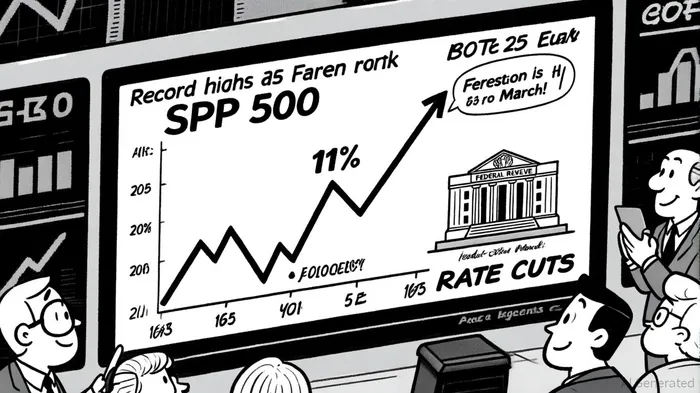
The U.S. equity market in 2025 has been a study in contrasts: record highs driven by AI optimism and strong earnings, punctuated by sharp corrections fueled by trade policy uncertainty and inflation concerns. As of September 2025, the S&P 500 and Nasdaq have oscillated between euphoria and caution, offering a compelling case study in market momentum and investor sentiment.
The Paradox of Record Highs and Corrections
Equity indices reached historic levels in 2025, with the S&P 500 hitting a new peak in August amid robust earnings from tech giants like AlphabetGOOGL--, AmazonAMZN--, and NvidiaNVDA-- [3]. Yet, these milestones were followed by notable pullbacks. A case in point: the 11% correction in early March 2025, triggered by the "Liberation Day" tariff announcements, which rattled investor confidence and pushed the index into a formal correction [2]. Such volatility underscores a key tension in modern markets—how sustained earnings growth can coexist with sudden, sharp declines.
Historical data suggests that corrections, while jarring, often fail to derail long-term trends. According to AllianceBernsteinAFB--, investing in the S&P 500 or MSCIMSCI-- World indices at or near record highs has historically delivered strong three-year forward returns, averaging over 36% [1]. Moreover, 75% of the time, investors who bought after a 10% decline saw positive returns within a year, averaging 11% [2]. This resilience is partly due to the gradual nature of earnings deceleration—companies rarely stop growing abruptly, even as macroeconomic headwinds emerge [1].
Investor Sentiment: Complacency or Confidence?
Despite recent turbulence, investor sentiment remains cautiously optimistic. Asset managers hold their highest net long exposure to the S&P 500 in over two decades, while the put-to-call options ratio—a gauge of market fear—has hit historically low levels [2]. This complacency, however, is not without risks. Morgan StanleyMS-- notes that much of the market's gains in 2025 have been concentrated in a handful of high-profile companies, leaving broader corporate fundamentals uneven [2].
The rotation from growth to value stocks further complicates the picture. As trade tensions and inflation fears mounted, investors flocked to dividend-paying equities and small-cap stocks. The Russell 2000 Index, for instance, surged 7.1% in August 2025 alone, outperforming large-cap peers [3]. This shift reflects a pragmatic recalibration: investors are hedging against uncertainty by prioritizing stability and cash flow over speculative growth.
The Role of Policy and Geopolitical Uncertainty
The Federal Reserve's evolving stance has been a critical wildcard. With job growth slowing and inflation signals mixed, the Fed's hints at rate cuts in late 2025 have injected optimism into markets [3]. However, geopolitical tensions—ranging from U.S.-China trade disputes to energy price shocks—continue to weigh on sentiment. As noted by the Financial Express, these factors have increased the likelihood of a meaningful correction in global equity markets, with potential spillovers into economies like India [4].
Looking Ahead: Momentum or Mean Reversion?
Technical indicators suggest the S&P 500 could add 5%-10% over the next 12 months, driven by momentum, liquidity, and seasonal patterns [2]. BlackRockBLK--, however, cautions that Q3 2025 volatility has highlighted the need for resilience and thoughtful stock selection [1]. Diversification and a focus on quality—companies with strong balance sheets and consistent earnings—remain key strategies for navigating the current environment.
Conclusion
The 2025 equity market has demonstrated both the power of innovation-driven growth and the fragility of investor confidence. While corrections like the March 2025 selloff test market resolve, historical patterns suggest that disciplined investors can capitalize on volatility. The challenge lies in balancing optimism about AI and tech-driven gains with caution about overvalued sectors and macroeconomic risks. As the year draws to a close, the interplay between momentum and sentiment will remain central to the market's trajectory.





Comentarios
Aún no hay comentarios