
Are We Looking At A Market Meltdown?
The global financial landscape in 2025 is rife with early warning signals that suggest a potential market meltdown. From inverted yield curves to fragile household balance sheets and divergent investor sentiment, the signs of systemic strain are hard to ignore. While equity markets continue to rally on AI-driven optimism and anticipated Federal Reserve easing, underlying macroeconomic imbalances and historical parallels to past crises demand closer scrutiny.
Macroeconomic Imbalances: A Recipe for Volatility
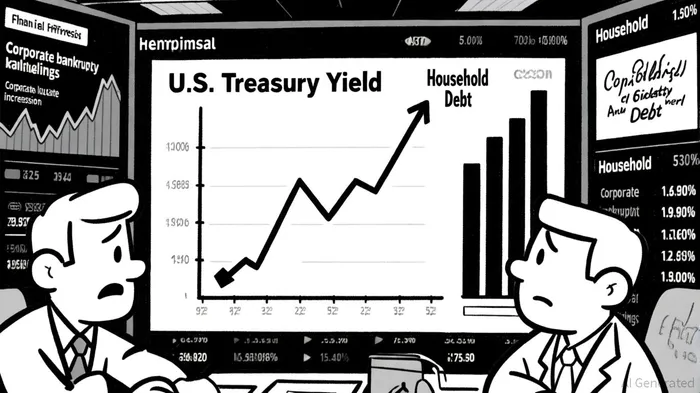
The most alarming indicator is the deep inversion of the U.S. Treasury yield curve, where the 2-year/10-year spread has reached historically negative levels. This inversion, a reliable precursor to recessions since the 1960s, reflects investor expectations of slower growth and tighter monetary policy in the near term, according to Recession Watchguard. Compounding this, consumer confidence has plummeted to multi-year lows, with households increasingly prioritizing savings over spending amid inflationary pressures and policy uncertainty, according to a Forbes analysis. Over 64% of Americans now live paycheck to paycheck, while total household debt has surged to $18.2 trillion, amplifying vulnerability to income shocks, Economics Help reports.
Corporate bond markets, meanwhile, mask fragility behind tight credit spreads. Despite low default rates, bankruptcy filings hit a 14-year high in 2024, signaling strain in overleveraged sectors, Business Insider reported. The labor market, though still relatively strong, shows cracks: declining quits rates and rising temporary layoffs suggest waning worker confidence, a CapIS analysis finds. In commercial real estate, delinquency rates near 12% in key markets highlight structural shifts in office demand, driven by remote work and AI-driven automation, the IMF report notes.
Globally, the risks are even more pronounced. Total global debt now exceeds $315 trillion, with derivatives notional values surpassing $600 trillion-levels that amplify contagion risks in a crisis, a Morningstar Q3 review found. The U.S.'s aggressive tariff hikes on imports from Mexico, the EU, and Canada, including a 50% tariff on copper, have further destabilized supply chains and inflation expectations, State Street notes.
Investor Sentiment: Optimism vs. Prudence
Despite these red flags, investor sentiment remains mixed. Equity markets, particularly in AI and semiconductors, have surged to record highs, fueled by strong earnings and expectations of Fed rate cuts, a Morningstar analysis observes. The Nasdaq's outperformance, driven by megacap tech stocks, reflects a "growth at all costs" mentality. Meanwhile, gold has surged 16.8% in Q3 2025, hitting $3,800 per ounce as a safe-haven asset amid geopolitical tensions and dollar weakness, according to a Vanguard survey.
The Federal Reserve's cautious approach to rate cuts-projecting only one or none in 2025-has created a tug-of-war between market expectations and economic reality. While investors price in a 98% probability of a 25-basis-point cut at the October FOMC meeting, policymakers remain wary of persistent inflation and fiscal risks. This disconnect between market complacency and central bank caution mirrors pre-crisis dynamics in 2007 and 2000.
Behavioral factors further complicate the outlook. Vanguard's survey (cited above) reveals growing short-term pessimism about inflation and interest rates, even as long-term confidence in growth persists. Herding behavior and loss aversion-classic psychological biases-could exacerbate volatility if sentiment shifts abruptly.
Historical Parallels: Lessons from the Past
History offers sobering parallels. The 1929 crash was preceded by a speculative boom in overvalued stocks and a fragile banking system, while the 2008 crisis stemmed from toxic mortgage-backed securities and lax regulation. The 2001 dot-com bust similarly reflected overconfidence in unproven business models. In each case, investor sentiment turned euphoric before collapsing, often after years of complacency.
Today's environment shares eerie similarities. The AI-driven tech rally echoes the dot-com era, with valuations stretched to unsustainable levels. Meanwhile, the global debt burden and shadow banking risks mirror pre-2008 conditions. The key difference lies in central banks' balance sheet firepower-a tool that may delay but not prevent a correction.
Conclusion: Navigating the Crossroads
The question is not whether a market meltdown is inevitable, but when and how severe it will be. While the Fed's tools and global liquidity provide a buffer, the cumulative weight of macroeconomic imbalances and divergent sentiment suggests a high probability of turbulence. Investors must balance participation in growth sectors with defensive positioning in gold, short-duration bonds, and cash.
As the IMF and OECD project global growth to decelerate to 3.0% in 2025 and 2.9% in 2026, the path forward demands vigilance. History teaches that markets often correct when complacency is highest. For now, the warning lights are flashing-ignoring them could prove costly.






Comentarios
Aún no hay comentarios