
Market Focus: DOJ-Fed Drama vs. Corporate Catalysts (Vistra, Tempus AI, Alibaba)
The immediate market mover this week is a political bombshell. The Department of Justice has served the Federal Reserve with subpoenas and threatened a criminal indictment over Chair Jerome Powell's testimony last June about headquarters renovations. This is not a routine oversight action; it is an unprecedented escalation in President Donald Trump's long-running battle with the central bank. The move directly targets the Fed's independence, framing Powell's actions as a pretext to pressure the institution into cutting interest rates more aggressively.
The market's reaction was swift and negative. U.S. stock futures plunged on Monday, with major indices like the S&P 500 and Nasdaq 100 each down over 0.7%. This volatility is a direct pricing of heightened systemic risk. The CME Group's FedWatch tool shows traders now pricing a 95% likelihood of the Federal Reserve leaving the current interest rates unchanged in January, a level of certainty that underscores the market's desire to avoid further disruption.
Powell himself framed the action starkly. In a video message, he stated that the threat of criminal charges is a consequence of the Federal Reserve setting interest rates based on our best assessment of what will serve the public, rather than following the preferences of the President. He called the DOJ's move an "unprecedented action" and a clear attempt to intimidate an independent agency. This isn't about building costs; it's about the fundamental question of whether monetary policy will be set by economic data or political pressure. For now, the market is reacting to the shock to the system, not the underlying policy debate.
Vistra: A Megadeal for Nuclear Power
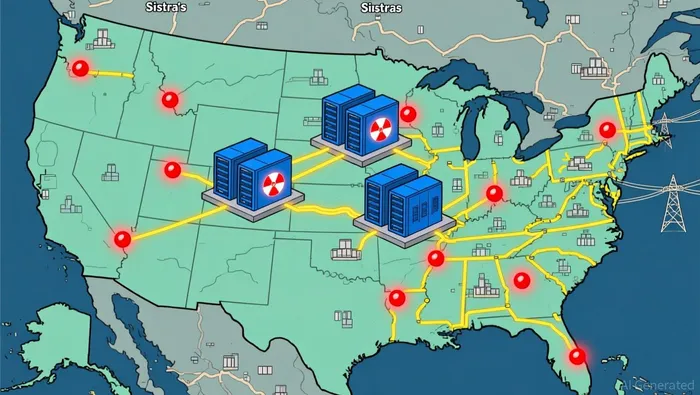
The corporate catalyst this week is a landmark energy deal that turns a nuclear power plant into a strategic asset for the AI era. Vistra announced 20-year power purchase agreements with Meta to provide over 2,600 megawatts of zero-carbon energy from three of its nuclear plants. This isn't just a routine supply contract; it's a multi-billion dollar bet on the long-term viability of existing nuclear assets, funded by a tech giant's insatiable appetite for clean power.
The scale is significant. The deal includes 2,176 MW of operating generation from the Perry and Davis-Besse plants in Ohio, plus an additional 433 MW of incremental output from equipment upgrades at all three sites. That 433 MW represents the largest nuclear uprate project ever supported by a corporate customer in the United States. More importantly, it extends the operational life of these plants. The PPAs provide the financial certainty Vistra needs to pursue subsequent license renewals, which would keep the reactors running for another 20 years beyond their current licenses.
For Vistra, the immediate implications are clear. The deal locks in long-term revenue visibility for a critical asset class, directly addressing the financial pressure that had previously pushed these plants toward retirement. It also provides a powerful narrative for investors: Vistra is no longer just a utility, but a key enabler of the AI infrastructure build-out. The partnership with Meta, which has positioned itself as a major corporate buyer of nuclear energy, adds a layer of credibility and signals that large-scale, reliable power is a non-negotiable input for next-generation computing.
The bottom line is a fundamental shift in the valuation calculus for nuclear. This catalyst moves the conversation from a debate about the future of the technology to a real-time, multi-decade commitment from a major corporate customer. It de-risks the capital-intensive path of plant uprates and license extensions, making a case for nuclear as a stable, carbon-free power source that can meet the firm, baseload needs of data centers. For now, the market's focus is on the political drama, but this Vistra-Meta deal is a tangible, event-driven story about energy infrastructure that could have lasting financial consequences.
Tempus AI: Record Contract Value and Growth
The market's focus on political drama is a distraction from a powerful corporate catalyst in healthcare AI. Tempus AI has delivered a clear signal of financial strength and explosive growth, announcing a record Total Contract Value (TCV) of > $1.1 billion as of December 31, 2025. This isn't just a headline number; it's a tangible measure of demand locking in future revenue for years to come.
The growth trajectory is equally impressive. The company reported 2025 net revenue retention of ~126%, a figure that demonstrates its platform is not only attracting new customers but also deeply embedding itself within existing ones, driving expansion at scale. This was fueled by signing data agreements with over 70 customers in 2025, including major pharmaceutical giants like AstraZeneca and Pfizer. The sheer volume and quality of these new contracts validate the commercial appeal of its multimodal dataset.
Put simply, this sets up a classic growth story. The record TCV provides exceptional visibility into future cash flows, while the high net revenue retention shows the business is sticky and scalable. For investors, this is a catalyst that moves the needle on valuation. It transforms Tempus from a promising AI company into one demonstrating real, contracted demand for its technology in the high-stakes world of drug discovery. The political noise fades in comparison to this kind of fundamental business momentum.
Alibaba: Qwen AI's Open-Source Dominance
While the West debates AI regulation, Alibaba is winning the open-source arms race. The company's flagship Qwen AI models have crossed a critical threshold, becoming the world's most widely used open-source system. As of January, the Qwen family had surpassed 700 million downloads on the developer platform Hugging Face.
The scale of this dominance is staggering. Research from consultancy AIBase shows that estimated Qwen downloads in December alone exceeded the combined total of the next eight most popular models globally. That includes heavyweights from Meta Platforms and OpenAI, as well as major Chinese competitors like Zhipu AI and Moonshot AI. This isn't just a lead; it's a commanding, multi-model victory.
For Alibaba, this is a powerful competitive and perception shift. It reinforces the company's leadership not just in China, but within the international developer community. The sheer volume of downloads-tens of thousands of real-world applications have been built on Qwen-validates its AI ecosystem as a foundational platform. This dominance in open-source adoption translates directly to market perception, positioning Alibaba Cloud as a central player in the global AI infrastructure build-out. In a landscape where developer mindshare is currency, Alibaba has just secured a massive, defensible advantage.
Catalysts and Risks: What to Watch
The immediate market narrative is a political standoff, but the lasting impact will hinge on a few key events and execution risks. The Supreme Court's oral arguments on President Trump's tariffs, scheduled for January 21, is the concurrent high-stakes event. A ruling that upholds or strikes down these measures will directly influence inflation expectations and corporate margins, adding another layer of volatility to an already stressed environment.
For the Fed's independence, the risk is operational. The DOJ's criminal investigation creates a chilling precedent. The market will be watching for any policy missteps or communications from the Fed that could signal a loss of operational independence. Chair Powell's stark warning that the investigation is a pretext for the president's desire for lower borrowing costs sets the tone, but the real test is whether the central bank's actions and rhetoric remain purely data-driven. Any perceived capitulation would validate the market's fears and likely trigger a repricing of risk.
On the corporate side, execution is the critical uncertainty. For Vistra, the catalyst is a multi-billion dollar deal, but the risk is in the details. The company must deliver on the 433 MW of combined power output increases and secure subsequent license extensions for the plants. These are complex, capital-intensive projects. Any delay or cost overrun would undermine the financial certainty the Meta partnership was supposed to provide. Meta's own commitment, as outlined in its announcement, is to add clean, reliable energy to electric grids and support the nuclear fuel supply chain-this is a long-term build-out, not an instant fix.
For Alibaba, the dominance of its Qwen models is impressive, but the risk is commercialization. The 700 million downloads are a powerful signal of developer mindshare, but converting that into sustainable revenue streams for Alibaba Cloud is the next hurdle. The company must demonstrate that its open-source lead translates into enterprise contracts and cloud service growth. The competitive landscape is fierce, with major players from both the West and China vying for the same developer ecosystem.
In this context of political and regulatory stress, these catalysts are not isolated events. The Vistra-Meta deal is a bet on stable, long-term power in a volatile world. The Tempus AI growth story is a counter-narrative of commercial momentum. The Alibaba Qwen dominance is a strategic win in a global tech race. The market's focus will oscillate between the immediate shock of the Fed drama and the longer-term, execution-driven stories that could define winners and losers in the coming quarters.





Comentarios
Aún no hay comentarios