
Mark Cuban's Alternative Asset Playbook: A New Era for Inflation Hedging
In the aftermath of the pandemic-driven economic upheaval, inflation has remained a persistent shadow over global markets. Traditional assets like gold, long revered as inflation hedges, now face competition from digital alternatives. At the forefront of this shift is Mark Cuban, a billionaire entrepreneur and investor whose recent statements and portfolio allocations underscore a bold reimagining of how to combat inflation in a post-pandemic world. Cuban's endorsement of cryptocurrencies and NFTs as superior hedges against economic uncertainty offers a compelling case study for investors navigating today's volatile landscape.
The Case Against Gold: BitcoinBTC-- as “Digital Gold”
Cuban has been unambiguous in his critique of gold as a store of value. In January 2025, he declared, “I'd rather own Bitcoin than gold if something bad were to happen to the economy,” arguing that Bitcoin's portability, divisibility, and utility as a medium of exchange make it a “better version of gold”[2]. This stance aligns with the growing narrative of Bitcoin as “digital gold,” a concept championed by institutions like MicroStrategy and Tesla. Cuban's skepticism of gold is rooted in its practical limitations: “People aren't gonna walk around with gold bars,” he quipped, highlighting Bitcoin's ease of use in transactions[2].
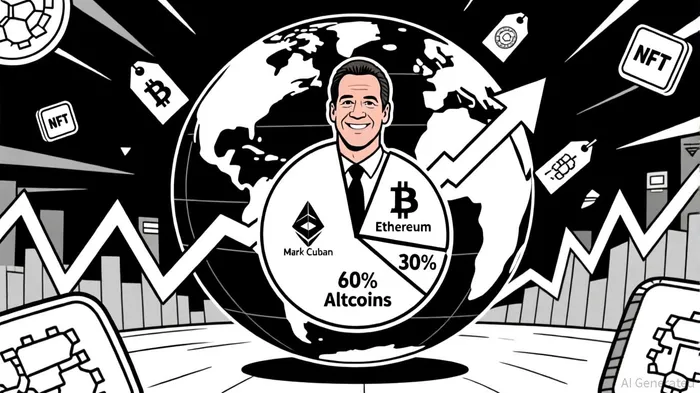
This perspective is not merely rhetorical. Cuban's crypto portfolio reflects a strategic allocation of 60% to Bitcoin, positioning it as his primary inflation hedge[1]. By contrast, gold's role in institutional portfolios has waned, with central banks adding just 113.7 tons in 2023, a 40-year low, according to the World Gold Council[3]. Cuban's preference for Bitcoin over gold signals a broader generational and technological shift in how value is stored and transferred.
Ethereum and Altcoins: Innovation as a Hedge
While Bitcoin dominates Cuban's crypto holdings, EthereumETH-- and altcoins play critical roles in his strategy. Ethereum's 30% allocation is justified by its dominance in decentralized finance (DeFi) and smart contract innovation, which Cuban views as foundational to blockchain's transformative potential[1]. Altcoins like Polygon (POL) and InjectiveINJ-- Protocol (INJ) further diversify his exposure to niche use cases, from decentralized exchanges to data privacy solutions[1].
This approach mirrors broader market trends. Ethereum's transition to a proof-of-stake model in 2022 reduced energy consumption by 99.95%, enhancing its appeal as a sustainable asset[5]. Meanwhile, altcoins have outperformed Bitcoin in certain sectors, with projects like ApeCoinAPE-- (APE) gaining traction in the NFT ecosystem[1]. Cuban's portfolio thus balances stability (Bitcoin) with innovation (Ethereum and altcoins), creating a multi-layered hedge against inflation.
NFTs: Beyond Speculation to Strategic Investment
Cuban's engagement with NFTs extends beyond speculative trading. In June 2024, he sold 14 NFTs, including a Pudgy Penguin for $30,578, while simultaneously investing in NFT platforms like Mintable and CryptoSlam[1]. These moves highlight his belief in NFTs as both collectibles and infrastructure for blockchain's future. By supporting platforms that enhance data transparency and accessibility, Cuban is positioning himself to capitalize on NFTs' evolving role in digital ownership and provenance tracking.
This strategy contrasts with the 2021 NFT frenzy, where speculative buying dominated. Today, NFTs are increasingly tied to real-world assets and utility, such as virtual real estate and ticketing systems[3]. Cuban's focus on platforms rather than individual NFTs suggests a long-term bet on blockchain's institutionalization.
Inflation's “Fixed” Rate and the Cost-of-Living Dilemma
Cuban has also addressed inflation's broader implications. In November 2024, he noted that the annual inflation rate had fallen to 2.7% from a peak of 9.1% in 2022, declaring it “fixed”[3]. However, he cautioned that “high prices are here to stay,” emphasizing the need for wage growth to offset the cost-of-living crisis[3]. This duality—lower inflation rates but entrenched price levels—highlights the limitations of monetary policy and underscores the role of alternative assets in preserving purchasing power.
A Blueprint for the Future
Cuban's strategy offers a roadmap for investors seeking to hedge against inflation in a digital-first economy. By prioritizing Bitcoin as a store of value, Ethereum as a platform for innovation, and NFTs as a bridge to blockchain's next phase, he exemplifies a diversified approach to alternative assets. His critiques of gold and emphasis on utility over speculation reflect a forward-looking mindset that aligns with the post-pandemic reality of decentralized finance and digital scarcity.
Conclusion
As central banks grapple with the legacy of pandemic-era stimulus and supply chain disruptions, traditional inflation hedges are being reevaluated. Mark Cuban's endorsement of cryptocurrencies and NFTs as superior alternatives to gold and fiat currencies reflects a paradigm shift in how value is perceived and preserved. For investors, his portfolio serves as a case study in leveraging innovation to navigate macroeconomic uncertainty. In a world where digital assets are no longer fringe, Cuban's strategy offers a compelling blueprint for the future.






Comentarios
Aún no hay comentarios