
Is a Margin Decline in Broadcom a Buying Opportunity or a Warning Sign?
The semiconductor industry's AI revolution has made BroadcomAVGO-- (AVGO) a standout performer, with its AI-driven revenue surging on the back of custom chip demand from hyperscalers. Yet, recent margin declines have sparked debate: Is this a temporary cost of growth, or a red flag for long-term sustainability? To answer, investors must weigh Broadcom's strategic strengths against structural risks in the AI semiconductor market.
AI Revenue Growth: A Double-Edged Sword
Broadcom's AI semiconductor revenue has exploded, jumping 74% year-over-year to $6.5 billion in Q4 FY2025. The company now forecasts AI-related revenue of $8.2 billion in Q1 2026, far exceeding the $6.9 billion consensus. This growth is fueled by a $73 billion backlog-most of it tied to five major customers, including Alphabet and Meta-and a $11 billion order from Anthropic. Such demand underscores AI's transformative potential but also highlights a critical vulnerability: customer concentration. If key clients shift to in-house chip development or renegotiate terms, Broadcom's revenue could face sudden headwinds.
Margin Pressures: The Cost of AI Ambition
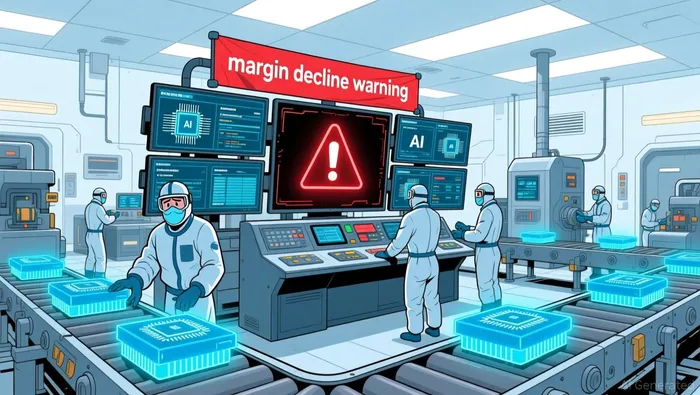 Broadcom's CFO, Kirsten Spears, has openly acknowledged that AI's rapid expansion is squeezing margins. The company expects a 100-basis-point sequential drop in gross margin for Q1 2026, driven by the lower profitability of custom AI accelerators compared to established segments. This aligns with broader industry trends: AI chips, while high-growth, often carry pass-through costs and face pricing pressures as competition intensifies. Historically, Broadcom has navigated margin challenges through its Infrastructure Software segment, which contributed 41.6% of total revenue in FY2024 and offers recurring, stable cash flows. However, with AI hardware now dominating the revenue mix, the buffer provided by software may not offset hardware margin declines indefinitely.
Strategic Resilience: Can Broadcom Adapt?
Broadcom's management has deployed several strategies to mitigate risks. First, it emphasizes modular AI platforms and long-term use cases to avoid fragmented deployments, ensuring clients derive measurable value from its solutions. Second, the company has linked executive compensation to customer satisfaction and innovation, incentivizing relationship stability and product differentiation. These measures aim to reduce churn and maintain pricing power. Additionally, Broadcom's $7.47 billion quarterly free cash flow provides flexibility to invest in R&D or return capital to shareholders, cushioning near-term margin pressures.
Industry-Wide Challenges and Opportunities
The AI semiconductor sector is at a crossroads. While demand for custom chips remains robust, analysts warn of commoditization as more players enter the market and supply catches up. A study of 95 semiconductor firms found that business model innovation and R&D efficiency are critical to sustaining valuations in competitive markets. Broadcom's focus on advanced packaging and ecosystem collaboration positions it to address technical hurdles like power consumption according to industry analysis, but its reliance on a narrow customer base could amplify risks if demand shifts.
### Conclusion: A Calculated Bet on AI's Future
Broadcom's margin decline reflects the inherent trade-offs of leading in a high-growth, capital-intensive sector. For investors, the key question is whether the company's strategic investments-modular platforms, software diversification, and customer-centric incentives-can offset structural margin pressures. The $73 billion backlog suggests strong near-term visibility, but long-term success will depend on Broadcom's ability to innovate beyond its current customer base and navigate industry-wide commoditization.
If the company can maintain its technological edge while expanding its client footprint, the margin dip may prove to be a buying opportunity-a temporary cost of capturing AI's long-term value. However, if customer concentration and pricing pressures persist, the warning signs could harden. For now, Broadcom's balance sheet strength and strategic agility offer a compelling case for cautious optimism.





Comentarios
Aún no hay comentarios