
MARA's Strategic Energy Flexibility as a Defining Competitive Edge in the AI Era
Vertical Integration: Powering AI at the Speed of Natural Gas
MARA's partnership with MPLX LPMPLX-- in West Texas exemplifies this strategy. The company is developing 1.5 gigawatts of gas-fired power generation to fuel its data centers, leveraging low-cost natural gas from MPLX's Delaware Basin operations. This vertical integration slashes energy costs and hosting expenses, as MARA no longer depends on volatile grid prices. The result? Record profitability: Q3 2025 net income hit $123 million, driven by synergies between bitcoinBTC-- mining, power generation, and AI infrastructure.
Traditional hyperscalers, by contrast, face a Catch-22. While Google, Amazon, and Microsoft invest billions in renewables and cooling innovations-Microsoft's chip-level liquid cooling reduces mechanical energy use by 46%-they remain exposed to grid constraints. In regions like Texas, where data centers already strain local grids, energy costs have spiked by 267% over five years. MARA's on-site power generation insulates it from such volatility, offering a scalability edge.
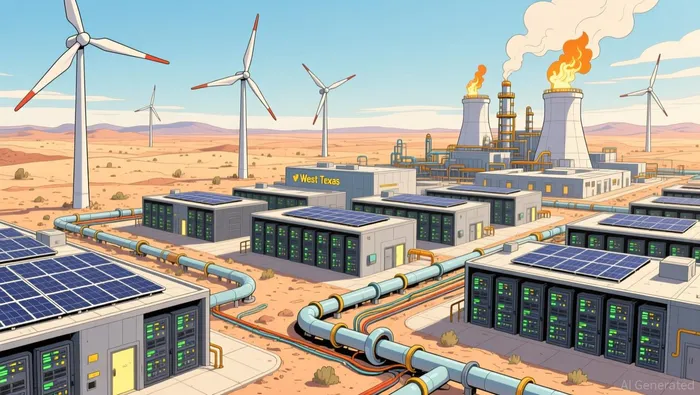
The Energy-Centric AI Play
MARA's model aligns with a broader industry shift: control over energy is becoming a competitive moat. As AI models grow larger, their power demands outstrip even the most efficient cooling technologies. Microsoft's $10 billion renewable energy deal with Brookfield and Alphabet's bets on long-duration storage highlight this trend. Yet these solutions remain grid-dependent, whereas MARA's energy ownership creates a self-sustaining ecosystem.
This flexibility is critical. Natural gas, while controversial environmentally, offers a cost advantage in regions with abundant reserves. For MARA, this isn't a long-term energy strategy but a pragmatic bridge to future-proofing. The company can pivot to renewables as they scale, without sacrificing performance or margins. Traditional providers, bound by grid limitations, lack this agility.
Risks and Realities
Critics argue that MARA's reliance on fossil fuels could backfire as regulators tighten emissions rules. However, the company's hybrid approach-pairing gas with renewable investments-mitigates this risk. Moreover, its energy-managed model reduces capital expenditures on hosting infrastructure, a $1.2 billion industry bottleneck. For investors, the key metric is not just energy efficiency but financial resilience: MARA's Q3 results suggest its strategy is already paying off.
Conclusion: The New AI Infrastructure Paradigm
In an era where energy costs determine AI dominance, MARA's energy-managed compute infrastructure is a masterstroke. By controlling its power supply, the company avoids the grid bottlenecks and price surges that plague traditional hyperscalers. While Google, Amazon, and Microsoft lead in innovation, MARA's vertical integration offers a leaner, more scalable path to AI supremacy. For investors, this isn't just about energy-it's about capturing the next phase of the AI revolution before the grid breaks.





Comentarios
Aún no hay comentarios