
MARA's Bitcoin Liquidation and Its Implications for Mining Company Strategy
Asset Liquidity: A Hybrid Strategy in Action
MARA's Q3 2025 results underscored its dual focus on near-term profitability and long-term Bitcoin accumulation. The company reported a 92% year-over-year revenue increase to $252 million and a net profit of $123 million, reversing a $125 million loss in the same period in 2024. This turnaround was driven by a 64% rise in hashrate and lower power costs, which reduced the daily cost per petahash to $31.30. Simultaneously, MARA's Bitcoin holdings surged by 98% year-over-year to 52,850 BTC, valued at approximately $5.3 billion.
However, the company's transfer of 2,348 BTC ($236 million) to exchanges in Q3 raised questions about liquidity needs. While MARA's official statement emphasized a "hybrid Bitcoin strategy" that retains mined Bitcoin for long-term value creation while generating stable cash flow, the timing-just one day after the earnings report-sparked speculation about potential sales according to a market analysis. Analysts like Willy Woo have highlighted that miners with diversified revenue streams, such as MARA's energy and AI infrastructure projects, can afford to hold Bitcoin without forced liquidation. This suggests that the transfer may reflect strategic flexibility rather than a liquidity crisis.
Market Sentiment: Volatility and Strategic Messaging
Market sentiment toward MARA's Bitcoin transfer was mixed. On one hand, the move reinforced perceptions of Bitcoin as a corporate asset class, with MARA's $5.3 billion Bitcoin treasury positioning it as the second-largest publicly traded Bitcoin holder. On the other, the transfer fueled fears of a miner-driven selloff, particularly as Bitcoin prices dipped below $100,000 in Q4 2025 according to an industry report.
MARA's strategic messaging, however, has consistently emphasized long-term appreciation. The company's expansion into energy production and AI infrastructure-such as its partnership with MPLX LP to build 1.5 gigawatts of gas-fired power generation-signals a commitment to leveraging Bitcoin's value while diversifying revenue streams. This approach aligns with broader industry trends, as miners increasingly integrate energy assets to hedge against Bitcoin's price volatility.
Bitcoin's Role in Miner Balance Sheets: A New Paradigm
MARA's balance sheet reflects a paradigm shift in how miners manage Bitcoin. As of September 30, 2025, the company held $961.9 million in current assets, including $826.4 million in cash and $3.7 million in digital assets according to its financial report. Its total assets grew to $9.15 billion, with Bitcoin holdings accounting for a significant portion. This contrasts with traditional balance sheet management, where Bitcoin is often treated as a short-term asset to cover operational costs.
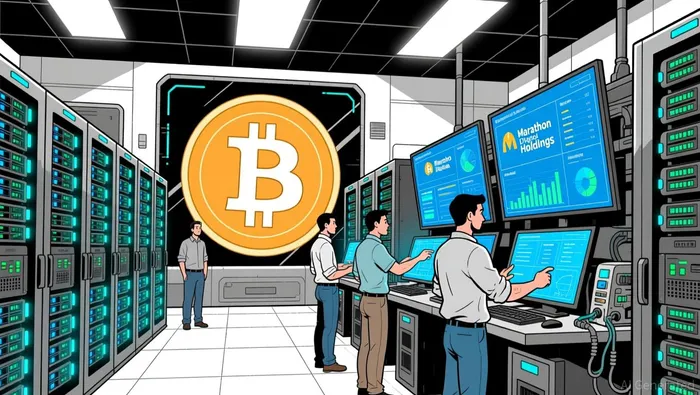 MARA's strategy of retaining Bitcoin while monetizing mining efficiency gains-such as its 15% year-over-year reduction in power costs-highlights a new model where Bitcoin serves as both a store of value and a liquidity buffer. This approach mirrors MicroStrategy's debt-structured Bitcoin strategy, which allows flexibility to avoid forced sales during downturns. For MARAMARA--, the key risk lies in prolonged Bitcoin stagnation, which could pressure its ability to service $3.5 billion in long-term liabilities. However, its diversified energy and AI initiatives provide a counterbalance as demonstrated in its recent operations.
Conclusion: Strategic Implications for the Mining Sector
MARA's Q3 2025 actions underscore a broader trend in the mining sector: the integration of Bitcoin into corporate balance sheets as a strategic asset rather than a liquidity tool. While the transfer of 2,348 BTC to exchanges raised short-term concerns, the company's financial performance and long-term investments suggest a calculated approach to managing Bitcoin's volatility. For investors, this highlights the importance of distinguishing between tactical liquidity moves and strategic asset allocation.
As Bitcoin's role in corporate finance evolves, miners like MARA are redefining the boundaries of asset management. Their success will depend on balancing Bitcoin's speculative potential with operational efficiency-a challenge that could reshape the industry's approach to liquidity, market sentiment, and balance sheet resilience.





Comentarios
Aún no hay comentarios