
Mantle's ZK Transition and the Implications for MNT's Long-Term Value
The transition of Mantle Network to a zero-knowledge (ZK) validity rollup in 2025 marks a pivotal moment in Ethereum's Layer 2 evolution, with profound implications for blockchain scalability and tokenomics dynamics. By integrating Succinct's SP1 and EigenDA, Mantle has notNOT-- only redefined transaction finality and security but also positioned its native token, MNT, as a cornerstone of a capital-efficient, institutional-grade ecosystem. This analysis explores how these technical advancements and economic incentives are reshaping Mantle's value proposition and MNT's long-term trajectory.
Technical Upgrades: A Scalability Revolution
Mantle's shift from an optimistic rollup to a ZK-based framework has delivered unprecedented improvements in performance. According to a report by CoinJournal, the network reduced chain finality from seven days to just one hour—a 168x enhancement—enabling faster asset settlements and bridging capabilities[1]. This leap in efficiency is underpinned by Succinct's SP1 zkVM, which ensures EVM equivalence while slashing proving costs to as low as $0.002 per transaction[2]. Such advancements align with Ethereum's modular scaling vision, fostering interoperability and reducing fragmentation across the ecosystem[3].
EigenDA's integration further strengthens Mantle's infrastructure by providing decentralized data availability at 15 MB/s throughput, a 234x bandwidth expansion[1]. These technical upgrades not only enhance security but also enable Mantle to process 175 million on-chain transactions, solidifying its role as a “Liquidity Chain” for DeFi, real-world assets (RWA), and institutional adoption[3].
Tokenomics Dynamics: Demand Drivers and Economic Incentives
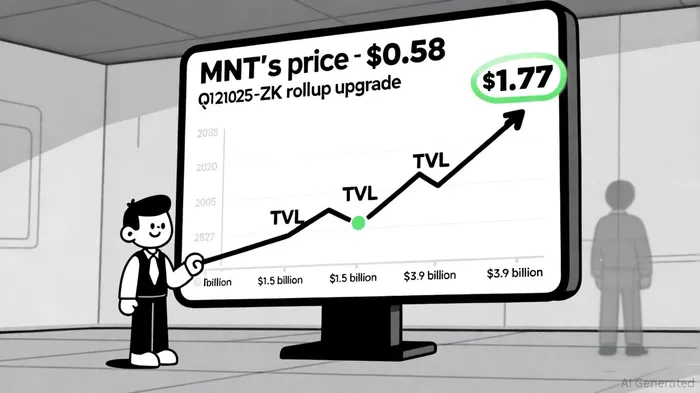
The ZK transition has directly influenced MNT's tokenomics, creating new demand drivers and utility layers. As stated by Messari in its Q2 2025 report, Mantle's total value locked (TVL) surged to $3.9 billion post-upgrade, with flagship assets like mETH and FBTC playing a critical role in institutional-grade settlements[3]. This growth has been mirrored in MNT's price performance, which hit an all-time high of $1.77 in September 2025, driven by increased TVL and institutional interest[3].
MNT's utility extends beyond governance and staking; it now underpins a robust economic model. The token's inflationary schedule, which halves every two years, creates a deflationary tailwind as usage grows. Additionally, Mantle's treasury—holding $2.3 billion in assets—funds initiatives like the Rewards Station S3 and Lightning Grants, distributing 1.2 million MNT monthly to incentivize liquidity provision and ecosystem development[3]. These mechanisms ensure sustained demand, particularly as Mantle's modular architecture supports cross-rollup interoperability and deeper DeFi liquidity pools[3].
Market Implications and Long-Term Value
The ZK transition has repositioned Mantle as a leader in the Layer 2 race, with MNT's long-term value hinging on three factors:
1. Scalability Leadership: By offering one-hour finality and sub-cent transaction fees, Mantle attracts developers and users seeking efficient, secure infrastructure[2].
2. Institutional Adoption: The network's focus on capital efficiency and RWA integration has drawn anchor investments, such as the $400 million Mantle Index Four (MI4), diversifying MNT's demand base[3].
3. Token Utility Expansion: With EigenDA and SP1 enabling novel applications, MNT's role in staking, gas, and governance is likely to expand, reinforcing its scarcity and utility.
However, challenges remain. Competition from established ZK players like Polygon zkEVM and regulatory scrutiny of restaking mechanisms could temper growth[1]. Yet, Mantle's first-mover advantage in ZK validity rollups and its $2.3 billion treasury provide a strong buffer against these risks[3].
Conclusion
Mantle's ZK transition represents a masterstroke in blockchain scalability, combining technical innovation with tokenomics that prioritize capital efficiency and institutional readiness. As the network solidifies its position as the largest ZK rollup by TVL, MNT's long-term value is poised to benefit from sustained demand, expanding utility, and a robust economic model. For investors, the key takeaway is clear: Mantle's ability to harmonize scalability with tokenomics positions it as a critical player in Ethereum's next phase of growth.






Comentarios
Aún no hay comentarios