
Mantle's Strategic Partnership with Apex: A Catalyst for Institutional Adoption in Crypto
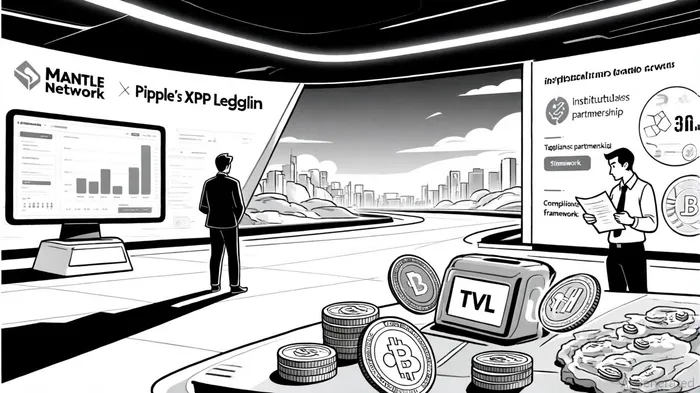
The institutional crypto landscape in 2025 is undergoing a seismic shift, driven by innovations in blockchain infrastructure that bridge traditional finance (TradFi) and decentralized finance (DeFi). At the forefront of this transformation are two key players: Mantle Network, a modular EthereumETH-- Layer 2 blockchain, and Ripple's XRP Ledger (XRPL), which has emerged as a global stablecoin and tokenization platform. While no direct collaboration between Mantle and Ripple's Apex 2025 initiatives has been explicitly confirmed, their complementary advancements—ranging from zero-knowledge (ZK) rollups to institutional-grade tokenization—collectively form a strategic ecosystem that is accelerating institutional adoption. For investors, this convergence signals a maturing market where scalability, compliance, and liquidity are no longer theoretical but operational realities.
Mantle Network: Redefining On-Chain Finance
Mantle Network has positioned itself as a critical infrastructure layer for institutional-grade DeFi by leveraging modular architecture and EigenDA for data availability. Its transition to a ZK validity rollup via Succinct's SP1 technology has reduced transaction finality from seven days to one hour, enabling faster settlements and capital efficiency[1]. By Q1 2025, Mantle's Total Value Locked (TVL) surpassed $1.2 billion, with daily active users hitting 650,000[2]. This growth is underpinned by products like the Mantle Enhanced Index Fund (EIF), which offers institutional exposure to BTC, ETH, and SOLSOL-- while generating yield through native tokens like mETH and FBTC[3].
Mantle's $4.3 billion community-owned treasury further amplifies its role as a liquidity hub, funding initiatives such as the Mantle EcoFund, which supports over 500 DeFi projects[4]. The network's integration with AI-driven platforms like MantleX and its focus on cross-chain interoperability position it as a bridge between TradFi and DeFi, addressing institutional pain points like custody, compliance, and yield generation[5].
Apex 2025 and the XRP Ledger: Institutionalizing Tokenization
Ripple's Apex 2025 event marked a pivotal moment for the XRP Ledger (XRPL), showcasing its evolution into a global stablecoin and tokenization platform. The launch of five new stablecoins (USDC, XSGD, EURØP, RLUSD, and USDB) and tokenized U.S. Treasuries via Ondo's OUSG demonstrated the XRPL's ability to deliver real-time liquidity and programmable assets[6]. Ripple's roadmap for 2025 includes a permissioned decentralized exchange (DEX) with decentralized identifiers (DIDs) for compliance checks, Ethereum VirtualCYBER-- Machine (EVM) sidechains for cross-chain compatibility, and Multi-Purpose Tokens (MPTs) for issuing complex financial instruments[7].
Institutional partnerships, such as BNY Mellon's custodial services for RLUSD and collaborations with SBI Holdings and Dubai Land Department for real estate tokenization, underscore the XRPL's role in mainstream finance[8]. These developments align with Ripple's vision of making the XRP Ledger a backbone for institutional DeFi, offering features like automated market makers (AMMs), zero-knowledge proofs (ZKPs) for confidential transactions, and credit-based lending protocols[9].
Synergies: A Strategic Ecosystem for Institutional Growth
While Mantle and Ripple's initiatives operate independently, their combined efforts create a strategic ecosystem that addresses institutional needs. Mantle's focus on modular scalability and ZK rollups complements the XRPL's tokenization and compliance frameworks, enabling seamless asset transfers across chains. For instance, Mantle's EigenDA integration reduces costs for data availability, while Ripple's WormholeW-- cross-chain protocol facilitates interoperability with Ethereum, SolanaSOL--, and Avalanche[10].
Indirect collaborations, such as Mantle's partnership with Bybit for MiCA-compliant staking products and ApeX Pro's support for Mantle's L2 architecture, further illustrate how these ecosystems align[11]. Together, they provide institutional participants with tools to manage risk, access yield, and navigate regulatory requirements—a critical factor in attracting traditional asset managers and hedge funds to crypto.
Implications for Investors
For institutional investors, the convergence of Mantle and Ripple's ecosystems offers a robust infrastructure to deploy capital in DeFi without sacrificing compliance or liquidity. Products like Mantle's EIF and Ripple's tokenized treasuries provide diversified exposure to crypto assets while mitigating volatility through yield generation and real-world asset (RWA) backing[12].
Retail investors also benefit from this institutionalization. As infrastructure costs decline and user-friendly tools emerge (e.g., MantleX's AI-driven portfolio management), retail access to institutional-grade products like staking, lending, and tokenized assets becomes more accessible[13]. This democratization of DeFi could drive mass adoption, mirroring the trajectory of ETFs in traditional markets.
Conclusion
The absence of a direct partnership between Mantle and Apex 2025 does not diminish their collective impact on institutional crypto adoption. Instead, their complementary innovations—Mantle's modular scalability and Ripple's tokenization expertise—form a cohesive infrastructure that addresses the core challenges of institutional participation. For investors, this ecosystem represents a unique opportunity to capitalize on the next phase of crypto's evolution, where infrastructure and compliance converge to unlock mainstream adoption. As 2025 progresses, the interplay between these platforms will likely define the contours of institutional-grade DeFi, making now a critical juncture for strategic investment.






Comentarios
Aún no hay comentarios