
Why MAKSY (Marks & Spencer) Faces Elevated Downside Risk in 2025
Marks & Spencer (MAKSY), a stalwart of the UK retail sector, has long been a symbol of British consumer retailing. However, as 2025 unfolds, the company faces a confluence of valuation misalignment and unresolved business model challenges that could amplify its downside risk. While M&S has made strides in digital transformation and omnichannel integration, its financial metrics and operational realities suggest a disconnect between current valuations and underlying fundamentals.
Valuation Misalignment: A Tenuous Balance
Marks & Spencer's trailing P/E ratio of 359.17 as of Q4 2025 starkly contrasts with its forward P/E of 9.70, highlighting a valuation tug-of-war between historical earnings and future expectations. This discrepancy arises from a sharp decline in basic earnings per share (EPS), which fell 33.3% year-over-year to 14.6p in 2025, despite a 22.2% increase in pre-tax profits before adjusting items. The company's adjusted EPS rose 29.7% to 31.9p, but this metric excludes £363.7 million in adjusting costs-primarily related to supply chain and restructuring efforts. Such one-time expenses have eroded net profit margins, which stood at 38.83% in the trailing twelve months (TTM), below the five-year average of 32.27%.
 Meanwhile, M&S's EV/EBITDA ratio of 10.22 exceeds the Q3 2025 industry median of 9.52, suggesting it trades at a premium to peers despite lagging performance. The company's enterprise value of $12.3 billion and market capitalization of $8.62 billion appear inflated relative to its EBITDA of $1.2 billion (TTM), particularly given the 7.22% year-to-date decline in its stock price. This misalignment raises questions about whether investors are overestimating the success of M&S's digital pivot or underestimating the drag from traditional retail headwinds.
Business Model Challenges: A Retail Sector in Flux
The UK retail landscape in 2025 is defined by two forces: the rise of e-commerce and the dominance of fast fashion. M&S's traditional retail model, which relies on brick-and-mortar stores for 70% of sales, is increasingly at odds with these trends. While the company has invested heavily in omnichannel strategies-such as using stores as micro-fulfillment centers and enhancing its app-it still trails competitors like Zara and H&M in agility and online presence.
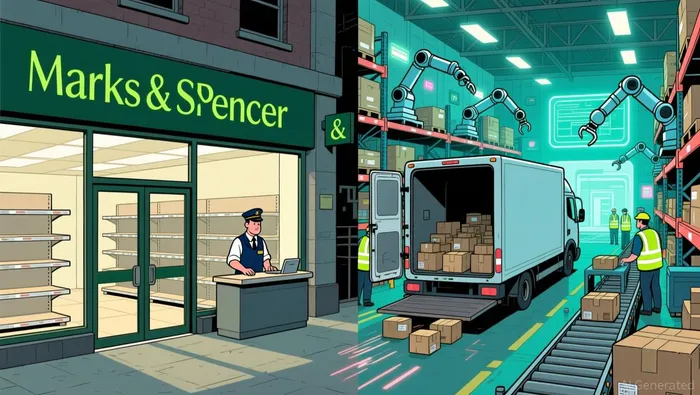
Consumer behavior further complicates M&S's position. A shift toward premiumization and experiential shopping has benefited brands that blend digital convenience with physical experiences, but M&S's supply chain struggles have hampered its ability to meet demand. Operational inefficiencies, including stock shortages and delayed restocking, have eroded customer satisfaction and sales. For instance, while M&S aims to boost online sales of non-food products to 50% of total revenue, its current 34% share reflects unresolved challenges in inventory management and fulfillment.
Strategic Gaps and Operational Realities
M&S's omnichannel initiatives, though ambitious, remain works in progress. The company's "Sparks" loyalty program and click-and-collect services have improved customer retention, but they cannot fully offset the operational costs of maintaining a dual-channel presence. Additionally, M&S's recent supply chain overhaul-designed to accelerate online growth in fashion-has yet to translate into consistent profitability. The 23.9% year-over-year decline in profit before tax after adjusting items underscores the financial toll of these transitions.
Moreover, M&S's reliance on marketing campaigns, such as the "Insiders Programme" leveraging employee-generated content, has yielded short-term gains but lacks the scalability of data-driven personalization seen in tech-native retailers. While the company has attracted 1.4 million new customers since 2022, sustaining this growth will require deeper integration of AI and analytics-a capability M&S has yet to fully develop.
Investment Implications
The combination of valuation overhang and operational fragility positions M&S as a high-risk investment in 2025. A re-rating of its P/E ratio to align with industry averages (e.g., a forward P/E of 9.70) would imply a 90%+ drop in share price, assuming no improvement in earnings. Even if M&S executes its digital strategy flawlessly, the sector's median EV/EBITDA of 9.52 suggests its current 10.22 multiple is unsustainable without material EBITDA growth.
For investors, the key risks lie in the execution of M&S's transformation. If the company fails to resolve supply chain bottlenecks or lose further ground to e-commerce rivals, its premium valuation could collapse. Conversely, a successful pivot to omnichannel dominance might justify the current multiple-but such an outcome remains speculative given the company's mixed track record.
Conclusion
Marks & Spencer's 2025 valuation appears disconnected from both its financial performance and the realities of a rapidly evolving retail sector. While its omnichannel initiatives and digital investments are commendable, they are insufficient to offset the drag from operational inefficiencies and competitive pressures. For now, the stock's elevated risk profile warrants caution, particularly as the market awaits concrete evidence that M&S can bridge the gap between its ambitions and its execution.







Comentarios
Aún no hay comentarios