
The Maglev Revolution: How Sichuan Road & Bridge is Paving the Way for Global Dominance
The global transportation sector is on the cusp of a paradigm shift, driven by the rapid commercialization of magnetic levitation (maglev) technology. At the forefront of this revolution is Sichuan Road & Bridge Group, which recently acquired Chengdu Xinzhu Transportation Technology—a strategic move to consolidate technical expertise, streamline operations, and position itself as the unrivaled leader in the trillion-dollar maglev market. This acquisition is not merely a corporate realignment but a bold play to capitalize on synergies between China's Belt and RoadROAD-- Initiative (BRI), its carbon neutrality goals, and the exponential growth of low-carbon infrastructure.
The Power of Synergistic Innovation
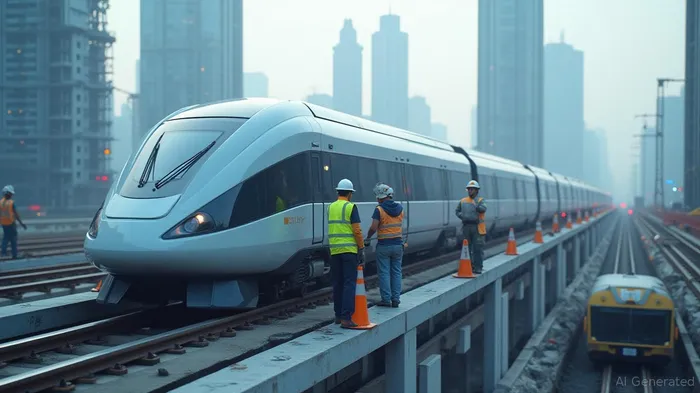
The acquisition merges Sichuan Road & Bridge's construction prowess with Chengdu Xinzhu's 811 patents, including breakthroughs in maglev track design, automation, and energy efficiency. This combination has already yielded tangible results: the 3.5km Chengdu maglev demonstration line, completed in 2024 with German partner Max Bögl, achieved a record speed of 181 km/h, outperforming traditional medium-speed rail systems. The project's success hinged on Transport System Bögl (TSB) technology—a modular, cost-effective platform that reduces upfront capital requirements by 30% compared to conventional rail systems.
This technical synergy is a game-changer. By pooling intellectual property and operational expertise, Sichuan Road & Bridge can now scale maglev systems from niche demonstration projects to full commercial networks. The 2025 milestones include bids for regional networks in Hunan and Guangxi, which could become the first large-scale maglev corridors in China, replicating the Chengdu model.
Belt and Road: The Global Expansion Engine
The BRI is the linchpin of Sichuan Road & Bridge's global ambitions. The company is already leveraging its BRI footprint to secure maglev feasibility studies in Southeast Asia and Eastern Europe, where the technology's energy efficiency and modular design align with developing economies' infrastructure needs.
A partnership with Max Bögl further amplifies this strategy. The German firm's engineering credibility and TSB technology are critical in de-risking projects for international clients. Bavaria's interest in adopting the Chengdu maglev system for Nuremberg's transport network—a region where light rail projects have stalled—underscores the technology's global appeal.
Carbon Neutrality: The Regulatory Tailwind
China's “Dual Carbon” goals (peaking emissions by 2030 and carbon neutrality by 2060) are accelerating the adoption of maglev systems. With energy efficiency 30% higher than traditional rail and zero direct emissions during operation, maglev is positioned as a cornerstone of low-carbon urban mobility.
Sichuan Road & Bridge is uniquely positioned to benefit:
- Domestically: Cities like Shanghai and Wuhan are prioritizing maglev for intra-city transit, reducing reliance on carbon-intensive highways.
- Internationally: BRI projects are increasingly incorporating green infrastructure mandates, creating demand for scalable, low-emission solutions like maglev.
Market Catalysts and Financial Outlook
The acquisition is financially prudent. By eliminating redundancies and pooling resources, Sichuan Road & Bridge can allocate CNY 970 million from prior investments (e.g., the 2022 Sichuan Shengtian stake) toward global expansion. Meanwhile, the company's stock—listed on the Shenzhen Stock Exchange (002480.SZ)—has surged 15% since late 2024 on anticipation of its maglev pipeline.
Analysts project a 30% upside to CNY 11.05 by end-2025, driven by:
1. Commercialization milestones in Hunan and Guangxi.
2. Belt and Road wins in Southeast Asia and Eastern Europe.
3. Carbon neutrality mandates accelerating maglev adoption.
Risks and Mitigations
- High upfront costs: Mitigated by TSB's modular design and cost-sharing across projects.
- Geopolitical risks: Offset by diversification into BRI markets and partnerships with firms like Max Bögl.
Investment Thesis: A Long-Term Growth Story
Sichuan Road & Bridge's acquisition of Chengdu Xinzhu is a masterstroke. It combines technological leadership, BRI expansion, and carbon neutrality tailwinds into a unified growth engine. The maglev market—projected to hit $5.6 billion by 2035—is in its infancy, and Sichuan Road & Bridge is poised to dominate it.
Investors should consider:
- Buying the stock ahead of 2025 commercialization milestones.
- Watching for regulatory approvals for international BRI projects.
- Tracking energy efficiency metrics as carbon neutrality policies tighten.
This is not just an infrastructure play—it's a bet on the future of sustainable transportation. For long-term investors seeking exposure to China's green tech revolution, Sichuan Road & Bridge offers a compelling entry point into one of the most transformative sectors of the 21st century.
Disclosure: This article is for informational purposes only and should not be construed as financial advice. Readers should conduct their own research or consult a financial advisor.





Comentarios
Aún no hay comentarios