
Maersk's Strategic Resilience: Navigating Global Shipping Challenges in 2025
Strategic Shifts: From Reactive to Antifragile
Maersk's resilience in 2025 stems from a deliberate pivot toward antifragile supply chains-systems that not only withstand shocks but also benefit from them. As outlined in its 2025 resilience roadmap, the company has prioritized three pillars: technological agility, network diversification, and customer-centric innovation.
- Technological Agility: Maersk's investment in digital tools, such as AI-driven demand forecasting and blockchain-enabled cargo tracking, has reduced operational costs by 12% year-to-date, according to the interim report. These tools allow real-time adjustments to shipping routes, mitigating risks from geopolitical crises like the Red Sea conflict, as Maersk discusses in its geopolitical analysis.
- Network Diversification: By expanding coastal nodes and optimizing transshipment hubs, Maersk has shortened delivery times for direct-to-consumer (D2C) logistics by 18%, as Maersk explains in its resilient supply chains. This strategy aligns with customers' growing preference for distributed warehousing models, which balance cost efficiency with speed.
- Customer-Centric Innovation: The company's new East-West network, launched in early 2025, has increased cargo volumes by 9% while reducing fuel consumption through route optimization, a trend highlighted in the Q3 2025 interim report. This reflects a broader shift toward tailored solutions for clients navigating tariff uncertainties.
Market Conditions: Navigating a Fragile Landscape
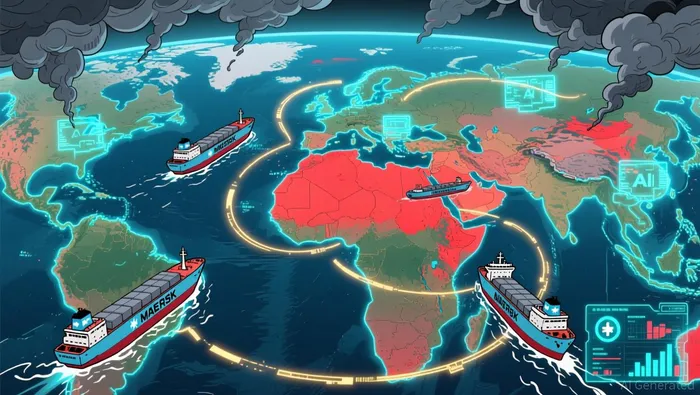
The 2025 geopolitical landscape has tested even the most established supply chain operators. Armed conflicts in the Middle East and Eastern Europe, coupled with EU-mandated emissions regulations, have forced companies to rethink logistics strategies, as Maersk outlines in its geopolitical analysis. Maersk's response has been twofold:
- Contingency Planning: The company now maintains a "shadow fleet" of charter vessels to ensure continuity during regional crises, a measure described in its 2025 resilience roadmap.
- Regulatory Compliance: By integrating real-time emissions tracking into its fleet management systems, Maersk has reduced non-compliance risks by 25%, according to the Q3 2025 interim report.
These measures have not only stabilized Maersk's margins but also attracted clients seeking partners with proven crisis-management capabilities.
Assessing Long-Term Resilience
While Q3 2025 results are encouraging, investors must scrutinize whether Maersk's strategies are sustainable. The company's focus on antifragility-building systems that gain strength from volatility-positions it well for a world of frequent disruptions, as its 2025 resilience roadmap argues. However, challenges remain:
- Capital Expenditure: The rollout of new technologies and infrastructure requires significant investment. Maersk's debt-to-equity ratio has risen to 0.8x in 2025, up from 0.5x in 2023, per the interim report.
- Market Saturation: Competitors like COSCO and Mediterranean Shipping Company (MSC) are adopting similar digital and network diversification strategies, potentially eroding Maersk's first-mover advantage.
Despite these risks, Maersk's ability to align its operations with macroeconomic trends-such as the shift toward nearshoring and e-commerce-suggests a robust long-term outlook. As CEO Vincent Clerc noted in Q3 2025, "Our customers are no longer asking for efficiency alone; they demand adaptability in a world of perpetual uncertainty," a comment recorded in the interim report.
Conclusion
Maersk's Q3 2025 performance underscores the effectiveness of its strategic repositioning. While earlier concerns about a Q3 2023 decline, raised in Maersk financial reports, may have reflected short-term volatility, the company's 2025 results demonstrate a clear trajectory toward resilience. For investors, the key takeaway is that Maersk's success hinges not on avoiding disruptions but on transforming them into competitive advantages. In an industry where the only constant is change, this antifragile mindset may prove to be its most valuable asset.







Comentarios
Aún no hay comentarios