
Maersk's Resilience Amid Global Trade Turmoil and the Failure of Short-Sellers
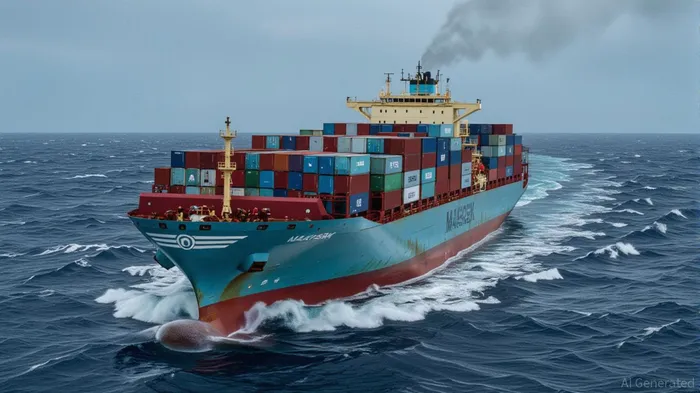
In an era of geopolitical volatility, trade wars, and supply chain fragmentation, Maersk (A.P. Moller-Maersk) has emerged as a rare beacon of stability. While short-sellers have struggled to capitalize on market turbulence, the Danish shipping giant has leveraged its logistical expertise and operational agility to outperform expectations. For contrarian investors, Maersk's resilience offers a compelling case study in how defensive industrial giants can thrive when the world's trade networks are under siege.
The Maersk Model: Turning Chaos into Competitive Advantage
Maersk's financial performance in 2023–2025 underscores its ability to adapt to a fractured global trade environment. Despite the Red Sea crisis, which disrupted 12% of global shipping lanes, the company reported a 2.8% year-on-year revenue increase in Q2 2025, with EBIT of USD 845 million. Its Terminals segment saw a 9.9% volume surge, while Logistics & Services delivered a 39% EBIT jump to USD 175 million. These results reflect a strategic pivot toward cost discipline, service reliability, and diversified revenue streams.
The launch of the Gemini Cooperation—a new East-West shipping network—has been a game-changer. By improving schedule performance to over 90%, Maersk has mitigated the operational risks of rerouted cargo and geopolitical bottlenecks. This reliability has become a premium asset in a world where 8.8% of U.S. GDP is now tied to logistics costs, per the Council of Supply Chain Management Professionals.
Why Short-Sellers Are Getting Smacked
Short-sellers, who once bet on the collapse of global trade during the 2024–2025 trade wars, have faced a harsh reality. While they gained USD 86 billion in March 2025, they lost USD 69.4 billion in early May, reflecting the erratic nature of a market driven by unpredictable tariffs and supply chain shifts. The Trump administration's aggressive trade policies—such as tariffs on Canadian and Mexican commercial vehicles—have created a “wildcard” effect, inflating costs for logistics firms but also boosting demand for Maersk's diversified services.
Short-sellers underestimated Maersk's ability to navigate this complexity. As Charles van der Steene, Maersk North America's president, noted, “Tariffs are inflationary in the short term, but the U.S. consumer remains resilient.” This resilience has kept freight demand steady, even as spot rates for dry van shipments declined. Meanwhile, Maersk's investments in AI-driven logistics and automation have reduced operational costs, further insulating it from margin pressures.
Contrarian Investing in a Fragmented World
Maersk's success highlights a critical truth: logistical expertise is now a premium asset in a world of “friendshoring” and “China Plus One” strategies. As companies diversify supply chains to avoid geopolitical risks, demand for reliable logistics partners has surged. Maersk's USD 5 billion investment in India's terminal infrastructure and inland logistics is a prime example of how the company is positioning itself to benefit from this shift.
For investors, this means Maersk is not just a shipping company but a linchpin in the global supply chain. Its upgraded 2025 guidance—underlying EBIT of USD 2.0–3.5 billion and EBITDA of USD 8.0–9.5 billion—reflects confidence in its ability to outperform in a volatile market. The company's $2 billion share buyback program, funded by 2024's windfall profits, also signals a commitment to rewarding shareholders during a period when many peers are struggling.
The Case for Defensive Industrial Giants
In a trade-war environment, defensive industrial giants like Maersk offer a unique combination of stability and growth. Unlike cyclical sectors, logistics and shipping are inelastic—demand for moving goods remains constant, even during economic downturns. Maersk's ability to adapt to disruptions (e.g., rerouting cargo through the Suez Canal or investing in inland terminals) ensures it remains indispensable to global commerce.
Short-sellers, meanwhile, are being punished for their reliance on linear models in a nonlinear world. The logistics sector's shift toward AI, automation, and real-time data analytics has created a moat around companies like Maersk, which can absorb volatility while smaller players falter.
Investment Thesis: Buy the Disruption
For contrarian investors, Maersk represents a rare opportunity to profit from market pessimism. While the Red Sea crisis and potential overcapacity in 2025 pose risks, the company's financial discipline, strategic investments, and market leadership position it to outperform. Its share price, currently trading at a discount to its 2025 EBITDA guidance, offers a margin of safety for long-term holders.
In a world where trade wars and supply chain complexity are the new normal, Maersk's resilience is not a fluke—it's a blueprint. Short-sellers may continue to chase volatility, but history favors those who bet on the companies that make the world's supply chains work.







Comentarios
Aún no hay comentarios